Showing posts with label Indo-Pacific. Show all posts

Sunday, 26 January 2025

PH to attract more investments at WEF 2025 meeting

Davos WEF reaffirms PH potential as global investment hub

By Zaldy De Layola
Philippine News Agency
January 26, 2025

MANILA – The country can expect more foreign investments following its participation at the World Economic Forum (WEF) Annual Meeting 2025 in Davos, Switzerland.


Speaker Ferdinand Martin Romualdez said the results of the productive engagements of the Philippine delegation would create more jobs to propel economic growth.

"The discussions we held in Davos reaffirm the immense potential of the Philippines as a key destination for global investments," Romualdez said in a news release on Sunday.

He said the team is grateful to President Ferdinand R. Marcos Jr. for sending a delegation that showcased the many reasons why global investors should choose the Philippines.

“The reception has been overwhelmingly positive and I am confident that this will translate to more investments that will fuel our economic growth,” he added.

Romualdez lauded the Philippine delegation composed of Finance Secretary Ralph Recto, Trade and Industry Secretary Trade Secretary Ma. Cristina Roque, and business leaders from various sectors for their significant contributions to promoting the country’s economic opportunities.

“I thank my fellow delegates for their tireless efforts and invaluable contributions in generating global interest in the Philippines,” Romualdez said.

“From highlighting our young and dynamic workforce to presenting our pro-business policies such as the CREATE MORE (Corporate Recovery and Tax Incentives for Enterprises to Maximize Opportunities for Reinvigorating the Economy) law and the Maharlika Investment Fund, we have successfully demonstrated that the Philippines is a viable and vibrant investment destination,” he added.

Key engagements

Romualdez participated in high-level discussions and engaged with prominent global business leaders and officials, including his participation as a panelist in the Stakeholder Dialogue titled “Navigating Asia’s Hotspots,” where he emphasized the country’s balanced geopolitical approach and commitment to economic stability.

“We presented a clear narrative of the Philippines as a reliable partner in the Indo-Pacific region, not only geopolitically but also economically. Our focus is on fostering peace, stability and cooperation, which are vital for sustained growth,” he said.

The country’s delegation also hosted the Philippine Breakfast Interaction, which convened close to 50 international public and private sector leaders for a briefing on the Philippine economy and its potential as the next big investment destination.

Among the notable guests during the event were Marcus Wallenberg, chair of Skandinaviska Enskilda Banken; Philippe Amon, chair and CEO of SICPA SA; Catarina Amon, CEO and founder of Classeek; Anthony Tan, CEO and co-Founder of Grab; John Riady, Group CEO of Lippo Indonesia; Tony Fernandes, CEO of AirAsia; and Calvin Choi, CEO of AMTD.

Also present were Jay Collins, vice chair of Citi; Helena Lersch, vice president of Public Policy of Tiktok; Amit Kalyani, vice chairman and joint managing director of Kalyani Strategic Systems Limited; and Albert Chang, managing partner of Southeast Asia, McKinsey & Co., among others.

During the discussions, the Philippine delegation showcased its robust domestic economy driven by e-commerce, making the country the fastest-growing digital economy in Southeast Asia in 2024.

Investment-friendly Reforms

The Philippine delegation likewise highlighted legislative reforms under the Marcos administration as concrete manifestations of the readiness of the country to listen to investors’ concerns.

In particular, they cited the CREATE MORE law, signed by President Marcos in November last year.

The CREATE MORE law is meant to accelerate investment momentum by offering enhanced tax incentives, streamlining the investment approval process, simplifying VAT rules, and providing targeted incentives for strategic investments.

He said the WEF once again placed the country on global investors’ radar, giving opportunities to the Philippines which is ready to turn them into concrete investments that will accelerate progress. (PNA)

Friday, 24 January 2025

Laguna harbors the first ever recorded swamp eel fossil in the world

Today I Learned: PH Geologists Found the First-Ever Global Record of a Swamp Eel Fossil

Christa I. De La Cruz 
Esquire Philippines
24 January 2024

"The fossil nobody wants," said Allan Gil Fernando of the National Institute of Geological Sciences, University of the Philippines Diliman.

The piece of rock was initially discarded and ignored by a student during fieldwork at the fish fossil locality site in Antipolo, Rizal, in 2013. The fossil specimen isn't complete, after all. However, the geologist, being the self-admitted hoarder that he is, stored it in his office without knowing its identity and significance. More than 10 years later, the specimen in question was identified to be the first-ever global record of a swamp eel fossil.


Freshwater Fossils Found in Pleistocene Laguna Formation

The research, "Fossil fish assemblage of the Laguna Formation, Philippines: unveiling the uniqueness of Pleistocene freshwater ecosystems in Southeast Asia," was published in the Swiss Journal of Paleontology in January 2025. It was a collaborative effort among Filipino scientists from the National Museum of the Philippines' Geology and Paleontology Division (Abigael Castro and Jaan Ruy Conrad Nogot), University of the Philippines Diliman's National Institute of Geological Sciences (Allan Gil Fernando) as well as the School of Archaeology (Clarence Magtoto), and Mines and Geoscience Bureau (Kevin Garas). Tomas Prikryl, the lead researcher, is from the Institute of Geology of the Czech Academy of Sciences; Dominique Mediodia and Chien-Hsiang Lin from Taiwan joined them. The group attempted to make great strides in Philippine and Southeast Asian paleoichthyology (the study of prehistoric fish).

"The fossil record in the Philippines, particularly concerning fish, is notably sparse. [... This limited evidence has provided only fragmented insights into the past biodiversity and evolutionary history of the region’s freshwater ecosystems. The absence of freshwater fossil records leaves a significant gap in our understanding of how this ecosystem has changed over time, especially in response to climatic and geological events," Prikryl et al. wrote.

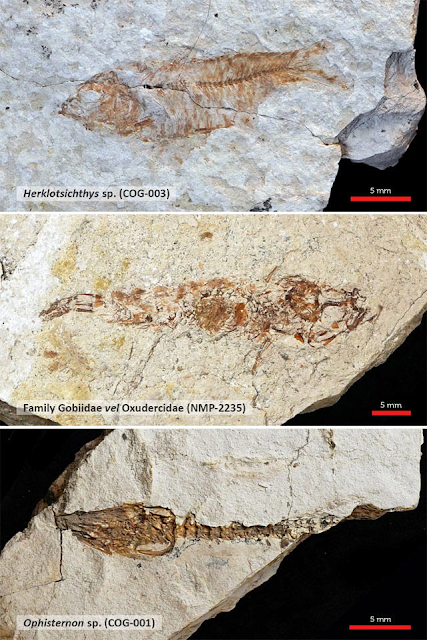
Their objective was to document a collection of freshwater fish fossils from the Pleistocene Laguna Formation in Antipolo, Rizal Province. This included a total of 14 articulated and semi-articulated specimens, which were deposited at the National Institute of Geological Sciences - University of the Philippines and at the National Museum of the Philippines.

Living specimens were compared to the fish fossil specimens, and their physical features—from length to dorsal profile—were documented. We'll not go into the specifics, but the scientists went as far as recognizing the prehistoric fish's jaws and measuring the skull. These are important not only in identifying the species, but also in studying the environment of their habitat, which in this case was the Laguna Lake.

"The fish fossil assemblage of the Pleistocene Laguna Formation is predominantly composed of the families Dorosomatidae, a Gobiidae vel Oxudercidae, and Synbranchidae. These fossils represent the first records of freshwater fish in the Philippines and the first discovery of these taxa in the tropical West Pacific region. Notably, this study also provides the first-ever record of a synbranchid fossil globally," the researchers concluded.


What This Means for Philippine Ecosystems

Aside from establishing several firsts, this discovery represented the first systematic study of freshwater fish fossils in the Philippines and provided valuable data that can be used to compare with modern ecosystems.

First, it provided solid evidence that the distribution of Herklotsichthys (a genus of herrings found mostly in Southeast Asia and Australia, with one species each in the Persian Gulf, the Red Sea, and the western Indian Ocean) was prehistorically restricted in the Indo-Pacific region.

Second, the presence of dorosomatid fish fossils in the lake suggests a habitat transition from marine to freshwater in the Pleistocene period. This is similar to Taal Lake, where fish species adapted from brackish to freshwater. The presence of demersal swamp eels and gobioid fishes also suggests that the Pleistocene Laguna Lake once had a silty and muddy bottom.

Third, the gobioid fossil from the Pleistocene showed their adaptability through all those periods in history. Up to 89 species of Gobiidae have been recorded in the Philippines, with 20 of them endemic (or found only in the country).

Fourth, the identification of the Pleistocene synbranchid fossil suggested that the swamp eel has an Indo-Pacific origin.

"These newly discovered freshwater fish fossils from the Pleistocene Laguna Formation in the Philippines not only provided evidence of their presence in the West Pacific region but also offered new insights into the origin and historical geographic distribution of these taxa," they said.