Showing posts with label Poland. Show all posts

Saturday, 1 August 2026

PH's Katrina Llegado wins Miss Supranational 2026

‘Above and beyond’: Katrina Llegado wins Miss Supranational 2026, ends PH’s 13-year title drought

Marilag Odtohan
ABS-CBN News
August 01, 2026

Pinay beauty queen Katrina Llegado has been crowned Miss Supranational 2026, ending the Philippines’ 13-year wait for the international title on Saturday, August 1 (PH Time) during the coronation night held in Poland.


The Taguig City native bested 66 other aspirants to become the successor of Eduarda Braum of Brazil, making her only the second Pinay delegate to win the Miss Supranational title.


Before Llegado’s victory, the Philippines last held the title in 2013 through Mutya Datul, whose triumph was considered historic after becoming the first Pinay and Asian contender to win the crown.

During the evening gown segment, Llegado dazzled in a Rian Fernandez creation featuring sheer long sleeves embellished with shimmering beadwork and intricate detailing. Llegado said the gown was inspired by the hope, light,and renewed inspiration that every sunrise brings. 

Her defining moment came during the final question-and-answer round when she was asked: “The moment you stopped trying to become the woman the world expected, and started becoming the woman you’re really meant to be.”

“I always believe that we should never fit into a mold. We are perfectly imperfect. I am someone who struggles [with] perfection, but I am here today doing my best, and becoming my best version [of myself]. And here in Miss Supranational, I know I belong [here]. I know [there’s] a place for me, and this is becoming Supra, above and beyond,” Llegado responded.

Ahead of the coronation night, the beauty queen had already strutted the pre-pageant events of the competition, particularly when she donned a gumamela-inspired national costume featuring a voluminous coral-pink ensemble composed of layered petals.


Hours before taking the Miss Supranational finals night, Llegado also shared a childhood photo of herself on social media with the caption, “Always doing it for my younger self.” 

The post quickly resonated with pageant fans who saw it as a heartfelt reflection on the journey that led her to the international stage.

This was not Llegado’s first international pageant stint. She previously represented the Philippines at Reina Hispanoamericana 2019 in Bolivia, where she finished as Quinta Finalista (5th runner-up).

She secured her ticket to Miss Supranational 2026 more than a year ago after reaching the finals of Miss Universe Philippines 2025.

Earlier this year, Llegado already crowned her successor as Miss Supranational Philippines in Allyson Hetland of Pampanga. 

Completing the Miss Supranational 2026 court were: Eve Gilles of France as 1st runner-up; Lara Marina of Brazil as 2nd runner-up; Ndah Eno of Nigeria as 3rd runner-up; and Karolina Gorylova of the Czech Republic as 4th runner-up. 


The pageant also named its continental titleholders: Tracy Nabukeera of Tanzania for Africa, Silvia Maestre of Venezuela for the Americas, Agnes Rahajeng of Indonesia for Asia and Oceania, Rasheda Green of Jamaica for the Caribbean, and Oliwia Mikulska of Poland for Europe.

Following the coronation, congratulations poured in from the Philippine pageant community. Mutya Datul warmly welcomed Llegado into the circle of Miss Supranational winners, while the Miss Universe Philippines Organization also celebrated the victory as another milestone for the country’s pageant legacy.

Former Reina Hispanoamericana 2017 winner Winwyn Marquez joined the growing list of beauty queens applauding Llegado’s achievement, while Miss Supranational 2025 3rd runner-up Tarah Valencia and Miss International 2025 4th runner-up Myrna Esguerra expressed their support through an Instagram Story shortly after the coronation.


Sunday, 12 July 2026

Philippines remains the world’s leading supplier of seafarers

Philippines remains top supplier of seafarers

Bella Cariaso 
The Philippine Star 
July 12, 2026

MANILA, Philippines — The Philippines remains the world’s leading supplier of seafarers, reaffirming its vital role in providing skilled maritime professionals to the global merchant fleet, the Maritime Industry Authority said yesterday.


MARINA cited the Seafarer Workforce Report 2026 which ranked the Philippines as first among the world’s five largest seafarer-supplying countries.

The report estimated that the Philippines supplies 203,179 officers, ahead of India with 140,718 officers, China with 110,893, the Russian Federation with 85,816 and Indonesia with 72,304.

The report said the Philippines and the four other top countries account for 56.25 percent of the global seafarer workforce supply.

MARINA added that data from shipping companies also showed that Filipinos are the leading nationality certified by the Standards of Training, Certification and Watchkeeping for Seafarers (STCW), followed by Ukrainians, Indians, Romanians and Poles.

Filipinos also ranked first in both the officer and rating categories, MARINA added.

The agency said it continues to strengthen the country’s maritime education, training, assessment and certification systems to keep Filipino seafarers competent, globally competitive and compliant with international standards.

“The agency also continues to pursue reforms that improve the quality of maritime training and certification and address the evolving skills and competency needs of the global shipping industry,” MARINA added.

It said the findings reaffirm the Philippines’ leading role in the global maritime workforce and the continued demand for the competence and professionalism of Filipino seafarers in international shipping.

Published every five years, the Seafarer Workforce Report provides estimates on the global supply and demand of STCW-certified seafarers, workforce demographics and the future manpower needs of the world merchant fleet.


Monday, 26 January 2026

Asia’s first portal opens in the Philippines

Asia’s first portal opens in the Philippines

GMA Integrated News
26 January 2026

The global art portal has finally expanded to Asia, landing in Bonifacio Global City, Taguig.

The installation marks the first Portal in the Philippines and only the sixth worldwide. It has existing locations in the United States, the United Kingdom, and Lithuania, where the project originated.


Located on 5th Avenue at Bonifacio High Street in Taguig, the BGC Portal features a 24/7 livestream connecting it with Portals in Vilnius (Lithuania), Lublin (Poland), Dublin (Ireland), Philadelphia (United States), and Ipswich (United Kingdom).

Additional Portals are set to launch in Brazil and other countries later in 2026.

“Bringing the Portal to BGC in Manila, a city known for genuine warmth and a deep sense of human connection, expands our vision of a world connected not by borders, but by direct human encounter,” Portals Organization founder Benediktas Gylys said in a press release.

The BGC Portal is spearheaded by the Portals Organization, a global network based in Vilnius and Berlin that creates creates immersive spaces connecting people across borders to experience Earth as one.

First conceived in 2016 by Gylys, the first Portals installation opened in 2021 connecting Vilnius and the Polish city of Lublin.  

— Hermes Joy Tunac/LA, GMA Integrated News

Sunday, 1 June 2025

Miss World PH landed in top 8, named Miss World Asia

Thailand wins Miss World 2025 crown, Philippines in Top 8

Earl D.C. Bracamonte 
Philstar.com
June 1, 2025

MANILA, Philippines — Chuangsri "Opal" Suchata bested 107 international delegates and won Thailand's first Miss World crown in glitzy rites in Telangana, India on Saturday.


Krystyna Pyzkova crowned the Breast Cancer survivor and advocate.

Miss World Philippines 2024 Krishnah Marie Gravidez shared the Top 2 spots with Thailand in the final cut for Asia and Oceania.


Hasset Dereje Admassu of Ethiopia was the other lady Opal was holding hands with while waiting for the proclamation to be given out, winning as 1st runner-up and Continental Queen of Africa. It is the first time for both countries to reach such high placement.

Maja Klajda of Poland was named 2nd runner-up and Continental Queen of Europe, while Aurelie Joachim of Martinique, in its first Top 4 finish, completed the royal court as 3rd runner-up and Continental Queen of the Americas and the Caribbean.

The other lucky four delegates who competed for the Final 4 placements were Jessica Pedroso (Brazil), Selma Kamanya (Namibia), Mayra Melnychenko (Ukraine), and Krishnah Marie Gravidez (Philippines).

The delegates who also made it to the Top 20 were Guadalupe Alomar (Argentina), Valeria Perez (Puerto Rico), Athenna Crosby (USA) from the Americas and the Caribbean); Issie Princesse (Cameroon), Joy Raimi (Nigeria), Lamis Redissi (Tunisia) from Africa; Jasmine Gerhardt (Ireland), Chiara Esposito (Italy), Millie-Mae Adams (Wales) from Europe; Jasmine Stringer (Australia), Nandini Gupta (India), and Nada Koussa (Lebanon) from Asia and Oceania.

The Top 20 semi-finalists were the ladies who made the next cut after the quarterfinals of 40 placements, 10 from each continent and region, including the fast track challenge winners.

The over three-week competition saw the delegates compete in several challenges that included Sports, Talent, Top Model, Multimedia, Head-to-Head, and Beauty with a Purpose. The delegates also enjoyed the cuisine, hospitality, and sights and sounds of Telangana.

Hosted by Sachiin Khumbar and Miss World 2016 Stephanie del Valle, with performances from Jacqueline Fernandez and Ishaan Khatter, the 72nd Miss World coronation ceremonies unfolded at the Hitex Exhibition Center in Hyderabad, India.

It was beamed to a global audience through Miss World's pay-per-view channel on YouTube.

Saturday, 31 August 2024

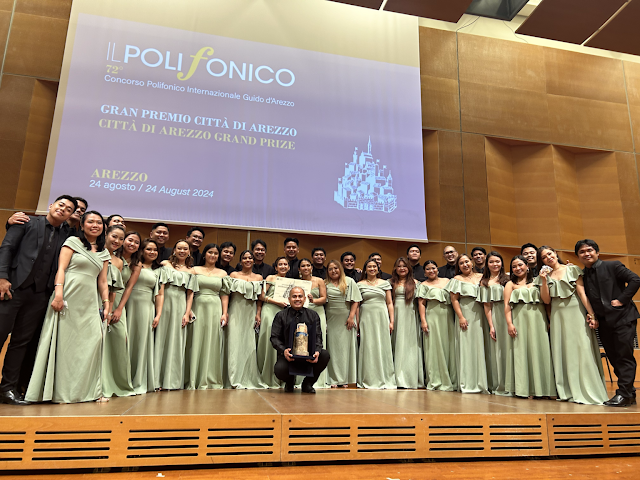
PH choir wins Grand Prix in Arezzo, Italy

PH choir Los Cantantes de Manila wins Grand Prix in international choir competition in Arezzo, Italy

Inquirer.net
31 August 2024

Los Cantantes de Manila (LCDM), a community choir based in Sampaloc, Manila, won the coveted Grand Prix at the recently concluded 72nd Concorso Polifonico Internazionale “Guido D’Arezzo” last August 20-25, 2024 in Arezzo, Italy.

LCDM bested 11 elite choirs from nine countries around the world by showcasing different styles of choral music in three competition categories: Compulsory, Sacred Music, and Secular Music programs. The group bagged the First Prize in each category, earning them the right to compete in the Grand Prix round of the competition. 

During the Grand Prix round, the choir emerged as the winner against fellow finalists Coro de La Rupe (Italy), Imusicapella (Philippines), Nuove Voci (Poland), and St. Paul’s Co-educational College Treble Choir (Hong Kong).

With their victory, LCDM earned the right to qualify in the 2025 European Grand Prix (EGP) for Choral Singing in Tolosa, Spain. This historic feat marks Los Cantantes de Manila as the first Filipino community choir to qualify for the prestigious competition.

“Now that we won in Arezzo, we have bigger plans for the future. We’re the first Filipino community choir to compete in the European Grand Prix, and we have a responsibility to represent the country well,” said Darwin Vargas, the conductor of the choir.

He also added, “We hope that we made the country proud with our victory here in Europe. We also wish for the Philippine choral community to continue supporting us as we prepare for the EGP next year.” 

Prior to their success in Italy, LCDM won the First Prize in the Sacred and Free programs at the 29th Béla Bartók International Choir Competition last August 1-4, 2024 in Debrecen, Hungary. They also received a Special Prize for the Best Interpretation of a Compulsory Piece (Cantate Domino).

Los Cantantes de Manila will continue to tour across different countries in Europe for concerts and competitions until September. This initiative is part of the group’s 10th-year anniversary celebration. 

Sunday, 7 July 2024

Alethea Ambrosio is crowned Miss Supranational Asia and Oceania in Poland

Alethea Ambrosio is crowned Miss Supranational Asia and Oceania in Poland

Story by Armin P. Adina 
Inquirer.net
07 July 2024

The Philippines’ Alethea Ambrosio was crowned Miss Supranational Asia and Oceania at the conclusion of the Miss Supranational 2024 pageant in Nowy Sacz, Poland, on July 6 (July 7 in Manila).


Her coronation also makes her the first Filipino woman to receive the continental title, and it came two days after Brandon Espiritu became the first entry from the Philippines to advance to the Top 5 of the Mister Supranational contest. He finished third overall.

Ambrosio and Espiritu won in the twin staging of The Miss Philippines and Mister Pilipinas Worldwide in October last year, and officially received their assignments as the country’s delegates to the Supranational competitions in February.

At the Miss Supranational pageant, Ambrosio advanced to the Top 12 of the competition. Part-Filipino Yuki Sonoda from Japan made it to the Top 25. Their fellow Asian delegate Harashta Haifa Zahra made history for Indonesia by winning the country’s first Miss Supranational crown.

Jenna Dykstra from the United States settled for the first runner-up spot, while heavy favorite Justyna Zednikova from the Czech Republic finished as second runner-up. Brazil’s Isadora Murtia was third runner-up, while Curacao’s Chanelle de Lau rounded up the winner’s circle as fourth runner -up.

Meanwhile, Ambrosio’s fellow continental queens were South Africa’s Bryoni Govender for Africa, Mexico’s Andrea Saenz for the Americas, Puerto Rico’s Fiorella Medina for the Caribbean, and Denmark’s Victoria Larsen for Europe.

Before flying to Poland for the international competition, Ambrosio has already crowned her successor as Miss Supranational Philippines, Tarah Valencia who was third runner-up in the 2024 Miss Universe Philippines pageant. She will compete in next year’s Miss Supranational contest.

Mutya Johanna Datul remains to be the lone Filipino woman to be proclaimed Miss Supranational. She won the title at the international competition’s fifth edition in 2013. Last year’s representative Pauline Amelinckx almost scored a second victory for the Philippines when she finished as first runner-up.

Saturday, 6 July 2024

Japan’s Miss Supranational 2024 bet is part-Filipino actress Yuki Sonoda

Japan’s Miss Supranational 2024 bet is part-Filipino actress Yuki Sonoda

Armin P. Adina
Inquirer.net
06 July 2024

Aside from Philippine bet Alethea Ambrosio, another participant in the 2024 Miss Supranational pageant has Filipino roots, Japan’s Yuki Sonoda.


Sonoda was crowned Miss Supranational Japan in Tokyo in May, but she is not new to pageantry, both national and international.

In 2017, she represented Japan in the Manila-based Miss Asia Pacific International pageant held in the Philippines. She advanced to the Top 10 of the competition.

In 2020, she competed in the Miss Universe Japan pageant, where she was proclaimed as second runner-up.

Sonoda had already embarked on a career in the local entertainment and modeling scene in Manila before she earned her pageant title.

She was one of the six finalists for the “Supra Talent” contest at the 2024 competition, currently running in Poland, where she sang a Japanese song.

No Japanese woman has ever brought home the Miss Supranational crown, and Sonoda hopes to score the first victory for the Land of the Rising Sun.

The 2024 Miss Supranational pageant will hold its coronation show at the Strzelecki Park Amphitheater in Nowy Sacz on July 6 (July 7 in Manila). Ecuadorian beauty Andrea Aguilera will relinquish her title to the winner.

Friday, 5 July 2024

Mister Supranational Philippines 2024 made history in Poland

Philippines' Brandon Espiritu is 2024 Mister Supranational 2nd runner-up!

Story by GMA Integrated News 
05 July 2024

Congratulations are in order for Mister Supranational 2024 Philippine bet Brandon Espiritu! 


Not only did he just finish as 2nd runner-up to the pageant — the highest placement the Philippines has achieved in the international tilt — he also won the social media influencer challenge of the pageant. 

On Instagram, the local organization congratulated Brandon. "You’ve made a whole country proud. You have achieved our highest placement in Mister Supranational so far," they said.


In a video posted by the organization, Brandon thanked his supporters "for backing me in this journey."

"We broke history, we broke Top 5. As a Filipino, I'm so proud to be here," he said.

During the finals, Brandon first made an incredible impression with his dance moves, and cemented it with his noteworthy final Q&A performance.

Before answering the question, the model and entrepreneur made sure to thank this parents for "helping raise me to be the man that I am today."

And then he began by demonstrating his sense of inclusivity. "I would tell every single man out there, not just every man but every man and woman, every person with a soul: You have intrinsic value."

"If you wanna be better and if you want to progress in your life, give yourself grace and take small steps. We have to start somewhere and build off that and progress. That's the only way to go about it," Brandon said to much applause.

South Africa was named 2024 Mister Supranational, and Netherlands was first 1st runner-up.

— LA, GMA Integrated News

Thursday, 9 May 2024

OFWs: Boon or Bane on Philippine economy?

Highly educated Filipinos as OFWs: A double-edged sword for PH

Story by Cristina Eloisa Baclig
Inquirer.net
09 May 2024

MANILA, Philippines—In a world that’s constantly on the move, the Philippines has carved out a unique position as a powerhouse in the export of skilled labor. Every year, waves of Filipinos pack their bags to set out across the globe, driven by the pursuit of brighter futures and better opportunities.


This mass migration, while opening doors for many, wields a double-edged sword: it propels Filipino talent onto the world stage, filling crucial roles in international industries, yet it simultaneously strains the local workforce, especially in critical sectors such as health care and education.

These workers, known as Overseas Filipino Workers (OFWs), are not just employees abroad; they are the lifeline of their homeland. Their remittances are the financial bedrock for countless families and a vital cog in the machinery of the Philippine economy.

However, this exodus of talent also brings to light the concerning issue of ‘brain drain,’ leaving the nation in a perpetual struggle to replenish its pool of professionals.

This phenomenon is reshaping the Filipino identity on the global map, striking a balance between loss and gain, between the home left behind and the promise of the world beyond.

Highly educated workers leave PH

Despite its relatively small population of just over 100 million, the Philippines has made a significant impact on the world’s skilled workforce. With an impressive 1.89 million highly educated Filipinos residing in OECD countries, the country ranks third in the world for having the largest educated diaspora, falling behind only India with 3.12 million and China with 2.25 million.

The significance of the country’s contribution to the global pool of skilled workers becomes even more pronounced when considering the country’s much smaller population compared to India and China, both of which have populations exceeding a billion. India’s population stands at approximately 1.325 billion, while China’s is around 1.379 billion.

However, this success story is not without its challenges. The country faces a critical issue: a high percentage of its highly educated workforce is emigrating abroad.

In recent years, the number of Overseas Filipino Workers (OFWs) has continued to grow, with data from the Philippine Statistics Authority showing a steady increase from 1,825,000 in 2021 to 1,963,000 in 2022. These numbers represent a significant proportion of the country’s workforce, engaging in a diverse array of occupations across the globe.

Of the Filipinos returning from overseas, data from the International Organization for Migration (IOM) revealed that 49.6 percent have some college education or higher, reflecting the level of education many choose to take abroad.

This phenomenon is more pronounced in the Philippines compared to countries like India, where the emigration rate of educated individuals is minimal despite its vast population. This raises concerns about the sustainability of the country’s workforce development.

It is essential to note that while other countries like the United Kingdom (1.75 million), Germany (1.47 million), Poland (1.20 million), Mexico (1.14 million), and Russia (1.06 million) also supply skilled migrants, the situation in the Philippines is particularly striking.

The country’s departure of a significant portion of its skilled and educated workforce highlights its crucial role in the global marketplace. It also underscores the potential challenges to its workforce development and sustainability.

Where OFWs go

According to data from the Philippine Statistics Authority (PSA) for 2022, Asia remains the predominant destination for OFWs, accounting for 80.8 percent of the Filipino workforce abroad. This substantial proportion reflects the longstanding ties and geographic proximity that facilitate labor migration within the region.

The Middle East is another crucial employment hub, with Saudi Arabia hosting 23.0 percent of OFWs alone. The United Arab Emirates and Kuwait also significantly contribute, with 13.7 percent and 7.7 percent respectively.

These regions depend on the diverse skill set of OFWs, particularly in sectors such as health care, construction, and domestic services, where their hard work and adaptability are highly valued.

In addition to Asia and the Middle East, other parts of the world also draw Filipino talent. Europe accounts for 9.0 percent of OFWs, while North and South America collectively make up 6.3 percent, with countries like the United States and Canada becoming increasingly popular due to higher wages, better living conditions, and opportunities for family reunification.

These nations, known for their multicultural makeup, provide a supportive environment for Filipinos, helping to foster a sense of community and belonging far from home.

This significant presence of OFWs across various regions highlights their integral role in the global workforce. It sets the stage for a deeper exploration into the impact of their financial contributions, mainly through remittances, on both their host countries and the Philippines.

Rising remittances

In 2023, remittances from OFWs continued to play a pivotal role in the Philippine economy, highlighting the significant financial contributions of Filipinos working abroad.

According to data from the Bangko Sentral ng Pilipinas (BSP), remittances reached an all-time high, with cash remittances alone amounting to $33.491 billion for the year. This marked a growth of 2.9 percent over the previous year, underscoring the resilience of OFWs’ financial contributions despite global economic uncertainties.

December 2023 saw a notable increase in remittances, with a 3.8 percent rise to $3.28 billion compared to the same period in 2022, reflecting the seasonal trend of increased remittance flows during the holiday season.

This boost was largely attributed to the contributions from both land-based and sea-based workers, demonstrating the ongoing commitment of OFWs to support their families back home during significant times of the year.

The United States, Singapore, Saudi Arabia, and Japan were among the leading sources of these remittances, pointing to the diverse global footprint of the Filipino workforce. The steady flow of funds from these countries not only supports individual families but also plays a crucial role in stabilizing the Philippine peso and bolstering the country’s economic growth.

Projected trends suggest that remittances will continue to grow, with an expected increase of 3 percent in the forthcoming years. The data showed that OFWs continue to send financial support back home, ensuring a robust economic connection with their homeland.

This steady stream of funds not only aids individual family members but also plays a crucial role in maintaining the economic stability of the Philippines.

Addressing ‘brain drain’

As the Philippine government acknowledges the profound impact of brain drain on national development, President Ferdinand Marcos Jr. has proposed a new strategy aimed at retaining local talent.

The strategy involves enticing graduates, particularly from the health and information technology sectors, to serve in the Philippines before moving abroad.

“We have to come up with some kind of strategy wherein, let’s say, you provide scholarships, and then the scholarship agreement includes that you stay three years. After that, then they’re free to go,” Marcos said

This initiative is complemented by the acknowledgment that while Filipino graduates are free to seek opportunities abroad, the loss of trained professionals could be mitigated by such programs.

According to Marcos, these efforts need to be supported by more attractive local employment options that could compete with international offers.

In support of this strategy, the Private Sector Advisory Council’s Jobs Sector Group (PSAC-Jobs) has highlighted that the local market struggles to match the high salaries offered in countries like the United States, the United Kingdom, Australia, and Europe.

“I think what we can do is to continue to offer certificate programs and train their skills. I think we can do that. There’s no way for us to retain them,” said Teresita Sy-Coson of SM Investments Corp.

The PSAC has also urged a more coordinated approach among government agencies—including the Department of Health (DOH), the Commission on Higher Education (CHEd), and the Department of Migrant Workers (DMW)—to create more compelling opportunities for Filipino workers.

Thursday, 18 April 2024

PBBM is one of the "Most Influential People of 2024"

Marcos among TIME’s ‘100 Most Influential People of 2024’

By Darryl John Esguerra
Philippine News Agency
April 18, 2024

MANILA – President Ferdinand R. Marcos Jr. has been included in TIME magazine's "100 Most Influential People of 2024."


TIME recognized Marcos’ leadership, citing how his administration steadied the post-coronavirus pandemic economy and how his presidency “elevated the Philippines on the world stage.”

The President’s stance against China’s aggression in the West Philippine Sea was also cited.

“Bongbong has stood steadfast against Chinese aggression in the disputed South China Sea and bolstered his nation’s alliance with the U.S. in the face of ‘rising tensions in our region and the world,’ as he said last May,” read Marcos' short profile as written by TIME correspondent Charlie Campbell.

Marcos is listed in the Leaders category, along with Yulia Navalnaya, widow of Russian opposition leader Alexei Navalny; Poland Prime Minister Donald Tusk; Taiwan President-elect Willian Lai; Argentina President Javier Milei; Qatar Prime Minister, Sheikh Mohammed bin Adbulrahman bin Jassim Al Thani; World Bank Group President Ajay Banga; Italian Prime Minister Giorgia Meloni and Chinese Premier Li Qiang; among others.

Other Philippine leaders who were featured in the list in previous years were Marcos’ predecessors Rodrigo Duterte in 2017 and Benigno Aquino III in 2013. (PNA)

Wednesday, 17 April 2024

Philippines as attractive alternative destination for international students

The rise of alternative destinations: Thailand, Poland, and the Philippines

ICEF Monitor
monitor.icef.com
17 April 2024

A growing body of industry research shows that in 2024, international students are considering a wider range of destinations, motivated by such factors as ease of getting a visa, post-study work opportunities, and affordability.

Today, our focus is on three alternative destinations that have – relatively quietly – been attracting considerably more student interest than in the past.

These destinations are Thailand, Poland, and the Philippines, countries that are all attractive in terms of affordability as well as strengths unique to their location and education system.

Please note: Cost of living and study costs change fairly regularly, as do visa requirements. It’s important to check with individual institutions and government officials for the most current information in these respects.

THAILAND

Increased demand from China

According to Thailand’s Office of the Permanent Secretary, Ministry of Higher Education, Science, Research, and Innovation, more than 30,000 international students were enrolled in Thai universities in in 2022, up from 25,100 in 2019. Since 2009, foreign enrolments in Thai universities have grown by about 2,000 per year thanks largely to increased demand from China.

The number of Chinese students studying in Thailand has doubled within the past five years to over 20,000, and University World News reports that 60% of foreign students in Thailand (as well as Malaysia) are Chinese. Myanmar and Cambodia are the next largest senders of students to Thailand, but they sent less than 5,000 students each in 2022.

The affordability advantage

Thailand has a compelling competitive advantage in 2024: affordability.

Thailand is not only more affordable than the Big Four destinations of Australia, Canada, the UK, and US, but it is also less expensive – in terms of tuition and living costs – than the top Southeast Asian destinations of Malaysia and Singapore. Students need only to prove they have savings of US$360 when applying for a Thai student visa – an indication of just how affordable the country is to live and study in. (By contrast, students need savings of at least US$20,000 to cover tuition and living when applying for a visa for study in Australia, Canada, and US).

In terms of programme costs, bachelor’s degrees in Thailand range from about US$1,775 to $1,900 a semester, while master’s run from about US$2,320 to $2,500. Unipage.net provides the following table showing average tuition.


Students can live on a much smaller budget in Thailand than in many destinations. QS notes:

“Those on a tight student budget will be able to live on 650 baht (US$20) a day, covering food, transport and accommodation. For those looking to do some travelling and exploring while undertaking study in Thailand, you will likely need to budget around 1500 baht (US$46) per day.”

QS cautions, however, that living costs are higher in major cities like Bangkok.

Quality education offerings

Thailand isn’t just competitive on the basis of cost: it also has some very good universities and highly ranked programmes. For example, two Thai universities are ranked in the Top 100 in the QS Asia University Rankings 2024: Chulalongkorn University (#44) and Mahidol University (#51). Chiang Mai University also ranks highly at #102.

On the global QS 2024 rankings, these are the Thai universities in the top 1000:
  • Chulalongkorn University: #211
  • Mahidol University: #382
  • Chiang Mai University: #571
  • Thammasat University: #600
  • Kasetsart University: #751-760
  • Prince of Songkla University: #901-950
  • Khon Kaen University: #901-950
  • King Mongkut's University of Technology Thonburi: #951-1000
Beyond those overall rankings, the following chart shows that several Thai universities perform well in specific subject areas.


Overflow from students failing China’s ultra-competitive exams

Studying in Thailand is part of a larger trend of Chinese students choosing to study in Asia if they fail their very competitive postgraduate exams. University World News has reported that:

“Yangyang Study Abroad Private education consultancy surveys in China put the proportion of applicants who fail the postgraduate exam and then apply to universities in Asia at between 40% (estimated by the agency) and 66% (estimated by other lesser-known agencies)."

Transnational Education (TNE) is part of Thailand's plan to become a regional education hub

Over the past five years, TNE activity has been intense in Thailand, and the Thai government sees foreign partnerships and the establishment of branch campuses in Thailand to be a key means of attracting more international students from the region. The UK is particularly active in this regard in Thailand, and there now more than 120 active collaborative agreements between British and Thai universities.

Thousands of Thai students are abroad but high costs are dampening demand

At the same time as Thailand is attracting more inbound students, it is also sending out tens of thousands (more than 30,000 in 2022). However, agents are noticing more hesitancy this year among Thai students considering study abroad. Speaking during StudyTravel’s Alphe Asia conference in February 2024, Sethaphol Rutrakool, president of the Thai education consultancy TIECA, said:

 “I think that since the pandemic, the market in Thailand has recovered, but in 2024 it is not so good. Because of inflation, the costs of everything have gone up – the costs of    homestays,  tuition fees and everything while the purchasing power of the students and  parents is not fully back yet. So, I think it's kind of a tough situation right now. It's going [to]     slow down from what I've seen for the remainder of this year and maybe next year as well.”

POLAND

Over the course of the past decade, the number of international students in Poland has tripled and last year reached a record-high of over 100,000 according to the education magazine Perspektywy. A total of 102,200 international students were registered in the education ministry database for the 2022/23 academic year and about 9% of all students in Poland’s universities are now foreign.

Poland offers over 300 English-taught university programmes, an advantage that appeals to a large segment of international students.

Steep rise in Ukrainians

A key reason for the increase is a significant rise in the number of Ukrainian students, many of whom have left their country due to Russia’s invasion. Nearly 50,000 Ukrainians are studying in Poland and account for nearly half of all foreign students.

But as reported in NotesfromPoland.com, Poland is also attracting students from a wide range of other countries, including Belarus (12,000), Turkey (3,800), Zimbabwe (3,600), India (2,700), Azerbaijan (2,500), Uzbekistan (2,100), China (1,800), Kazakhstan (1,700), and Nigeria (1,600).

The presence of so many Zimbabweans is interesting – there are more Zimbabwean students in Poland than in Canada (1,425), the US (1,790), or Australia (1,665), despite these destinations’ more intense recruiting in Zimbabwe over the past couple of years.

Of the 100,000+ international students in 2022/23, Perspektywy magazine notes: “This reflects the huge amount of work done by Polish higher education in the last 19 years … when Poland joined the EU in 2004 it had only 8,800 foreign students … just 0.5% of all students at the time and the lowest relative figure in Europe.”

Affordability

Poland is an affordable destination compared to many in Europe. Study.eu provides the following illustrative chart showing tuition fees at several major Polish universities:


The Polish government says that international students can expect a cost of living of about €330 (US$350) a month, though living in cities can be more expensive. 

The fee for a student visa application is €80 (US$85). In terms of proof of funds, a student must show they have 776 PLN (US$190) plus tuition for each month of their stay in Poland plus enough for return travel back to their country. They must also show they can pay for accommodation.

12 unis in the Top 1,000

There are close to 400 state and private universities in Poland. Two Polish universities are in the top 500 in QS’s 2024 World University Rankings: University of Warsaw (#262) and Jagiellonian University (#304). Overall, these are the Polish universities in the top 1,000:
  • University of Warsaw: #262
  • Jagiellonian University: #304
  • Warsaw University of Technology: #571
  • Adam Mickiewicz University, Poznań: #731-740
  • Poznan University of Life Sciences: #801-850
  • Gdańsk University of Technology: #851-900
  • AGH University of Krakow: #901-950
  • Nicolaus Copernicus University: #901-950
  • University of Wroclaw: #901-950
  • Wroclaw University of Science and Technology: #901-950
  • University of Gdańsk: #951-1000
  • University of Lodz: #951-1000
PHILIPPINES

The Philippines is a crucial source of students for many destinations. It is now Canada’s third largest market behind only India and China, sending 48,870 students in 2023, 50% more than in 2022. It is Australia’s fourth largest market after China, India, and Nepal, with 48,300 students enrolled in 2024. Australia has been expanding its Filipino student population even faster than Canada has – the total for 2024 is up 194% over 2023 and represents a massive jump of 469% since 2019.

But the Philippines is also an attractive destination for a growing number of students, even though international students make up only 1% of the total student population. In 2022, the Philippines hosted 22,250 international students, 53% more than in 2021. As in Poland, international students have many English-taught programmes to consider in the Philippines.


STEM programmes draw the most students

Interestingly, the Philippines is enrolling most of its international students to STEM programmes. As you can see from the chart below, STEM students make up a larger proportion of the overall student population in the Philippines than they do in any other destination represented in the data.


Indian students’ growing interest in the Philippines

The Philippines’ international enrolment growth has been largely driven by Indian students. In 2022, these were the top five markets for universities in the Philippines:

India: 16,010
China: 4,460
Nigeria: 1,930
South Korea: 144
Thailand: 137

The Economic Times notes: “While traditional destinations like the UK, US, Australia and Canada remain popular [for Indian students], other countries like Uzbekistan, Philippines, Russia, Ireland, Kyrgyzstan and Kazakhstan are gaining interest.”

ApplyBoard points out that once a destination attracts a critical mass of Indian students, it tends to expand its international student population at an increasingly rapid rate:

“Once Indian students penetrate a market, history tells us that the market will skyrocket in popularity. Not just among Indian students, but all international students.

Take the UK for example, which hosted 18,000 Indian students in 2017. Today, the UK is projected to welcome over 100,000 new Indian international students next year, which will make India the UK’s number one source market.

We will be watching the Philippines closely to see if this spike in Indian interest is the catalyst of quick growth.”

Affordability

International students can expect to pay €500–€2,000 (US$530–$2,030) per year in tuition – making the Philippines one of the most affordable study abroad destinations in the world, especially considering that the cost of living ranges from €650–€1,000 per month (US$692–$1,065).

The visa application fee is US$100 plus $40 for a compulsory registration card. There is no set amount required for proof of financial means, but students must present evidence they can afford their course of study, accommodation, and living expenses while in the Philippines.

QS rankings

Five universities in the Philippines feature in QS’s 2024 World University Rankings:
  • University of the Philippines: #404
  • Ateneo de Manila University: #563
  • De La Salle University: #681-690
  • University of Santo Thomas: #801-850
  • University of San Carlos: #1201-1400
The allure of alternative destinations

The costs of living and studying – plus hefty requirements for proving sufficient financial resources – are making it impossible for thousands of students to study in the leading English-speaking destinations. But strong demand for study abroad remains, and students are proving themselves quite willing to travel to emerging destinations to earn a foreign degree at a cost that won’t leave them (and their families) desperate for cash.

Thailand, Poland, and the Philippines are just three of the alternative destinations enrolling many more students than in the past on the basis of affordability. Other host countries that have attracted significantly more international students over the past few years include Mexico, the Netherlands, Russia, and Japan.