Showing posts with label Spain. Show all posts

Wednesday, 7 October 2026

Manila won silver award at Seoul Smart City Prize 2026

Manila bags silver Smart City award

Philstar Global 
07 October 2026

MANILA, Philippines — The city of Manila won the silver award in the tech-innova city category at the Seoul Smart City Prize 2026.


Recognized for its integrated geographic information systems (GIS), Manila tied with Buenos Aires in Argentina for the prize.

Madrid won gold, while Cuenca in Ecuador, Granada in Spain and Konya in Turkey garnered bronze.

The Manila Innovation Integrated GIS and Data Hub can be used in disaster risk reduction, public safety, sustainable environment management and inclusive economic growth.

“This is proof that Manila belongs on the world stage. Years of hard work by our GIS team and our disaster risk reduction personnel brought us here. I could not be more proud of what they have built,” Mayor Isko Moreno said in a statement.

The award recognized how Manila used digital mapping, spatial analysis and real-time data monitoring to strengthen the city’s management of floods, fires and other emergencies across its six districts.

Ramon Jefferson Verano is officer-in-charge of the electronic data processing services under the Office of the Mayor and concurrent chief of the Manila Innovation and Integrated GIS and Data Hub.

The hub is under the special projects section of the Manila City Disaster Risk Reduction and Management Department led by director Arnel Eustacio Angeles.

“When we invest in technology like GIS, we are investing in the safety of every Manileño. Every peso we put into this system is a peso that goes toward making sure our people are protected when disasters strike,” Moreno said.

Saturday, 29 August 2026

Alexandra the Great - How Eala united Filipinos worldwide

 How Alex Eala Became a Symbol of the Philippines

At only twenty-one, the tennis phenom is likely already the best-ever player from Southeast Asia. Now she is seeking her first Grand Slam title at this summer’s U.S. Open.

Albert Samaha
The New Yorker
August 29, 2026

Practice Court No. 3 at the U.S. Open, in Queens, sits at the far end of the grounds, beyond the stadiums. Last Sunday, a week before the start of the main draw, the court was at capacity. Fans packed the bleachers, sweating under the summer sun, or lined up along the concourse, hoping to nab a seat. There were plenty available at adjacent practice courts, where the Grand Slam champions Naomi Osaka and Aryna Sabalenka were warming up. But this crowd had come for Alexandra Eala, a twenty-one-year-old Filipino rising star, who has recently reached a career-high world ranking of eighteen, making her the highest-ranked Southeast Asian player in women’s tennis history. In the stands, I met Ysa Llanos, a twenty-one-year-old Filipino American. “It’s inspiring to see somebody who looks like you, talks like you, be in the kind of places we’ve never been in before,” Llanos told me, explaining that she had travelled from New Jersey with her parents and her thirteen-year-old brother to get a glimpse of Eala.


Everywhere that Eala plays, from Melbourne to Abu Dhabi, legions of fans follow, often waving the Philippine flag and signs in Tagalog (“Laban, Alex!”). Eala mania, people call it. “Many, many Filipinos, they come to watch her win,” Joan Bosch, Eala’s coach, told me recently. “You try to explain to her—there is no pressure.” Yet, in her relatively short career, practically every accomplishment of Eala’s comes with a historic superlative. Eala is the first Filipino to win a junior Grand Slam, beat a Top Ten opponent, win a Grand Slam match, reach Wimbledon’s fourth round, win a Women’s Tennis Association tournament, and attain a Top Twenty ranking. In the Philippines, many time zones away from these major tournaments, fans organize watch parties for matches that often start after midnight. Eala’s popularity has outpaced her on-court success. To meet the surging demand at tournaments, where early-round matches take place concurrently across the grounds, schedulers have scrambled to move Eala to the main courts, which have the most seats and are usually reserved for the highest-ranked players. The chairman of a recent tournament in Washington, D.C., estimated that eighty per cent of ticketing inquiries were for Eala. The Canadian Open’s director credited Eala with unprecedented ticket sales, remarking in a press conference that “a sold-out Wednesday night this early in the tournament is really unheard of.” In a post-match interview during the Dubai Tennis Championships, the American star Coco Gauff thanked Eala “for bringing a new demographic” to tennis. “I’ve played this tournament for many years, and to see the stadium full means a lot,” she said. Venus Williams, who has partnered with Eala in doubles, deemed her a “world star.”

Nowhere is Eala’s fandom more visible than at the U.S. Open. Around fifty thousand people of Filipino descent live in Queens, many of them in Woodside, which boasts New York City’s oldest Jollibee, a mega-popular Filipino fast-food chain. If Wimbledon, with its docile audience dressed in white, embodies a subdued, Old World version of the sport, Flushing Meadows Corona Park has historically flaunted the rambunctious spirit of a new version of tennis. In recent years, the U.S. Open has turned into one of the city’s most glamorous events. Anna Wintour sits beside Lewis Hamilton. Beyoncé and Jay-Z cheer on Serena Williams. Barack and Michelle Obama show up for a first-round Gauff match. Long lines snake toward bars selling the tournament’s specialty cocktail, and a David Chang stall cooks elevated chicken tenders. Last year, a nosebleed seat for Gauff’s fourth-round match, against Osaka, cost around eight hundred dollars. This year, Eala is among the biggest draws. For many of her fans, the practice court offered a chance to see her up close for free. “She makes us so proud,” a teacher who drove in from Jersey City with her family told me. “We want to be a part of it.”

Eala has said that tennis was not “love at first sight” but, instead, a game she embraced gradually. Tennis was her grandfather’s idea. Although Roberto Maniego had no formal training, he read books and magazines about the sport and instilled in his grandchildren the idea that tennis offered a path to a college scholarship. Many public tennis courts in the Philippines have a surface made of crushed shells, rather than the grass, clay, or asphalt topped with acrylic that is standard in top competitions, so Maniego trained her and her older brother, Miko, at Valle Verde, a palm-lined country club that featured the only hard court anywhere near the their home, in Quezon City. The court had also been used for basketball, with the hoops still up behind the baseline.

Tonette Mendoza, a former college player who is now the executive director of the Philippine Tennis Association, first saw a six-or-seven-year-old Eala play at a local tournament. By then, Miko, three years older, had a growing collection of tennis-championship trophies. Eala would often partner with him against boys his age, frequently facing the brunt of the action. “The boys are always attacking her,” Mendoza told me. But rather than drift back to the baseline, Mendoza explained, “she was at the net and clearing, and I said, Oh, my God, this girl is so strong.”

Eala’s training would begin at five in the morning; after school, she did her homework in the car on the way to evening practice. She competed in tournaments around the country, and before long she was travelling the world. As a young child, in a nationally televised news segment, she expressed her dream to win all four Grand Slams. In another TV interview, a few years later, Eala said that she didn’t have much time for “normal children things,” such as “a party with friends or going to the mall. I don’t have the hours. I’m tired then.”

Her school from fourth to seventh grade, Colegio San Agustín Makati, accommodated her tournament schedule. Rowen Ayta, her sixth-grade teacher, told me she had to accept that Eala “would not be attending school every day.” She would often return from competitions to find a stack of waiting assignments, and would have to catch up on weeks of missed lessons within days. Another one of her teachers, Robynne Reyes, told me about a quote Eala picked for her sixth-grade yearbook: “I am motivated by the fear of being average.”

After Eala won a tournament in France at twelve years old, she attended the Rafa Nadal Academy, which offered her and her brother the chance to train and study at the school’s campus in Manacor, Spain. Her coach at the academy, Daniel Gomez, told me that he was immediately struck by the maturity of her game. She anticipated her opponent’s moves and executed with precise timing. Her serve was slow, but she compensated with aggression, fearlessly charging forward, cutting down her rival’s time to react. The coaches helped her hone the fundamentals, adding spin to her serve and power to her forehand, but Gomez also saw Eala developing tools that were harder to teach. She carried herself with a calmness rare in a sport that tends to incite extreme emotions, making calculated decisions on the court and celebrating wins with silent fist pumps. During a tournament in South Africa, when she was fourteen, Eala was a few points away from clinching the match when her opponent began to climb back. Eala paused to huddle with Gomez, but she wasn’t seeking counsel; she just wanted to “create doubt in the opponent’s mind,” he told me, making it seem as if she might change her strategy. Gomez remembers thinking, “My God, this girl is different.”

At age fourteen, Eala won a junior Australian Open doubles title. At fifteen, she reached the junior French Open semifinals; then, at sixteen, she won a junior French Open doubles title. A few months after her seventeenth birthday, in 2022, she raised a junior U.S. Open trophy as the first-ever Filipino winner. A few weeks later, Eala was on the cover of Vogue Philippines.

While her brother earned a tennis scholarship to Penn State, Eala dove straight into the professional circuit, competing in every event she could find. Even before she climbed the rankings, when she was playing in matches that typically feature empty stadiums, her fan base followed. “Filipinos would come to support me,” she said, on “The Player’s Box” podcast. At the 2025 Miami Open, she upset three Top Thirty players, before narrowly falling to Jessica Pegula, an American, who later marvelled at how many Eala fans were in the stands at a U.S. tournament. “Why is nobody cheering for me?” she joked.

Then, at the 2025 U.S. Open, with a rowdy crowd behind her, Eala won her first Grand Slam match, breaking into the Top Fifty in the global rankings soon after. At the 2026 Australian Open, so many people showed up to watch her practice that she had trouble getting through the crowd. All of a sudden, she was famous enough to need a security escort. She beat Top Ten players in Dubai and Berlin, and then, at Wimbledon this summer, defeated the then reigning champion, Iga Świątek, to reach the fourth round. In Washington, D.C., in August, she defeated three Top Fifteen players en route to the tournament title. After a match, an on-court interviewer asked, “What is it like to be this popular everywhere around the world?” Eala replied, “I think the question should be rephrased. It’s ‘What is it like to be Filipino?’ ”

Eala has embraced the role of ambassador. In online videos, she lists puto bumbong as one of her favorite Filipino foods, argues that the resort island Boracay isn’t overrated, shares that she named one of her (pig) slippers Chicharrón, and proclaims her love for karaoke. She walked the red carpet of an awards gala in a Filipiniana gown designed by her uncle. Nike released a commemorative shirt bearing the Philippine national flower, the sampaguita, over a grass court, and supplied her with a visor stitched with a Tagalog phrase that means “once it grows, it cannot be stopped.” Clips of her cursing in Tagalog reliably go viral. In Queens, I spoke to one Eala fan who mentioned kapwa, the Filipino virtue of honoring a shared identity, and another who brought up bayanihan, a Filipino concept of cooperation rooted in the traditional practice of a community carrying a neighbor’s house to another location.

History has left Filipinos hungry for solidarity. Across the archipelago’s more than seven thousand islands, countless sovereign communities once bloomed with distinct languages and traditions, until Spain claimed them all under a single name. The writer José Rizal described Filipinos, in the nineteenth century, as a fragmented people unified by a “common misfortune.” After the Philippines attained independence, in 1946, with the country’s economy constricted from more than three centuries of colonization, a diaspora spread around the world. Immigrants raised children in the U.S. or Australia, and overseas foreign workers sought jobs as housekeepers around the Persian Gulf or as deckhands on cruise ships. Even today, remittances account for roughly ten per cent of the Philippine economy.

When Eala was growing up, Manny Pacquiao united Filipinos anytime he stepped into the boxing ring. In the Philippines, “it was like a holiday,” Eala said on Andy Roddick’s podcast, “Served.” “Crime rates would go down, everyone would gather.” If, as Jimmy Connors has said, tennis is boxing at ninety feet—a lonely battle of wills that punishes the slightest lapse in concentration—Eala’s southpaw forehand drives resemble Pacquiao’s blazing left hooks. In a post-match interview at Wimbledon, Eala tearfully explained that a third-round win “may seem small” for some players, “but for someone who grew up in the Philippines,” training “every day after school with my ruffled socks and my light-up shoes and chubby cheeks, so—to her, this is everything.”

Mendoza, of the Philippine Tennis Association, told me that new public courts are being built around the country, and the government is constructing a new national tennis center. Eala’s grade-school tennis coach, Polly Hipolito, said that in the past year the number of students who’ve signed up for tennis at the school has doubled, explaining that several recent players told him, “I want to be like Alex.” Some kids call her Ate Alex, Tagalog for “older sister.” “People tell me I’m a role model for people back home,” Eala said on “Served.” “I’m the only Filipina that people really see in high-level tennis . . . so I really do my best to be on my best behavior and represent the best of the Philippines.”

With her new stature, some in the Philippines have sought to project Eala onto their political agendas. Pacquiao, after all, eventually became a senator and an ally of the disgraced former President Rodrigo Duterte. After partisans on social media argued that Eala wore a green outfit to a match to express support for Duterte’s embattled daughter, Vice-President Sara Duterte, who is facing an impeachment trial, others responded by circulating a fake quote claiming that Eala opposed her. And, during the trial, legislators on both sides gave speeches celebrating Eala. But, for now, Eala remains a unifying figure and seems focused on becoming more than just the best tennis player from the Philippines, a title she has already earned. “Every error I hit on the court keeps me grounded,” she said in a Tennis Channel interview. “When I wake up in the morning, I have bad hair—keeps me grounded.”

Eala’s first competition at this year’s U.S. Open was an early morning mixed-doubles match on Tuesday. Filipinos filled the stadium’s lower bowl. Some told me that they’d woken at five to make the commute from other boroughs, New Jersey, or upstate. “Only for Alex,” Gilda Wong Penaco, a seventy-one-year-old from Yonkers, who came with a group of fellow retired nurses, told me.

Tagalog chatter filled the air. People ran into folks they knew. “It’s like we’re in the Philippines,” Christian Battung, a thirty-two-year-old from New Jersey attending the match with several family members, told me. After watching Eala on TV last year, Battung bought a pair of racquets and started playing the game with his three-year-old son.

Among the young fans in the crowd was a six-year-old girl. Her parents, Monique and Anthony David, had driven an hour and a half to get to Flushing Meadows. Anthony told me that they had watched so many of Eala’s matches that their daughter had become enamored. Their daughter knows Eala is Filipino, “but I don’t think she really understands what it means,” Monique said. “She just sees her as a tennis player.” ♦

Sunday, 7 June 2026

PH wins its first crown for Man of the World

Philippine bet Oliver Eugen Kretz wins Man of the World 2026

Oliver Eugen Kretz becomes first Filipino to win Man of the World title.


Erwin Santiago
Philippine Entertainment Portal
07 June 2026

Philippine representative Oliver Eugen Kretz was crowned Man of the World 2026 at the grand coronation held at the Palacio de Manila in Manila, Philippines, on Saturday night, June 6, 2026.


The 25-year-old Filipino-German beat out 27 other contestants in the 8th edition of the male beauty pageant.


The first runner-up in Man of the World 2026 is Abel Adrian Diaz of Ecuador.

Second runner-up si Fidel Arellano ng Chile.

Third runner-up si Luis Arturo Jauregui ng Mexico.

Afiq Naufal of Malaysia was fourth runner-up.

OLIVER EUGEN KRETZ A FRONTRUNNER

Even before the grand coronation of Man of the World 2026, Kretz was considered the frontrunner.

He won three special awards throughout the pageant: Best in Swimwear, Best in Beachwear, and Media's Choice.

Crowning Kretz was 2025 Man of the World Juul Missiaen of Spain.

Saturday, 18 October 2025

Back-to-back: PH's Emma Mary Tiglao wins Miss Grand International 2025

Back-to-back: PH's Emma Mary Tiglao wins Miss Grand International 2025

Earl D.C. Bracamonte 
Philstar.com
October 18, 2025

MANILA, Philippines — Emma Mary Tiglao bested 76 other international delegates to be crowned the 13th Miss Grand International at glitzy rites in Bangkok, Thailand.


It was technically a back-to-back victory, with outgoing queen, the Philippines' Christine Juliane "CJ"  Opiaza crowning the newscaster from Pampanga.

Finally, the Golden crown was won, fair and square. Emma's victory harks back to the near-wins of Nicole Cordoves in 2016 and Samantha Bernardo in 2020.

Sarunrat Puagpipat of Thailand was proclaimed 1st runner-up. The Thai beauty also won Best in Swimsuit and Best National Costume.

Aitana Carolina Jimenez of Spain, Faith Maria Porter of Ghana, and Hariman Battikha of Venezuela were named as 2nd, 3rd, and 4th runners-up, respectively.

Emma wore a custom burnt orange Rian Fernandez gown in the finals. The Kapampangan beauty also impressed with her final question-and-answer portion where they were asked: “Scammers are an online threat — a form of warfare often tied to human trafficking that has global consequences.Countries such as South Korea and the USA have launched severe crackdowns. What penalties do you think could help dismantle these operations?”

The beauty queen related her winning answer as a TV presenter. 

"As someone who reports this kind of stories, I really want to use the power of balance. Ask people to be educated and aware for us to not be scammed, and the help of the government to enhance their justice system for the scammers to be behind bars, to be accountable.

“'Cause one day I hope that we will live in a peaceful, peaceful world where no one should deceive just to survive," Emma answered. 


The other five semi-finalists who were all declared 5th runners-up were Laura Ramos (Colombia), who automatically joined the Top 10 through the Popular Vote; Marietta Norwickova (Czech Republic); Montserrat Villalva (Mexico), Best in Evening Gown; Ana Lendl (Guatemala), and Beatrice Alex Akyoo (Tanzania).

The other lucky delegates who made it to the first cut (Top 22) were Ivana Garcia (USA), Cecilia Romero (Paraguay), Sirisopha Phimmakaisone (Laos), Erika Ishibashi (Japan, one of two Miss Grand Talent recipients, alongside Miss Ghana), Harriote Iane (United Kingdom), Madelyn Mejia (Dominican Republic), Axelle Rene (Martinique), Vina Sitorius (Indonesia), Elisabeth Eva Mysyshyne (France), Anna Musonda (Zambia), Jane Baesen (Belgium), and Samantha Quenedit (Ecuador).

The other special award recipient was Vishakha Kanwar (India), one of three winners of the Best National Costume, alongside Misses Thailand and Brazil, Kaliana Diniz. On the other hand, the national directors of Dominican Republic (Golden Award), India (Silver Award), and Myanmar (Bronze Award), each received their individual distinctions.

Miss Grand International 2026 will be hosted by India, with pre-pageant activities in the cities of Jaipur, Agra, and New Delhi.

This is Emma's second bid for a back-to-back victory. The first one was in 2019 when she aimed for a consecutive victory, while representing the country in Egypt, after Karen Gallman won the Philippines' first Miss Intercontinental crown in 2018.

Hosted by Matthew Deane, the 13th Miss Grand International final show unfolded at the MGI Hall in Bangkok, Thailand. The fabulous state-of-the-art coronation rites was streamed live to a global audience through the GrandTV channel on YouTube. 

Sunday, 6 October 2024

Philippines wins Mister Global 2024

Mister Global 2024 is Daumier Corilla from the Philippines

Pageant Circle
October 06, 2024

Daumier Corilla of the Philippines was proclaimed Mister Global 2024 on Sunday, October 6 at MCC Hall of The Mall Lifestore Bangkapi in Bangkok, Thailand.

The 28-year-old model, actor, and host bested over 30 other contestants to become the first-ever Filipino winner of the international male pageant.

Manuel Romo of Spain and Favour Ogbuokiri of Nigeria were named the first and second runners-up, respectively, while Luiz Mascarenhas of Brazil and Patrick Pho-ngam Forstner of Thailand rounded out the Top 5 finalists.

The rest of the Top 10 were from China, Keda Luo, England, Baltej Tattla, Korea, Yun Hyun Jae, Laos, Kisun Pansengmeruang, Mexico, Bryan Vázquez, and Puerto Rico, Jose Ali García.

Completing the Top 20 were from Croatia, Carlos Wiher, Cuba, Rodolfo Fernández, France, Julien Didier, India, Gemin Darin, Indonesia, Fernando Wenur, South Africa, Anton Siebert, Taiwan, Ace Lin, Turkey, Can Tiras, and Venezuela, Sergio Gómez.

The representatives from Indonesia, Brazil, and England were awarded the Best in National Costume, Mister Congeniality, and Mister Popular Vote, respectively.

This year's competition, now under the ownership of TPN Global, marked the 10th edition of the annual Mister Global pageant. Last year's winner from India,  Jason Bretfelean, reliquished his reign at the end of the event.

Former Miss Universe Thailand and Miss Universe 2023 first runner-up Anntonia Porsild hosted the final show with Thai actor Kornkan Sutthikoses.

Saturday, 21 September 2024

Philippine weightlifting is continuously producing world champions

Philippines junior lifters deliver gold medals

Joey Villar 
 The Philippine Star 
September 21, 2024 

MANILA, Philippines — Like a factory, Philippine weightlifting is continuously producing world champions.

Two more emerged from the ashes in Lovely Inan and Angeline Colonia Thursday who each captured two gold medals and a silver in the IWF World Junior Championships in Leon, Spain.


The lift of Inan, 19, was as lovely as her name as she struck gold in clean and jerk with 100 kilograms and total with 179kg to add to her silver in the snatch with a 79kg, or a kilo behind Colombian Dahyanne Lopez Alvarez’s 80kg in the women’s 49kg class.

Colonia, 18, for her part, was cherubic on the mat as she soared to triumphs in snatch (74kg) and total (162kg) in the women’s 45kg division while settling for silver in the clean and jerk (88kg) to match Inan’s total.

“This were their first steps for a thousand miles, ‘pang 2028 LA Olympics na mga ito. One or two of them will get Olympic medals,” said Samahang Weightlifting ng Pilipinas president Monico Puentevella, whose sport has already produced an Olympic gold medalist in Hidilyn Diaz and countless Asian and world champions in the past.

Another Filipina, Rose Jean Ramos, was sixth in the same division with a total lift of 165kg.

Eron Borres and Prince Kiel delos Santos went for medals but faltered in the men’s 55kg with total lifts of 227kg and 222kg, respectively, in the event dominated by Vietnamese K Duong (253kg).

Still to plunge into action are Jodie Peralta in the women’s 55kg and Albert Ian delos Santos in the men’s 67kg.


Saturday, 14 September 2024

Philippines crowned Miss Elite World 2024

Philippines’ Juvyel Anne Saluta crowned Miss Elite World 2024 in Egypt

By Eton B. Concepcion
Manila Standard
September 14, 2024

Juvyel Anne Saluta of the Philippines was crowned Miss Elite World 2024 during the pageant’s coronation ceremony in Somabay, Egypt on Saturday. 


The 20-year-old model emerged victorious, surpassing 34 candidates from around the globe. Saluta, who also received the Best Smile award, was crowned by outgoing Miss Elite 2023, Mejreme Hajdaraj of Kosovo.

Prior to her win, Saluta held the title of Hiyas ng Pilipinas-Continental World 2023 and was originally set to compete in the Miss Continental World 2024 pageant in Thailand.

A proponent of education and women’s empowerment, Saluta was appointed by the Hiyas ng Pilipinas organization to represent the country at Miss Elite World.


Despite a short preparation period, Saluta noted that her team made every effort to excel in the competition.

First runner-up honors went to Victoria Maneiro of Venezuela, while Irene Grande of Spain, Sofia Gonzalez of Mexico, and Tawana Sheldrick of Indonesia rounded out the top five.


Saturday, 31 August 2024

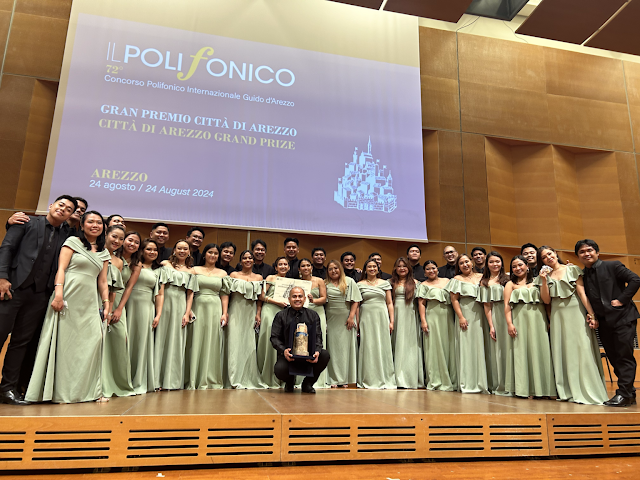
PH choir wins Grand Prix in Arezzo, Italy

PH choir Los Cantantes de Manila wins Grand Prix in international choir competition in Arezzo, Italy

Inquirer.net
31 August 2024

Los Cantantes de Manila (LCDM), a community choir based in Sampaloc, Manila, won the coveted Grand Prix at the recently concluded 72nd Concorso Polifonico Internazionale “Guido D’Arezzo” last August 20-25, 2024 in Arezzo, Italy.

LCDM bested 11 elite choirs from nine countries around the world by showcasing different styles of choral music in three competition categories: Compulsory, Sacred Music, and Secular Music programs. The group bagged the First Prize in each category, earning them the right to compete in the Grand Prix round of the competition. 

During the Grand Prix round, the choir emerged as the winner against fellow finalists Coro de La Rupe (Italy), Imusicapella (Philippines), Nuove Voci (Poland), and St. Paul’s Co-educational College Treble Choir (Hong Kong).

With their victory, LCDM earned the right to qualify in the 2025 European Grand Prix (EGP) for Choral Singing in Tolosa, Spain. This historic feat marks Los Cantantes de Manila as the first Filipino community choir to qualify for the prestigious competition.

“Now that we won in Arezzo, we have bigger plans for the future. We’re the first Filipino community choir to compete in the European Grand Prix, and we have a responsibility to represent the country well,” said Darwin Vargas, the conductor of the choir.

He also added, “We hope that we made the country proud with our victory here in Europe. We also wish for the Philippine choral community to continue supporting us as we prepare for the EGP next year.” 

Prior to their success in Italy, LCDM won the First Prize in the Sacred and Free programs at the 29th Béla Bartók International Choir Competition last August 1-4, 2024 in Debrecen, Hungary. They also received a Special Prize for the Best Interpretation of a Compulsory Piece (Cantate Domino).

Los Cantantes de Manila will continue to tour across different countries in Europe for concerts and competitions until September. This initiative is part of the group’s 10th-year anniversary celebration. 

Monday, 29 July 2024

Audio walking tours project by Filipino anthropologist wins UNESCO award

Audio walking tours project by Filipino anthropologist wins UNESCO award

Rowegie Abanto
ABS-CBN News
Jul 29, 2024 

MANILA — A Filipino anthropologist's audio walking tours project that featured famous tourist spots in the country received a prestigious award from the United Nation's heritage agency UNESCO. 

Raizel Pauline Albano’s "Anthro on Foot" — a collection of 57 audio walking tours from 17 regions across the country — was honored at the 2024 Global Awards for World Heritage Education Innovative Cases (AWHEIC) at the 46th session of the UNESCO's World Heritage Committee in New Delhi, India last week.

Out of some 300 entries, Albano's work was selected as one of the ten heritage education projects in the "Star of Outstanding" category. 

The awards category included heritage projects from Hong Kong, China, Spain, Abu Dhabi, Hungary, and Britain.

She said she is the first Filipino to receive an award from the AWHEIC, launched in 2022 to commemorate the 50th anniversary of the World Heritage Convention.

The heritage award body is organized by the World Heritage Institute of Training and Research for the Asia and the Pacific Region (WHITRAP) with the help and support of UNESCO.

Albano's audio walking tours were featured by Philippine news outlets early this year, which she said "brought us to places I never would have imagined finding myself in."

"We are incredibly grateful for WHITRAP’s support and confidence in our abilities to amplify the powerful and colorful stories of the Philippines and (...coming soon) the Asia-Pacific region!" she wrote on Facebook on Sunday as she announced her award.

The Global Awards for World Heritage Education Innovative Cases honors heritage education projects "with contemporary exemplary significance." 

It also provides an international exchange platform for global heritage education practitioners.

Saturday, 6 July 2024

PH biosphere reserve in new Unesco list

PH biosphere reserve in new Unesco list

Story by Aric John Sy Cua 
Manila Times
06 July 2024

MANILA, Philippines — A biosphere reserve in the Philippines is on the list of 11 new reserves, after it was approved by the United Nations Educational, Scientific and Cultural Organization (Unesco) on Friday.


Located in Apayao province, the yApayaos Biosphere Reserve consists of two distinct regions -- Lower and Upper Apayao.

"This biosphere reserve in the Province of Apayao is divided into two distinct regions: the Upper Apayao sports rugged terrain with towering peaks, plateaus and valleys, whereas the Lower Apayao features flatlands adorned with rolling hills and plateaus," Unesco said in its website. "Stretching 180 kilometers, the majestic Apayao River serves as a vital watershed, nurturing 18 tributaries across the province."


The name "yApayaos", as described by Unesco, was "a name that encompasses both the people and diverse flora and fauna living in the area".

Unesco also mentioned the biosphere reserve's ethnolinguistic groups and its 10 Indigenous Cultural Communities, that also included the Isneg community, which comprises 30 percent of its population of 124,366.

The yApayaos biosphere reserve, which spans 3,960 square kilometers, also engages in rice and corn cultivation, with ecotourism also progressing in Apayao.

Other biosphere reserves in the list include the Changnyeong Biosphere Reserve in South Korea, the Julian Alps Transboundary Biosphere Reserve in Italy and Slovenia, Kempen-Broek Transboundary Biosphere Reserve in Belgium and the Netherlands, and the Val d'Aran and the Irati Biosphere Reserves in Spain.


Friday, 5 July 2024

Slovenia, Philippines head to Olympic qualifying semis

Slovenia, Philippines head to Olympic qualifying semis

Manila Times
Story by Associated Press
05 July 2024

Luka Doncic and Slovenia still have Olympic hopes. And so does the Philippines, much to its own surprise.


Doncic had 36 points, 11 rebounds and 10 assists, and Slovenia beat New Zealand 104-78 on Thursday to clinch a semifinal spot in the Olympic qualifying tournament at Piraeus, Greece. Slovenia needed to win by at least 10 points to make the semifinals.

Slovenia's opponent on Saturday is Greece, meaning it'll be Doncic and fellow NBA All-Star Giannis Antetokounmpo leading their squads — with the winner advancing to Sunday's final with a berth in the Paris Olympics at stake, and the loser eliminated.

Josh Nebo had 20 points and 10 rebounds for Slovenia. Shea Ili led New Zealand with 28 points.

Semifinal Matchups

The matchups for Saturday's semifinals are taking shape.

At Valencia, Spain — Finland vs. Spain; Bahamas vs. Lebanon.

At Piraeus, Greece — Slovenia vs. Greece; Croatia vs. Dominican Republic.

At Riga, Latvia — Brazil vs. Philippines; Cameroon vs. Latvia.

At San Juan, Puerto Rico — Lithuania vs. Italy or Puerto Rico; Italy or Puerto Rico vs. Mexico.

The finals at all four sites are Sunday, and those four winners go to the Paris Olympics.

Georgia 96, Philippines 94


The Philippines lost but advanced to Saturday's semifinals of their tournament in Riga, Latvia, anyway. That created a bit of an issue; the team had flights home scheduled for Friday.

Monday, 10 June 2024

Manila Moves Up in 2024 Global Top 100 List of Emerging Startup Ecosystems

Manila Moves Up in 2024 Global Top 100 List of Emerging Startup Ecosystems

Story by Paul John Caña 
Esquire Philippines 
10 June 2024

Despite funding challenges and a general air of uncertainty, Manila’s startup ecosystem is bouncing back and is showing signs of recovery. The biggest proof is that the country’s capital has moved up in the annual ranking of the world’s Emerging Startup Ecosystems. From last year’s 91-100 spot, Manila is now at 81-90, driven mainly by growth in the fintech, e-commerce and gaming sectors. 


Manila shares the 81-90 spot with global startup ecosystem heavy hitters like Las Vegas (Nevada, USA), Columbus (Ohio, USA), Kansai Region (Japan), Bucharest (Romania), San Bernardino and Santa Barbara (California, USA), Turin (Italy), Madison (Wisconsin, USA), and Ho Chi Minh City (Vietnam). 

Manila placed higher in the list than cities like Rio De Janeiro (Brazil), Leipzig (Germany), Cape Town (South Africa), Valencia (Spain), and Adelaide (Australia).

According to the ecosystem focus page, the GSER estimates Manila’s total startup ecosystem value at $6.4 billion (about P375 billion) as of the second half of 2021 to 2023. This is up significantly from last year’s estimate of $3.5 billion but still far from the global average of $29.4 billion. 

"In 2023, startups in the Philippines raised $960 million across 96 deals," the report said. "In mid-2023, Manila-based VC Kaya Founders closed $12 million in new funds, aiming to broaden their investment focus across pre-Seed to Series A stages."

Kaya Founders is one of the country’s most prominent investment firms focusing on early-stage startup companies. It has invested in many of the country’s top startups, including Etaily, GoRocky, Kindred, Kraver’s Canteen, Locad, Netbank, Plastic Credit Exchange, Paymongo, Peddlr, Toki, and many more. 

By the numbers

Manila’s startup ecosystem value grew a hefty 72 percent between the periods of the second half of 2021 to 2023 versus the second half of 2019 to 2021. For comparison, the global average in ecosystem value growth was only 46 percent last year. 

Total early-stage funding in the country (also from the second half of 2021 to 2023) was at $371 million (vs global average of $655 million), while total venture capital funding was at $1.1 billion between 2019 to 2023 (vs global average of $4.6 billion).

Manila also ranked in the GSER’s Top 15 of the Asia Ecosystem in Bang for Buck, Top 20 in Asia Ecosystem in Funding, and Top 30 in Asia Ecosystem in Performance.

"The Philippines is rising steadily in the Global Innovation Index, from #100 in 2014 to #56 in 2023, with plans to break into the top 50 by 2028 as outlined in the 2023-2028 Philippine Development Plan," the report said. "The Department of Trade and Industry (DTI), Department of Science and Technology, and Department of Information and Communications Technology lead efforts to support the country’s tech startup ecosystem. The National Innovation Council leads in developing the country’s innovation goals, priorities, and long-term national strategy."

Looking at the sub-sector strengths, the GSER highlighted the 38 percent growth, from 216 companies to 299, between 2021 to 2023 in fintech. Thanks to the Bangko Sentral ng Pilipinas Digital Payments Transformation Roadmap, digital retail payments soared from just one percent in 2013 to 50 percent of all transactions in 2023.

In e-commerce, the Philippines ranked fifth in the region for e-commerce traffic thanks largely to the extreme popularity of online marketplaces Shopee and Lazada, whose combined user bases is expected to balloon to 60.41 million by 2027.

And in gaming, the country is still the world’s undisputed leader in Web3 gaming interest for the third year in a row. The report made special mention of the Web3 Gaming Summit hosted by YGG last year and the launch of the country’s first esports course at Lyceum Philippines University.

In some ways, the GSER made many of the same points highlighted in the 2024 venture capital report released by Foxmont Capital Ventures and Boston Consulting Group. That report acknowledged the slowdown in funding for startups over the past year but still chose to shine a light on other bright spots in the startup ecosystem, including the country achieving a record number of deals, and how much the country is growing its share of regional capital.

Finally, the GSER put the spotlight on some major players in the country’s startup ecosystem, including the Gobi-Core Philippines Fund, Plug and Play Tech Center, Ideaspace, Launchgarage Innovation Hub, Brainsparks, and Startup QC.

"The Philippines invests in its startup ecosystem to create opportunities for a more prosperous and sustainable future, enhance quality of life, bolster global competitiveness, and foster innovation by addressing the critical challenges of our society and changing market needs," the report quoted DTI Usec. Rafaelita M. Aldaba of the agency’s Competitiveness and Innovation Group as saying.

Regional rankings

This year’s GSER report also includes a ranking of startup ecosystems by region. In Asia, Manila made it to the 21-25 ranking, tied with Bangkok (Thailand), Wuhan (China), Kansai Region (Japan), and Ho Chi Minh City (Vietnam). 

Asia’s top startup ecosystem this year is Singapore followed by Beijing, Seoul, Tokyo, and Shanghai.

For other Southeast Asian cities, Jakarta was at 12th place, second only to Singapore. The Indonesian capital was followed by Kuala Lumpur at 16th, Manila, Bangkok and Ho Chi Minh, and Hanoi at 26-30.

State of global startups

The GSER recognized the global downturn in startup metrics, including VC funding, and exit deal value, saying that both fell below the 2019 levels but, as in the Foxmont-BGC VC report, chose to look at the bright spots.

"While global Series A funding fell 46 percent in 2023 compared to 2022, average Series A deal size increased in H2 2023 compared to H2 2022," the report said. "Q1 2024 shows signs of further improvement. The Cleantech and Generative AI (GenAI) sub-sectors offer another positive note, demonstrating that frontier innovation can still attract investor enthusiasm regardless of global funding conditions."

The top 3 in the global top 40 ecosystems retained their positions from last year, with Silicon Valley still at number one and New York and London tied at second place. Tel Aviv has moved up one rank and is now tied with Los Angeles at number 4, while Tokyo has entered the Top 10 for the first time, moving up to number 10 from number 15 last year. 

The GSER 2024 is the 12th edition of the report that "provides insights into the world’s leading startup ecosystems, emerging trends, and key challenges facing entrepreneurs." Startup Genome says the report is based on an extensive study of more than 4 million companies across over 350 startup ecosystems.

Thursday, 18 April 2024

Philippines among top country for expat in 2023

Philippines among best countries for living and working abroad in 2023—survey

Story by Yoniel Acebuche
Philstar Life
18 April 2024

The Philippines was among the top countries for expats in 2023, according to a recent survey on living and working abroad.


In the latest Expat Insider survey, the country placed eighth in the list of best places for expats when it comes to "the ease of settling in and getting started abroad" as well as personal finances, work, and quality of life in general.

In case you didn't know, an expat or expatriate is "an individual living and/or working in a country other than their country of citizenship, often temporarily and for work reasons." They can also be someone who "has relinquished citizenship in their home country to become a citizen of another."

Around 12,000 expats based in 172 countries and territories participated in the survey. Mexico, Spain, Panama, Malaysia, and Taiwan topped the list, followed by Thailand, Costa Rica, the Philippines, Bahrain, and Portugal, respectively.

According to the survey, Mexico's top performance didn't come as a surprise as the country has consistently been part of the Top 5 since its first edition in 2014. It has also consistently ranked among the best in the Ease of Settling In Index for ten years due to local friendliness, finding friends, easy-to-get-use culture, affordable housing and accommodation, as well as personal career opportunities such as fair pay, work-life balance, and quality of life.

Expats also said that they "feel at home and happy in Spain," making it the second best country worldwide for them. They also found Panama, which placed third on the list, an easy destination to settle in.

Conde Nast Traveler, in a report on the same survey, said that the Philippines made it to the list likely because of its proximity to some of the world's most beautiful islands and affordability.

"We suspect being near some of the world's most beautiful islands probably makes expats pretty happy," the digital travel site said. "The country ranked third in the survey's 'Personal Finance' index, with people reporting an enviable cost of living and affordable housing."

The Expat Insider 2023 survey was conducted by InterNations, an expat networking community with more than 5 million members.

The latest edition assigned ratings to more than 50 aspects of expat life, including the ease of settling in, work-life balance, cost of living, healthcare quality, and friendliness of the local population.

Thursday, 11 April 2024

DoubleDragon: Philippines' first Nasdaq listed company

Injap Sia's Hotel101 Will Be First Philippine Company on US Nasdaq After $2.3 Billion Merger Deal

Story by Christa I. De La Cruz 
Esquire Philippines
11 April 2024

Hotel101, the business and leisure hotel chain with its flagship property in Pasay, is all set to go public on the Nasdaq in New York City. This comes after the announcement of Philippine-listed real estate development company DoubleDragon Corporation that its Singapore-headquartered subsidiary Hotel101 Global Pte. Ltd. and JVSPAC Acquisition Corporation (NYSE: JVSA) have entered into a binding definitive merger agreement.


Once completed, Hotel101—with ticker symbol HBNB—will have an equity value of $2.3 billion (P130 Billion). The merger is expected to close in the second half of 2024, subject to regulatory and shareholder approvals and other customary closing conditions.

Albert Wong, Chairman of JVSPAC, with DoubleDragon/Hotel101 Chairman Edgar Injap Sia II, CEO Hannah Yulo Luccini, and Co-Chairman Tony Tan Caktiong

DoubleDragon Group is led by Edgar "Injap" Sia II (founder of Mang Inasal) and Tony Tan Caktiong (founder of Jollibee). Tan Caktiong was recently listed in the Forbes' billionaire list with a net worth of $1.4 billion. With the listing made via a special purpose acquisition company (SPAC), Double Dragon positions Hotel101 Global as the first Filipino company in the US Nasdaq Stock Exchange.

Outside the Philippines, Hotel101 properties are currently under construction in Madrid, Spain; Hokkaido, Japan; and Los Angeles, California. The company said in a statement that it had identified 25 priority countries for expansion: the Philippines, Japan, Spain, the U.S., United Kingdom, the U.A.E., India, China, Thailand, Malaysia, Vietnam, Indonesia, Singapore, Cambodia, Bangladesh, Mexico, South Korea, Australia, Canada, Switzerland, Turkey, Italy, Germany, France, and Saudi Arabia.

JVSPAC Acquisition Corporation is a blank check company incorporated for the purpose of executing a business merger. It is led by Chairman and CEO Albert Wong, who is also the CEO and Director of Kingsway Group Holding. Kingsway is in the automotive industry, particularly the sole distributor of Lamborghini in Hong Kong, Macau, and Guangzhou; as well as Koenigsegg Automotive, Rimac Automobili, and Bugatti Automobiles for China.