Showing posts with label Davao City. Show all posts

Thursday, 10 July 2025

PH 3rd safest destination for Travelers in 2025 - Travelbag

Philippines Ranks Third Safest Destination for Travelers in 2025, According to Travelbag

Christa I. De La Cruz 
Esquire Philippines
10 July 2025

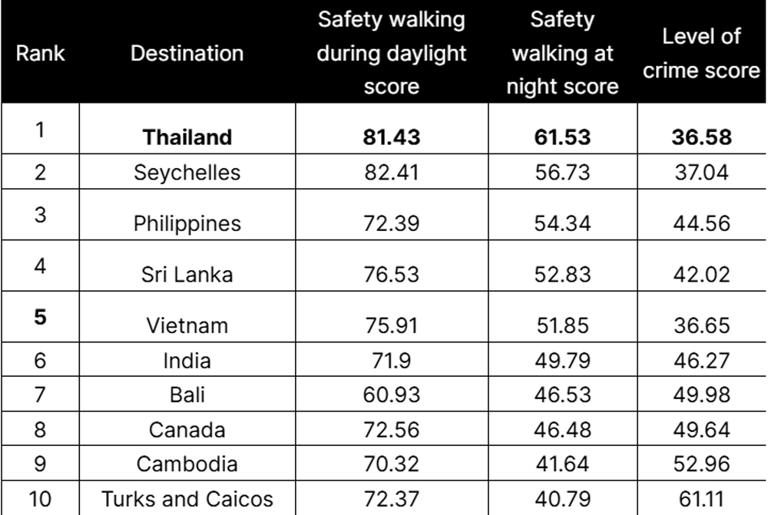
Research by travel booking platform Travelbag revealed that the world's safest destination for travelers in 2025 is Thailand, with the Philippines ranking third in the list.

Philippines Ranks Third Safest Destination for Travelers in 2025, According to Travelbag

For many travelers, feeling safe is just as important as the destination. Whether it's a quiet solo trip, a family adventure, or a romantic getaway, knowing that you won't be robbed at gunpoint anytime soon makes a big difference. The long-haul travel platform examined safety ratings, crime levels, and how safe people feel walking around both day and night based on data from Numbeo.

Travelbag

The Philippines, with its thousands of islands, rich culture, and famously friendly people, is increasingly viewed as a safe choice for tourists. The Travelbag report gives the Philippines solid scores: 72.39 for "Safety walking during daylight" and 54.34 for "Safety walking at night." Its "Level of crime" is noted at 44.56. These numbers suggest a country where you can enjoy adventure with growing peace of mind.

This positive ranking comes as the Philippines actively works to improve tourism and safety. The Department of Tourism (DOT) and local governments focus on traveler safety. For instance, cities like Dumaguete and Davao have been named among the safest in the country for 2025 by the World Travel Index. They scored well for day and night safety, low crime rates, and strong public trust in authorities. Dumaguete earned a Safety Index score of 81.36, making it the highest among Philippine cities and ranking 1097th globally. Davao City in Davao Del Sur, which used to be the first on the list, came in second with a Safety Index score of 80.73. Bulacan, Balanga (Bataan), Lucena (Quezon), Naga City (Camarines Sur), Baguio City, Puerto Princesa, Legazpi City, and Makati City round up the top 10 in the Philippines.

The DOT is also planning to establish Tourist First Aid Facilities in popular tourist destinations like La Union, Boracay Island, Siargao Island, Panglao Island, Palawan, and Puerto Galera. These locations will have medical staff ready to help.

Sunday, 4 August 2024

Budots taking over Tiktok

What to know about the ‘Emergency Budots’ taking over TikTok

By Harmeet Kaur
CNN
04 August 2024

“Paging Dr. Beat! Emergency! Emergency!”

Before budots became a TikTok style trend, it was a hit sensation in the Philippines. Some users are showing others on the platform how the dance is done. @b.snipe/@nurse.john/@kielzfics/TikTok

If you’re up on the latest TikTok dance trends, you may have heard this refrain looped over a wobbly electronic bassline punctuated by high-pitched noises. The disco remix has been used in thousands of videos across the platform, many featuring people showcasing a series of outfits while lightly swinging their shoulders and feet. Even the Kamala Harris campaign and singer Olivia Rodrigo have gotten in on the fun.

Pop star Olivia Rodrigo is among the participants in the latest TikTok trend, which involves using a budots remix to show off different outfits. Olivia Rodrigo/TikTok

But for those who know the context behind the song, the real emergency is that these users are doing the dance all wrong.

The track from DJ Johnrey, which samples Miami Sound Machine’s “Dr. Beat,” belongs to a Filipino electronic dance music subgenre called budots. And though many users participating in the recent trend are exhibiting subtle, stiff movements, dancing budots involves smoother, more exaggerated motions and getting way lower.

Well before budots became a vehicle to share fashion inspiration, it was a hit dance phenomenon in the Philippines and the stuff of memes and parodies.

Here’s the little-known history behind the genre.

Budots was born out of Filipino street culture.

Budots, slang for “slacker” in the Visayan language, is thought to have originated in Davao City on the Philippine island of Mindanao.

It first emerged as a dance and was associated early on with youth drug culture, per Fritz Flores, who wrote an undergraduate thesis on the dance craze. Some scholars have also linked budots dance moves to art forms of the indigenous Badjao people.

Sherwin Calumpang Tuna, known by the moniker DJ Love, is credited with transforming budots into a full-fledged musical genre. While working at an internet cafe in the late aughts, DJ Love — also a choreographer — began producing song and remixes corresponding with the dance seen on Davao City’s streets, as recounted in the short documentary “Budots: The Craze.” He also distanced himself from budots’ early iterations by including the slogan “Yes to dance, no to drugs” in many of his videos.

Like the “Emergency Budots” track that has recently taken off on TikTok, songs of the genre take electronic and house music and layer on boisterous beats and over-the-top sound effects such as vinyl scratches, sirens and whistles. They typically lack a verse or chorus, with vocals instead featuring as repetitive samples throughout the track.

“With 140bpm four-on-the-floor patterns, budots reanimates the corpse of eurodance, albeit stripped of the latter’s melodramatic singing and theatrical piano melodies, and discarding the expressions of emotional vulnerability in favor of obscene jokes and calls for riotous partying,” said writer and musician Dominic Zinampan, while describing the genre in a 2020 essay.

“Pulsating, thumping basslines accent the upbeat while chintzy synths, oft-described onomatopoeically as »tiw-tiw,« reminiscent of rayguns, sirens, and noisemakers, snake through high and low.”

Davao City radio stations were playing budots by 2007, according to Flores’ research, and the genre continued to grow in popularity. In 2008, budots was catapulted to the Philippines’ mainstream after Ruben Gonzaga performed the dance on the reality show “Pinoy Big Brother” (Gonzaga went on to win the season). The Philippines news show “Kapuso Mo, Jessica Soho” covered the phenomenon in 2012.

How the genre became a sensation

Budots was such a phenomenon in the Philippines that even politicians attempted to capitalize on its popularity.

In 2015, while the controversial Rodrigo Duterte — then the mayor of Davao City — was running for president of the Philippines, a video of him dancing budots with a group of teenagers circulated widely online, racking up millions of views and contributing to Duterte’s self-cultivated image as a populist everyman. In 2017, the electronic music collective BuwanBuwan appeared to parody the genre and then-President Duterte by setting clips from his speeches to budots beats.

Former movie star Ramon “Bong” Revilla Jr. also danced to budots in a campaign ad while running for the Philippines’ Senate in 2019.

Budots is now a cultural mainstay in Davao City and the Philippines more broadly. There are countless song and dance compilations of budots remixes on the internet, and budots Christmas remixes can be heard at holiday parties across the country.

“While some use it to get famous because of its virality, I also feel that for these people, this is a kind of identity badge they use to express themselves, and they’re proud of it,” Jay Rosas, the filmmaker behind “Budots: The Craze,” said in a 2019 interview with VICE News. “The fact that it’s even used in Christmas parties and played on the radio means it has achieved a certain level of acceptance as a culture and part of our identity in Davao.”

After years of being overlooked, budots finally appears to be achieving recognition and respect across the dance music industry. Last year, budots pioneer DJ Love played a Boiler Room set — showcasing the genre and its characteristic maximalism on one of the industry’s biggest and most influential platforms.

Though the initial TikTok craze was divorced from the history of budots and its signature dance moves, it also spawned a spinoff trend in which those in the know demonstrated the proper way to dance budots — shining a spotlight on a slice of Filipino culture.

“If you gonna dance it, dance it right baby,” creator John Dela Cruz, known on TikTok as Nurse John, captioned one of his videos.

“you will NOT catch me walking in place,” wrote user Michi Kollette on a video of her rhythmically moving her knees to the beat.
Saturday, 29 June 2024

Philippines travel industry heading toward record high

Philippines travel industry heading toward record high P5.4 trillion

Story by Elijah Felice Rosales
Philstar Global 
29 June 2024

MANILA, Philippines — The Philippine travel industry is heading toward an all-time high value of P5.4 trillion this year, propelled by efforts to boost tourism in the provinces and upgrade aviation infrastructure.

Based on forecast by the World Travel and Tourism Council (WTTC), the country will grow its travel and tourism to new highs in 2024, particularly on economic contribution, job generation and visitor spending.


WTTC projects travel’s contribution to the economy to rise by almost a quarter to P5.4 trillion this year, from P4.34 trillion in 2023.

Likewise, travel will generate at least 9.5 million jobs for Filipinos, comprising one in every five of the labor force. Also, domestic visitor spending is seen to go up to P3.7 trillion, while foreign tourist expenditure is estimated to hit P715.6 billion.

WTTC president and CEO Julia Simpson said travel would benefit from public and private efforts to upgrade regional airports. The Department of Transportation (DOTr) is investing P14 billion for the development and reconstruction of provincial gateways this year.

Similarly, the DOTr is arranging public-private partnership contracts for the upgrade of airports in Bacolod, Bohol, Davao, Iloilo, Kalibo, Puerto Princesa and Siargao.

Apart from this, Simpson said travel would gain from the impending turnover of the Ninoy Aquino International Airport (NAIA) to the New NAIA Infrastructure Corp. led by San Miguel Corp.

The DOTr is set to hand over NAIA to the consortium by September, and from there the airport will undergo a P170.6 billion rehabilitation in the next 15 years.

WTTC estimates that travel and tourism will raise about P9.5 trillion for the Philippine economy by 2034. By then, the industry will take up 22 percent of the economy, creating jobs for as many as 11.9 million, sustaining one in every five Filipinos.

Regionally, WTTC believes Southeast Asia will grow its travel segment by 21 percent to hit P21 trillion this year. Additionally, jobs in travel and tourism will balloon to 42.4 million, expanding the role of the industry in livelihood generation.

The government is working on the improvement of transport infrastructure across the Philippines to enhance inter-island connectivity, benefitting industries reliant on tourism.

For one, the rehabilitation and upgrade of NAIA is expected to increase the passenger capacity of the airport to 62 million a year, from 32 million at present.

Sunday, 2 June 2024

Philippines: $397-billion reclamation projects underway, more planned

Philippines: $397-billion reclamation projects underway, more planned

Mega projects expanding urban landscape, adding spaces, with more on the drawing board

Jay Hilotin, Senior Assistant Editor
Arab News
May 31, 2024 

Manila: The skyline of the Philippine capital is changing. So is the view from above. Multi-billion-dollar mega projects are expanding the urban landscape, with massive sea-ward transformation projects in progress – or on the drawing board.

The aim: push back the sea, create new spaces and opportunities. Manila Bay is the centre of this action. Outside the capital, more land reclamation jobs are planned or are in progress.

The total area of land reclamation projects in the Philippines, both completed and planned, is significant. As of 2023, there are around 187 ongoing and approved reclamation across the country.

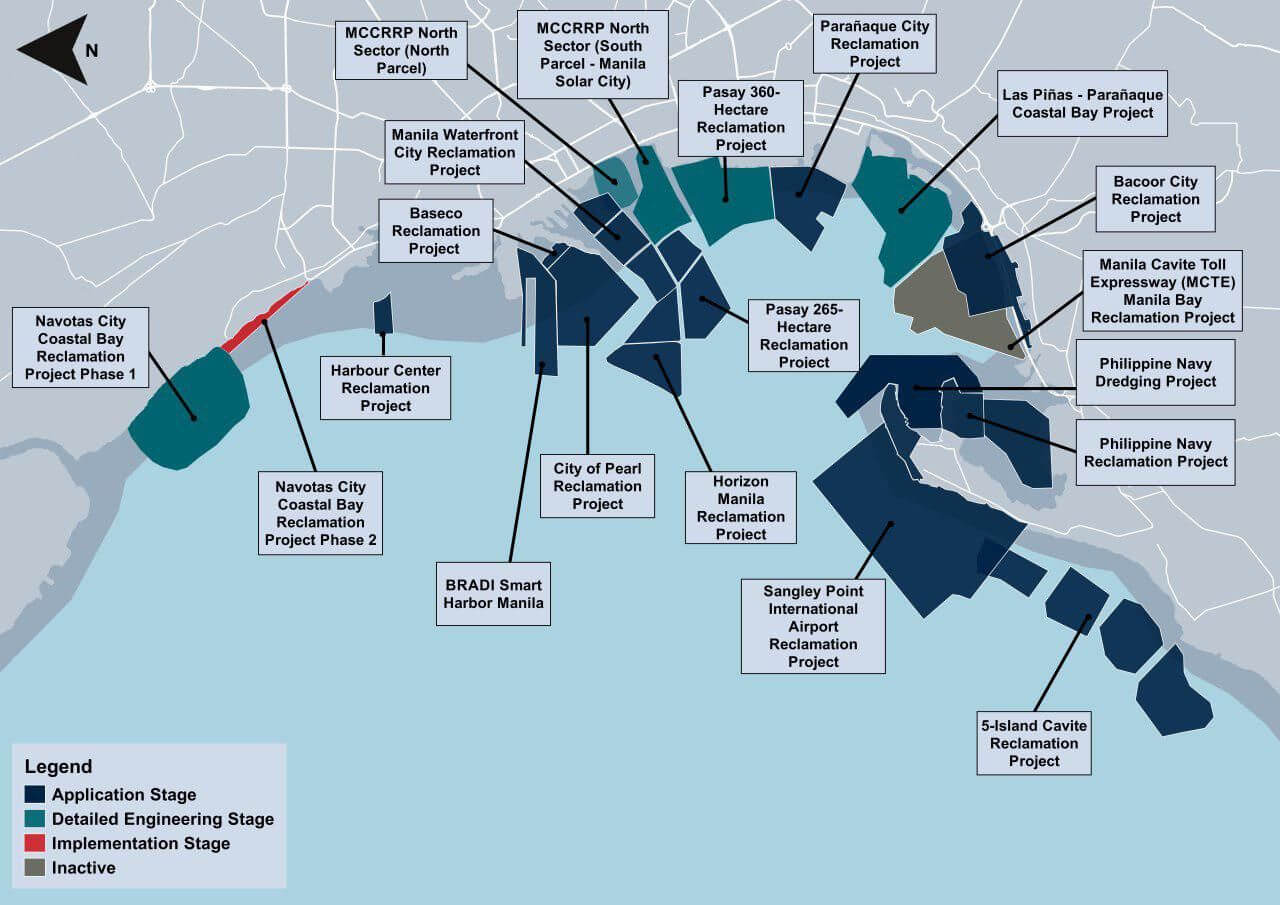
Grabbed from: 6-soon-to-rise-manila-bay-reclamation-sites-in-2019.jpg (1280×905) (kmcmaggroup.com)

Specifically, Manila Bay has a considerable concentration of these projects, valued at more than 23 trillion pesos ($397 billion), according to one estimate.

Reclamation, a trend that started here in the early 1960s, has been revived in recent years. It’s helping decongest cities, creating new land for development, mass housing and easing the pressure cramped metropolises.

Here’s the lowdown:

Manila Bay Reclamation
Area: 5,503 hectares (13,598 acres)

The Roxas Boulevard reclamation projects collectively represent a significant expansion of the Manila Bay coastline. This involves 14 approved projects covering 5,503 hectares (55 km2).

Also known as the Manila Bay Reclamation Project, this involves several planned and ongoing reclamation initiatives along the Manila Bay coastline, particularly in the areas adjacent to Roxas Boulevard. Components include the 148-hectare Manila Solar City Project (a mixed-use development), the 419-hectare Horizon Manila, and the 318-hectare Manila Waterfront City.

The total investment for property development is estimated at nearly 23 trillion​ pesos ($397 billion). The original plan was to reclaim 3,000 hectares (30 km2) of land in Manila Bay.

Besides the SM Mall of Asia Complex, it is known for the 77-hectare (0.77 km2) Cultural Center of the Philippines Complex, the Aseana City Business Park, integrated resorts and complexes such as the City of Dreams Manila, Okada Manila and Solaire Resort, and the Asiaworld compound where the Parañaque Integrated Terminal Exchange (PITX) is situated.

Bulacan Aerotropolis
Area: 1,168 hectares (2,886 acres)

Developed by San Miguel Corp. (SMC), this project includes the construction of the New Manila International Airport, also known as Bulacan International Airport, and surrounding urban infrastructure. The project area spans 2,500 hectares (25 km2) with the airport covering 1,168 hectares and an adjoining airport city, part of the under-construction $15-billion behemoth. It’s a major part of the overall effort to boost the region’s economic growth​​.


Part of the material used for this reclamation project is the use of up to 6 million tonnes of silt, solid waste and trash dredged from rivers in Manila and nearby provinces.

These include 3 million tonnes extracted from more than 50 kilometers of rivers in the flood-prone Bulacan province spanning the cities and towns of Meycauayan, Obando, Bulakan, Bocaue, Marilao, Balagtas, and Guiguinto. Moreover, 1.2 million tonnes of waste were dredged from 26 kilometers of the Pasig River, 1.1 million tons from 11 kilometers of the Tullahan River, and almost 320,000 tonnes from the San Juan River.


Cebu South Coastal Urban Development Project (CSCUD):
Area: 300 hectares (740 acres)

This includes various projects like the Cebu South Coastal Urban Development Project, which focuses on commercial, residential, and industrial areas to stimulate economic activity in Cebu.


It has an ambitious socialised housing component. The South Road Properties (SRP), also known as the South Reclamation Project, is a 300-hectare (740 acres) reclamation area in Cebu, a trading and cultural hub in central Philippines.

The area, which is reclaimed from Mactan Channel, is located off the coast of the southern district of Cebu City, near Barangays Mambaling, Inayawan, and Pasil.​

This is a large-scale initiative aimed at transforming the southern coastal areas of Cebu City into a modern urban hub. Its primary objective: alleviate congestion in the city centre, promote sustainable urban growth, and enhance the overall quality of life for residents.


The project will be developed in three phases and aims to provide 40 buildings for socialised housing across a 60-hectare site and other areas along the SRP. Phase 1 alone covers 30 hectares and is expected to benefit approximately 10,000 informal settler families.

The development is part of the larger "National Pabahay Para sa Pilipino Housing" drive to address the housing deficit by constructing 6 million units by the end of President Ferdinand Marcos Jr.'s term in 2028.

The project will also have essential facilities such as schools, markets, and health centers to create a sustainable and integrated community and aligns with the overall national budget allocated for this extensive housing initiative.

Cebu City North Reclamation Area (NRA)
Area: 169 hectares (417 acres)

The Cebu City North Reclamation Area (NRA), started in 1962 with about 169 hectares, has been further expanded to cover about 330 hectares today. Situated along the northern coastline of the city, it provides easy access to key transportation hubs like the Cebu International Port and the Mactan-Cebu International Airport. Its central location makes it a crucial area for business, commerce, and tourism.


The NRA is a significant economic driver for Cebu City, housing several commercial establishments, shopping malls, and office buildings. Major developments in the area include SM City Cebu, at least 20 hotels, and the Cebu Business Park, which hosts numerous multinational corporations and local businesses.

These establishments contribute significantly to the local economy by providing jobs and attracting investments. Its central location makes it a crucial area for business, commerce, and tourism.

Navotas Coastal Development
Area: 650 hectares (1,606 acres)

This development north of Manila, aims to develop urban, commercial, industrial, housing and green spaces to support the local economy and improve living standards in Navotas​. This significant undertaking covers an extensive area along the coastal region of Navotas City. The entire project is designed to cover approximately 650 hectares. A substantial portion of the project involves land reclamation from Manila Bay.


This reclaimed land will be used for new developments and infrastructure. A significant portion of the reclaimed land will be dedicated to housing, aimed at providing affordable and sustainable living spaces for thousands of families.

Large tracts of land will also be used for commercial and industrial activities. The development also includes parks, recreational areas, and waterfront promenades, enhancing the livability and aesthetic appeal of the area.

Pasay Reclamation Project
Area: 265 hectares (654 acres)

This project, covering approximately 265 hectares, is a large-scale development initiative aimed at transforming the coastal area of Pasay City (south of Manila) into a thriving urban hub.

This development aims to enhance economic growth, provide housing and job opportunities, and improve the overall quality of life through the creation of new residential, commercial, and industrial zones, as well as public amenities and green spaces, to be implemented in several phases.

Following the initial land reclamation and establishment of basic infrastructure, including roads, utilities, and seawalls, the residential and commercial zones will be developed, along with public amenities. Further expansion of industrial areas and completion of remaining infrastructure and public spaces.

Las Piñas-Parañaque Coastal Bay Project
Area: 635 hectares (1,569 acres)

The Las Piñas-Parañaque Coastal Bay Project is planned to cover a total area of approximately 635 hectares, reclaiming the shallow coastal area from Asia World Properties to the municipality of Bacoor in Cavite. This reclaimed land will support various types of development – residential, commercial, and industrial zones, along with infrastructure for flood control and coastal defense.

In October 2021, the Philippine Supreme Court en banc voted 11-2 to approve the reclamation project covering approximately 530 hectares of the Manila Bay coastline in Las Piñas and Parañaque, ruling that the alleged environmental threat was not sufficiently established.

In 2009, Alltech Contractors proposed developing 321.26 hectares in Las Piñas and 174.88 hectares in Parañaque along the Manila Bay coastline.

Senator Cynthia Villar (Las Piñas ex-representative), along with local residents, petitioned the Supreme Court to scrub this reclamation, arguing it would increase “flood risk” in their communities. The Philippine Reclamation Authority (PRA) approved the project in 2010, after subjecting to environmental compliance.

The proponents submitted an amended Environmental Performance Report and Management Plan (EPRMP) in December 2010, expanding the project to 203.43 hectares in Parañaque and 431.71 hectares in Las Piñas.

In March 2011, the Department of Environment and Natural Resources–Environmental Management Bureau (DENR-EMB) issued an Environmental Compliance Certificate (ECC) for the project. Villar contended that the project would impede the flow of the Las Piñas-Zapote and Parañaque rivers. In 2013, the Court of Appeals (CA) denied the petition, stating that the project had undergone the proper process, and noted that the submission of an EPRMP is a valid form of Environmental Impact Assessment (EIA).

Panglao Island Reclamation
Area: 450 hectares (1,112 acres)

The Panglao Island Reclamation project, located in Panglao Island, which is part of Bohol province in the Central Visayas region of the Philippines, is situated southwest of Bohol's main island and is known for its beautiful beaches, dive sites, and tourism attractions.

It is planned to cover a total area of approximately 450 hectares. This reclaimed land will be utilised for various purposes, including residential, commercial, tourism, and industrial development. Panglao Island is connected to Tagbilaran City, the capital of Bohol, by two bridges.

The island is famous for its popular tourist destinations. The island is home to Bohol-Panglao International Airport, which boosts connectivity and accessibility, making it an ideal location for further development.

The Davao Reclamation Project
Area: 214 hectares (504 acres)

The Davao Reclamation Project, also known as the Davao Waterfront Development Project, is a major land reclamation initiative in Davao City, located in the southern part of the Philippines.

In January 2023, Davao City officials and representatives from the Philippine Reclamation Authority signed a Memorandum of Understanding – in line with the application of the city to reclaim and develop 57 hectares along the reclaimable areas enclosed by the Davao City Coastal Road Project.


This extensive reclamation will be developed to support a variety of uses, including residential, commercial, industrial, and public amenities. An area has been earmarked for affordable housing units and high-end residential complexes, as well as commercial spaces, offices, retail establishments, hotels, entertainment facilities, industrial activities, public amenities and green spaces.

Cebu Reclamation Projects
Area: 765 hectares (1,890 acres)

The Cebu Reclamation Projects are collectively substantial – adding over 765 hectares of new land to support various types of development. These projects aim to enhance Cebu’s economic capacity, provide new residential and commercial spaces, and improve public amenities while addressing environmental sustainability and regulatory compliance.

Includes multiple smaller-scale projects in areas such as Balamban, Carmen, Compostela, Minglanilla and Oslob, focusing on port facilities, commercial spaces, and public amenities​​. Toledo City (Area: 18 hectares, 44.5 acres) reclamation project will form part of the waterfront area's urban development effort as a new place for a sports stadium, yacht club, commercial and business process outsourcing centers, hospitality, and education facilities.

Balamban reclamation project (Area: 8.4 hectares, 20.75 acres) is the west Cebu province's shipbuilding capital. It plans to construct a dome, a wharf, and an evacuation center in its 84,000-square-meter proposed reclamation area.

Oslob reclamation project (Area: 10 hectares, 27.7 acres) is planned in the whale-watching town of Oslob. It poised to build a commercial hub in its planned 10-hectare reclamation lot. Dumanjug, another town in Cebu, wants to establish income-generating food and commercial facilities in its undetermined size of reclamation area.

Each of the five-hectare reclamation projects in the towns of Carmen and Compostela will be home to their respective public market, transport facilities and structures to protect residents from storm surges.

Dumaguete Smart City
Area: 174 hectares (430 acres)

The Dumaguete Smart City, a 174-hectare, 23-billion-peso township project aims to transform Dumaguete, a city in central Philippines, into a technologically advanced urban center. The project is expected to drive significant economic growth and social benefits for Dumaguete.

By improving infrastructure and public services, the Smart City initiative aims to attract new investments, create job opportunities, and boost the local economy. The integration of smart technologies is also anticipated to enhance the quality of life for residents, providing better healthcare services, improving education systems, and ensuring more efficient public transportation.

Efforts are being made to minimize the environmental footprint through the use of green technologies and sustainable practices.


Looking ahead

Reclamation, like bridge-building, does offer significant economic and social benefits.

It's not all bed of roses. Besides the engineering challenges, there are environmental concerns raised. Fisherfolk and local communities have expressed their opposition to some of these projects, citing their potential negative environmental impacts. These concerns, and others, must be carefully considered to ensure sustainable practices and comprehensive environmental assessments, in order to mitigate the downsides.

Adherence to national and local regulations, i.e. conducting comprehensive Environmental Impact Assessments (EIA), securing necessary permits and approvals from relevant authorities, including the Philippine Reclamation Authority (PRA) and the Department of Environment and Natural Resources (DENR), and thorough environmental scrutiny underscores the need to balance development with ecological preservation.

Tuesday, 21 May 2024

Nine PH cities made it to Top 1000 Cities by Oxford Economics

Nine Philippine cities among top 1,000 global urban economies 2024 Oxford Economics Global Cities Index

By Chino S. Layco
Manila Bulletin
May 21, 2024 

AT A GLANCE

  • Manila ranks 256th globally with strengths in economics and human capital but weaknesses in quality of life.
  • Cebu City is at 436th place, excelling in the environment but lacking in quality of life.
  • Other Philippine cities like Cagayan de Oro, Davao City, and Angeles City are also identified.
  • Bacolod shines in the environment but struggles with human capital.
  • Dagupan highlights strong environmental aspects.
  • Zamboanga excels in the environment but faces economic challenges.
  • General Santos thrives in the environment but faces challenges with human capital.
  • The 2024 Global Cities Index by Oxford Economics provides insights into urban environments worldwide, with New York, London, San Jose, Tokyo, and Paris leading the rankings.

UK-based think tank Oxford Economics has identified nine cities in the Philippines among the largest urban economies in the world.

In the Oxford Economics Global Cities Index, which ranks the 1,000 largest cities worldwide, Manila is the biggest city in the Philippines but is not considered a major player on the global scale.

Taken from Rising Philippines Facebook Page

The Oxford Economics report did not specify if "Manila" refers to just the capital city or includes the entire metropolitan area in the National Capital Region (NCR). The report did not list any other NCR cities besides Manila. 

Oxford Economics ranks based on five categories: economics, human capital, quality of life, environment, and governance.

“By analyzing these five dimensions in depth, the Global Cities Index provides a nuanced understanding of each city's strengths and areas for improvement, empowering policymakers, investors, employers, and residents to make informed decisions,” Oxford Economics said in a statement.

Among the 1,000 urban economies worldwide, Manila is ranked 256, placing it above the global average scores, although not among the top-performing cities.

Based on the report, Manila’s strength is human capital, ranking 101, followed by economics (150) and environment (238). However, its weakest points are quality of life (461) and governance (614).

Another city that has made it to the global rankings is Cebu City, which secured the 436th spot worldwide. The Queen City of the South excels in the environment (24) but lags behind in quality of life (684).

Cagayan de Oro ranked third in the Philippines, holding the 487th position globally. Similar to Cebu City, CDO’s strong suit lies in the environment (338), while its weakness is quality of life (626).

Davao City occupied the 500th position, with its main weakness being in human capital (645) and strength in the environment (229).

Angeles City has also been listed in the global rankings, securing the 502nd place. Its strength lies in the environment (191), while its weakest aspect is human capital (634).

Bacolod attained the 538th position among the 1,000 global urban economies. Its strength is in the environment (12) but shows weakness in terms of human capital (739).

Meanwhile, Dagupan ranked 604 globally, with its environment as a key advantage (220) and human capital is its weakness (701).

Zamboanga, positioned eighth in the Philippines, held the 695th global rankings. It excels in the environment (48) but faces challenges in economics (961).

General Santos, placed at 723 globally, known as the country's tuna capital, showed strength in the environment while encountering difficulties in human capital (915).

In the 2024 Global Cities Index, the first publication by Oxford Economics, New York leads the list, which also claimed the top position in the Economics category. 

London secures the second spot, followed by San Jose, Tokyo, and Paris.