The 10 best places to visit in the Philippines, ranked
From tropical beaches and hidden caves to mountain terraces and surf breaks, these destinations showcase the many sides of the Philippines
Quartz (qz.com)
23 September 2026
The Philippines poses an unusual planning problem for travelers: too many options. The archipelago spans more than 7,400 islands, and the challenge isn't finding somewhere worth visiting but narrowing the list to something manageable. What the country offers across those islands is remarkable in its range, from world-class wreck diving and underground river systems to terraced rice paddies cultivated for 2,000 years, from powdery white beaches designed for doing nothing to surf breaks that draw riders from every corner of the world. The phrase “island-hopping” understates what inter-island travel in the Philippines actually delivers.
Jarno Colijn / Unsplash
The practical question is how to structure the trip. Focusing on one region at a time produces depth that trying to cover the whole country in one visit cannot. At the same time, inter-island connections, by air, fast boat, and ferry, are frequent enough that moving between hubs is straightforward with some advance planning. The destinations below span the main island groups, Luzon in the north, the Visayas in the center, and Mindanao to the south, with enough variety in character that no two entries on the list duplicate each other.

The 10 places below appear in Lonely Planet and cover the best destinations in the Philippines for every kind of traveler, from beach lovers and surfers to trekkers, divers, and food-focused visitors. Each entry represents a different side of what the archipelago offers, and no two destinations on the list require the same kind of trip to experience properly. A well-planned Philippine itinerary can combine several of them in sequence, and the inter-island transport network, by air and sea, is well developed and reliable enough that multi-destination trips are logistically straightforward for most travelers, as long as connections are planned ahead.
1. Palawan stretches 2,000km of coves and white-sand beaches
Geio Tischler / Unsplash
Palawan is the largest island in the province that shares its name, and its coastline stretches nearly 2,000 kilometers of rocky coves, limestone formations, and sugar-white beaches. The variety within that coastline means the island functions differently depending on where travelers choose to base themselves, and each section rewards a different kind of visitor. First-timers flying in through Puerto Princesa, the provincial capital, can reach the Puerto Princesa Subterranean River National Park in about an hour by road. The UNESCO-listed underground river runs 8.25 kilometers and flows directly into the sea. Boat tours take you through sections of the river past stalactites and stalagmites of extraordinary scale.

Subterranean River National Park
Travelers looking for a slower pace can base themselves in Port Barton, a coastal fishing village that provides easy access to snorkeling sites, sea turtles, and nearby waterfalls without the crowds that more prominent Palawan destinations attract. Those who want a spectacular beach on an almost-empty stretch can head to San Vicente, where the country’s longest white-sand beach stretches 14 kilometers and rarely feels crowded. The contrast between Palawan’s accessible tourist hubs and its quieter alternatives captures what makes the province such a satisfying destination for first-timers and returnees alike.

Port Barton
The most efficient way to see Palawan’s full range is to connect the province’s dots by sea or land, treating Puerto Princesa as a gateway rather than the sole base. Arriving in El Nido or Coron first and working south, or vice versa, lets travelers experience the province’s distinct personalities in sequence. Inter-island boat services, private van transfers, and motorbike rentals are all available for onward travel from any of the main hubs. Nagtabon Travel and Tours offers private transfers from Puerto Princesa to the province’s less-visited destinations and handles motorbike rentals for independent travelers who want to set their own pace through the region. The motorbike option is particularly well-suited to Palawan’s relatively flat and consistently scenic coastal roads south of Puerto Princesa.

2. El Nido draws island-hoppers to karst lagoons and beaches
Cauayan Island Resort / Unsplash
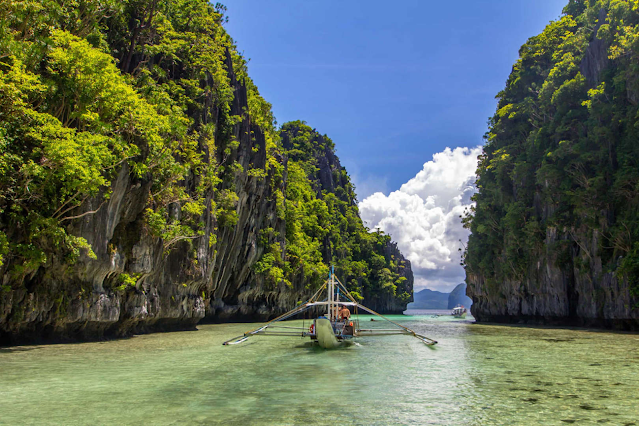
El Nido sits on the northern tip of Palawan Island and is widely regarded as one of the most visually striking destinations in all of Southeast Asia. The 45 islands and islets in the surrounding area feature towering limestone karst formations that rise directly from turquoise water, enclosing lagoons, hidden beaches, and snorkeling sites within their formations. This variety means island-hopping tours are organized by area, not a single fixed circuit, giving travelers a way to systematically cover different sections of the archipelago over several days.

The specific experiences available reflect how much the terrain does the creative work. You can reach the Big and Small Lagoons by kayak through narrow karst passages that open into still, luminous water surrounded by cliff faces. Hidden Beach requires swimming through an underwater crevice to reach a sheltered cove that the surrounding rock keeps invisible from the water. Seven Commandos Beach is the most accessible and most social, a palm-lined stretch where the atmosphere is relaxed, and the crowd is a mix of visitors from every part of the world. You can book all of these, and dozens of alternatives, online or arrange them on arrival.
Big and Small Lagoons
El Nido also has a strong practical case. The weather is generally fair across most of the year. Boutique accommodations, vibrant nightlife, and a dining scene with genuine variety in cuisine and atmosphere make it comfortable regardless of travel style. Direct flights connect El Nido to Manila, and van services run the 238-kilometer road from Puerto Princesa for travelers who want the overland option. The road is fully paved and consistently described as an enjoyable ride. Motorcycles are available for rent in Puerto Princesa for travelers who want to make the journey part of the adventure. For those prioritizing speed, direct flights from Manila to El Nido take roughly one hour and avoid the road, its distance, and its travel time entirely.

3. Coron pairs WWII shipwreck diving with hot springs
Guillermo Bresciano / Unsplash
Coron, accessible by air from Manila and by fast boat from El Nido, offers a diving experience that makes it one of the world's most significant wreck-diving destinations. The waters around Coron contain more than a dozen Japanese warships sunk by U.S. naval aircraft in September 1944, and the visibility conditions in the surrounding Calamian Islands allow divers to explore those wrecks with exceptional clarity. Several wrecks are shallow enough that snorkelers can see them from the surface, making the attraction accessible to visitors who do not dive.

Diving and snorkeling don't exhaust what Coron offers. Kayangan Lake, reached by a short climb above the shoreline, holds cool, clear water that has a different quality from the surrounding sea, and swimming through it is one of the more unusual freshwater experiences available in the Philippines. The Maquinit Hot Springs provide thermal bathing in water that stays at around 39 degrees Celsius, making it one of the few naturally occurring saltwater hot springs in the country. Mt. Tapyas requires climbing 721 steps but delivers a panoramic view over Coron Bay that justifies the effort.
Kayangan Lake
Travelers who want to move beyond the main Coron circuit can take a 45-minute boat to the island of Culion, once the world’s largest leprosarium, which now offers secluded beaches and exceptionally preserved snorkeling sites with far fewer visitors than Coron’s main attractions. Kawil Tours organizes overnight beach camps and multi-day expedition tours across Culion, Coron, and the surrounding Busuanga area for visitors who want more structured arrangements. Coron is accessible by air from Manila on daily flights and by fast boat from El Nido on a journey that takes several hours and passes some of the most dramatic karst island scenery in the Philippines. Most visitors spend three to five days in Coron before deciding whether to continue to another part of Palawan or return to Manila.

4. The Cordillera Region rewards hikers with rice terraces
Ramon FVelasquez / Wikimedia Commons (CC BY-SA 3.0)
The Cordillera Region in northern Luzon offers a completely different experience from anything the Philippine coast provides. Majestic mountain views, terraced rice paddies that cascade down hillsides in formations maintained for about 2,000 years, and pine-shrouded forests at altitude create a landscape that feels a world apart from the beach-focused tourism that dominates most Philippine itineraries. Zigzagging roads through the Cordillera Central Mountain Range pass remote trails and indigenous villages that require real effort to reach, keeping crowds proportionally smaller.

Sagada, the region's most visited town, offers a practical base for a range of activities. The hanging coffins, a traditional burial practice of the indigenous Kankanaey people that places coffins on cliff faces overlooking gorges, are among the country's most distinctive cultural sites. Sunrise treks, the Blue Soil Hills with their unusual geological coloring, and the four-hour cave-connection crawl between the Lumiang and Sumaging cave systems show the range available from a single base without moving accommodations.
Sagada Hanging Coffins
A three-hour drive from Sagada leads to Banaue, where the UNESCO-listed Batad rice terraces are organized in an amphitheater formation that photographs cannot fully capture. Staying in rural villages near Batad and arranging hiking trips through the terraces at ground level provides a scale of experience that viewing platforms alone cannot deliver. Beyond Batad, Mt. Pulag at 2,928 meters is Luzon's highest peak and offers a sunrise view over a sea of clouds that ranks among the Philippines' most dramatic natural spectacles. Overnight buses from Manila connect directly to both Sagada and Banaue on Coda Lines, letting travelers save time by sleeping through the journey and arriving in the mountains in the morning with a full day ahead. The bus journey takes eight to nine hours depending on the destination, and booking ahead is recommended during peak travel periods.

Banaue Rice Terraces
5. Batanes provides cyclists with cliff-hugging scenic roads

Rexy Quieta / Unsplash
Batanes is the Philippines’ smallest province by area and one of its most distinctive by character. The group of islands at the country’s northern tip, closer to Taiwan than to Manila, has a landscape that looks more like coastal Ireland or the Azores than anything typically associated with Southeast Asia: rock-hewn cliffs, rolling green hills, stone-walled farmhouses, and winding roads that hug the coastline above the Pacific Ocean. Compact terrain, virtually no traffic, and preserved indigenous Ivatan culture together make Batanes genuinely unusual in the Philippine context.

Ivatan's stone houses
Batan Island, the most accessible of the group, is compact enough to explore by bicycle in a day, and the terrain rewards cyclists with a succession of viewpoints that alternate between crashing Pacific surf and calm farmland. Basco Lighthouse on Naidi Hills provides a wide perspective over the island’s northern coast, and Valugan Boulder Beach, formed from rocks deposited by the ocean over millennia, is a geological spectacle as striking as anything a coral reef can offer. The lack of major commercial development means the scenery that photographers discovered decades ago remains largely unchanged.

Valugan Boulder Beach
Batanes also has practical considerations worth noting. The dry season from December through May is the recommended travel window, as the typhoon season from June through November brings unpredictable weather and possible flight cancellations that can strand travelers on the island for days. Mountain bikes are necessary for tackling the hilly roads effectively. Bisumi Tours specializes in eco-adventures in Batanes and can arrange bikes and guided itineraries. The limited flight schedule means building in extra days on either side of the visit is sensible planning. Flights to Batanes operate from Manila and Tuguegarao, with the frequency varying by season. Weather disruptions are common enough that a buffer of at least one extra day on either end protects the itinerary from the cascading delays that a single canceled flight can produce. Batanes rewards the extra planning it requires.

6. Boracay serves sunseekers powdery sand and sailing tours
Ramon Kagie / Unsplash
Boracay is the Philippines’ most internationally recognized beach destination, and its reputation rests on a specific quality: the powdery white sand of White Beach, with a texture and brightness most beach destinations can only approximate. The beach runs for about four kilometers along the island’s western coast and is backed by a continuous strip of accommodation, restaurants, bars, and activity operators, making it one of the most fully developed beach resort environments in Asia. For travelers whose priorities are clear, Boracay resolves the decision quickly.

White sand beach
The activities available extend well beyond lying on the sand. Paraw sailing, the traditional double-outrigger sailboat used by local fishermen, offers tours that get visitors on the water in a craft specific to the region. Crystal kayaks, with transparent hulls that let paddlers see the seabed beneath them, operate near the shore for a different kind of water experience. The dining options along the beachfront cover a range of cuisines and price points that can sustain a week-long stay without repetition.

Paraw Sailing at sunset
The island’s interior, which most visitors treat as background, rewards exploration. Bike rental from Is’la Siklista in Station 3 gives access to mangrove forests, secluded beaches not visible from White Beach, and inland tracks that show how the island functions beyond its tourist infrastructure. Boracay underwent a rehabilitation closure in 2018 to address environmental degradation, and the stricter regulations that followed have improved the environmental condition of the beach area. The island now has lower crowd volumes than at its previous peak, and the restored beachfront has produced a version of Boracay that delivers its core promise more consistently. Water sports, beach dining, and nightlife are the island’s primary draws, and travelers who approach it with those expectations intact will find Boracay meets them reliably. Those looking for a quiet, undeveloped Philippine beach experience should look at Port Barton in Palawan or Batanes instead.

7. Cebu blends canyoneering, sardines, and Cebuano lechon
Ken Suarez / Unsplash
Cebu functions as the hub of the Visayas and offers more variety within a single destination than most Philippine provinces. The island’s second city provides urban energy and a sophisticated food scene, while the surrounding terrain within a few hours’ drive covers experiences that would each justify a separate trip. Kawasan Falls, reached by canyoneering through a series of river gorges, delivers swimming holes with impossibly turquoise water in a jungle setting. Moalboal, on the island’s southwestern coast, has a sardine shoal of millions of fish that moves in synchronized formations through the water alongside the reef, creating a snorkeling encounter of unusual scale.

Sardine run at Moalboal
Cebu's food culture has a distinct identity that sets it apart from the rest of the Philippines. Cebuano lechon, the roasted whole pig that is the country’s most celebrated dish, is considered by many to be definitively better in Cebu than anywhere else, with crackling skin and seasoning that the Cebuano version maintains with particular consistency. Sutukil, the dining format that serves fish prepared three ways on a single plate, is a specific Cebu tradition that visitors can access at any of the city’s seafood restaurants or market kitchens.

Cebu Lechon
A ferry ride of one to two hours connects Cebu to Bohol, which functions as a natural extension for visitors who have seen Cebu’s main highlights. Bohol’s Chocolate Hills, the geological formations of more than a thousand uniform mounds, are one of the country’s most recognizable landscapes, and the Philippine Tarsier Sanctuary provides close access to one of the world’s smallest primates in a responsible wildlife environment. Luxury beach resorts along Bohol’s coast contrast with Cebu’s activity-focused tourism, and the island is particularly well-suited for families with children who want a mix of wildlife, geology, and beach in a single short trip. The ferry from Cebu’s port to Tagbilaran, Bohol’s main town, takes between two and three hours and departs on a regular schedule throughout the day.

8. Iloilo earned UNESCO recognition for its food culture
Wabi Jayme / Unsplash
Iloilo, on the island of Panay in the western Visayas, received UNESCO Creative City of Gastronomy designation and has a food culture that justifies the title, not merely holds it. The city’s signature dishes have specific identities that set them apart from the generic Filipino cooking found elsewhere. La Paz batchoy is a noodle soup made with pork organs, liver, and crushed chicharron in a rich broth, associated with the La Paz public market since the 1930s. Pancit molo is a wonton soup that reflects the Ilonggo approach to Chinese culinary influence. Inasal, the grilled chicken dish marinated in cane vinegar and local spices, originated in the nearby city of Bacolod but has been adopted and refined throughout the region.

La Paz Batchoy
Breakthrough Restaurant, an open-air dining spot beside the sea, exemplifies the Iloilo approach to seafood: fresh catch cooked to the diner’s specification, with grilling, stewing, and other preparations available, in an environment where the water that provides the ingredients is visible from the table. Market stalls in and around La Paz offer the same dishes in a more atmospheric, lower-cost format for travelers who prefer to eat where locals eat.

Breakthrough Restaurant
A 30-minute boat ride from Iloilo’s wharf takes you to Guimaras, a small island province best known for producing some of the sweetest mangoes in the Philippines. The reputation is strong enough that Guimaras mangoes are marketed separately from other Philippine varieties, and the island’s cooks have integrated them into a range of dishes from chicken adobo to pizza. Guimaras is a half-day addition to an Iloilo visit, offering a natural break from the city’s food markets. The island is small enough that a few hours covers the main mango farms and coastal areas without requiring an overnight stay. For travelers spending multiple days in Iloilo, the food trail extends to the city’s historic colonial architecture and the Jaro district’s preserved Spanish-era churches, adding a cultural dimension beyond cuisine.

Guimaras mango

9. Samar hides cathedral-sized caves and jungle waterfalls
Credit: Philippines Department of Tourism
Samar, in the eastern Visayas, is one of the Philippines’ least-visited major islands, a significant advantage for travelers interested in dramatic natural formations without large crowds. The island’s interior holds cave systems of extraordinary scale, with Calbiga Cave in western Samar described as the country’s largest, entered through an opening wide enough to feel like a canyon rather than a cave mouth. The experience of moving deeper into a system that large requires a guide, appropriate equipment, and physical stamina, all of which the operators based in Catbalogan City can arrange.

Calbiga cave
The most accessible entry point into Samar’s underground world is Sohoton Cave, with a cathedral-scale dome, a natural skylight, and a stone bridge visitors can cross. The Torpedo Extreme Boat Ride on the Ulot River, despite its name, delivers a manageable adrenaline experience on fast water through jungle terrain. Together, the two offer a lighter version of Samar’s wilderness, suitable for travelers who want the atmosphere without the commitment of a full expedition.

Torpido Extreme Boat Ride, Ulot River
Pinipisakan Falls rewards the most effort. Reaching the cascade requires hours of trekking and travel through jungle territory, and the falls themselves guard a natural cave system that extends the experience beyond the waterfall itself. Joni Bonifacio of Trexplore, based in Catbalogan City, runs guided spelunking and trekking tours throughout the island and handles the permits and equipment that self-organized visits would require travelers to arrange independently. Trexplore handles the permits and equipment that self-organized visits would require travelers to arrange independently, and Bonifacio’s local knowledge of the island’s cave systems goes well beyond what any guidebook can provide. Samar rewards travelers who are prepared for genuinely remote conditions and who understand that the effort required to reach its most spectacular sites is precisely what keeps those sites from being crowded. The island’s status as one of the Philippines’ least-visited major destinations is not a warning. It is part of the appeal.

Pinipisakan Falls

Jarno Colijn / Unsplash
Siargao has built its identity around Cloud 9, the barreling reef break roughly three kilometers offshore and a fixture on the international surf circuit since the 1990s. The wave breaks over a shallow coral reef in a consistent tube formation that produces some of the most technically demanding surfing in Southeast Asia, and it attracts riders who have specifically organized their travel to reach it. That concentration of surf culture shaped everything else about Siargao: the accommodations, the cafes, the social atmosphere, and the sense that the island rewards a longer stay.

Cloud 9
General Luna is the hub of activity, where most visitors base themselves. Beginners can take surf lessons at any local school without needing Cloud 9 at all. The island’s other breaks are more forgiving and produce a sustainable learning environment. Kermit and Shaka are cafes travelers consistently return to, and spots like the Catangnan Bridge serve as informal social gathering points where the island’s community of surfers, digital nomads, and long-term travelers cross paths. Accommodation runs from budget hostels to the high-end Nay Palad Hideaway, covering the full range of travel styles.

Catangnan Bridge
Beyond surfing, boat tours operate to nearby islets, tidal pools, and Sugba Lagoon, a stretch of aquamarine water accessible only by sea and surrounded by mangroves. Once the boat drops visitors off, they can reach the lagoon by paddleboard or kayak, and the surrounding silence and water color reward a full morning. Got Marked Tours offers island-hopping packages that cover the main sites efficiently for visitors with limited time. Siargao’s consistent quality across its surf, social scene, and natural surroundings explains why many travelers who arrive planning to stay a few days end up extending their visit well beyond the original itinerary. The island’s infrastructure has grown significantly over the past decade without losing the relaxed character that made it attractive in the first place.

Sugba Lagoon