Showing posts with label Pangasinan. Show all posts

Monday, 28 September 2026

Uranium-bearing minerals found in Camarines Norte

Potential source of uranium found in Camarines Norte

Andrea Gregorio 
Inquirer.net
28 September 2026

MANILA, Philippines — Filipino scientists have identified a potential uranium resource in Camarines Norte which they hope can help fuel the country’s ambitions for nuclear energy, the Philippine Nuclear Research Institute (PNRI) said on Friday.


Researchers from the University of the Philippines-Diliman, the Department of Science and Technology (DOST)–PNRI, and Japan’s Akita University reported that uranium-bearing minerals were found on surface deposits at the Bessemer mine pit in the Larap-Paracale district of Jose Panganiban town.

The area is a “historic center” that has been explored for uranium for decades, the PNRI said in a statement. Among other findings, the work confirmed that uraninite is the main uranium-bearing mineral on the material examined in the study.

The researchers said they developed a laboratory process to concentrate the material for further testing.

This material “can be processed into a product with higher uranium content,” the PNRI said.

Depth not yet established

“This finding is an important step toward further research on producing uranium concentrate, commonly known as ‘yellowcake,’ an intermediate material used in the nuclear fuel cycle,” the agency also said.

But the amount of uranium underground has yet to be determined.

"Because the present work examined only surface manifestations, it does not establish the depth of the deposit, how thick it is, or how deep and widespread the uranium-bearing zones are,” the PNRI said.

Potential nuclear sites

The research, however, may prove important as the Philippines advances plans to include nuclear power in its future energy mix, the agency said.

Under the Philippine Energy Plan, the country is targeting at least 1,200 megawatts of nuclear power capacity by 2032.

In August, President Marcos signed Executive Order No. 122, creating a national framework for developing the Philippine critical minerals industry, emphasizing investment, local mineral processing, value addition and downstream industries.

Earlier, the Department of Energy said the government identified potential nuclear sites across five provinces and was exploring financing options as it aims to add 1.4 gigawatts of nuclear capacity within 12 years.

Of the seven potential sites, two are located in Bataan, two in Palawan, and one each in Masbate, Pangasinan and Camarines Norte.

Clear opportunity

Researchers said determining whether Larap contains enough uranium to be considered potentially economically significant would require a much more extensive exploration program.

They said this would involve detailed geological, radiometric and geophysical surveys, followed by systematic drilling and analysis of drill cores.

These activities would enable geologists to develop a three-dimensional map of the mineralization and determine the extent of the deposits and their uranium content, they added.

“Only after such work can geologists confidently assess the area’s resource potential. This represents a clear opportunity for the next phase of the work,” the PNRI said, adding institutions and investors could help support the “full-scale exploration of what lies underground.”

Uranium, a heavy metal, is the primary fuel for nuclear reactors to produce electricity through nuclear fission. A pencil-eraser-sized uranium pellet can produce as much energy as one ton of coal, three barrels of oil, or about two tanker loads of natural gas, according to the PNRI.

Other valuable minerals

In Camarines Norte, the sampled mineralized zone measured about half a meter in width, from which researchers collected 180 kilograms of material for laboratory analysis.

Through microscopy, X-ray diffraction and advanced elemental analysis, the researchers confirmed the presence of uraninite grains alongside minerals containing copper and molybdenum, as well as iron-bearing magnetite.

The government is still finalizing the Philippines’ official Critical Minerals List, so the study does not assume that any of the resources examined will eventually be classified as critical minerals, the PNRI clarified.

Even so, it said the “broader significance” of the research was not that the Philippines is ready to produce its own nuclear fuel, but that Filipino scientists are now capable of developing methods to concentrate a potential uranium resource.

The PNRI said the next question for the Larap mine was now clear: “What lies beneath the surface, and is there enough of it to justify the next stage of exploration?”

The study was funded through the DOST’s Grants-in-Aid Program under the NuCycle Program–NuMER Project and jointly carried out by the UP Diliman Department of Mining, Metallurgical and Materials Engineering and the PNRI. /cb


Tuesday, 10 June 2025

Fil-Am elected mayor of San Antonio, Texas

Fil-Am daughter of Ilocana public school teacher wins US mayoral race

Story by Cristina Chi 
Philstar Global
10 June 2025

MANILA, Philippines — The daughter of an Ilocana immigrant made history over the weekend by becoming the first Filipino-American and woman of color elected mayor of San Antonio, Texas — the seventh-biggest city in the United States. 


Gina Ortiz Jones, 44, defeated her conservative rival, former Texas Secretary of State Rolando Pablos, with 54.3% of the vote in Saturday's runoff election, according to US media reports. This also makes Jones the first openly gay mayor and only the third woman to lead the Texas metropolis of 1.5 million residents.

Jones will take office on June 18 for a four-year term. 

Her mother, Victorina Ortiz, left behind an established career as a public school science teacher in Pangasinan to immigrate to the United States in the 70s, according to an interview with Jones by People Asia.   

A University of the Philippines Diliman graduate, Victorina initially worked household jobs after arriving in the US before eventually returning to education — spending over 40 years teaching special needs students at a public school district in San Antonio.

"My journey has been a uniquely American story. My mom came to this country from the Philippines and raised me and my sister by herself," Ortiz said in her campaign website.  

The decision to leave the Philippines required courage that Jones says she inherited. "That same courage is in my heart, that's in my blood, that's in my sister's heart," she told People Asia magazine in 2023.  

Jones said she was raised by her mother to be conscious of finding ways to give back to her community. "It’s why my sister and I both joined the military, and it’s why I’ve worked as a public servant," the San Antonio mayor-elect said.

Historic win amid partisan battle

Jones' victory is seen a breakthrough for Filipino-American political representation in the United States, where Asian-Americans remain underrepresented in major offices despite being the fastest-growing ethnoracial group in the US electorate.

Before running for mayor, she unsuccessfully sought a congressional seat twice under the Democratic party, losing close races in 2018 and 2020 in South Texas.

According to a report by the Texas Tribune, the mayoral race turned bitterly partisan, with Jones having to parry attacks from Pablos, whose campaign ran television advertisements questioning her military record and painting her as an outsider.

Jones responded by assembling a coalition of progressive organizations, veterans groups and labor unions. Her platform focused on expanding pre-kindergarten programs, increasing affordable housing, and improving internet access in poor neighborhoods. 

Pablos trailed by more than 12,000 votes, according to a report by the San Antonio Express.

From Air Force to City Hall

Jones served as an intelligence officer in Iraq under the US military's "Don't Ask, Don't Tell" policy, which prohibited openly gay service members. She left the Air Force early to care for her mother, who had been diagnosed with cancer while Jones was deployed.

She later worked for federal agencies, including the Defense Intelligence Agency, before serving as undersecretary of the Air Force under US President Joe Biden — the first openly gay woman of color in that position.

Thursday, 30 May 2024

30 reasons to visit the Philippines

30 reasons to visit the Philippines

Stars Insider (Portugal)
30 May 2024

With over 7,000 tropical islands to choose from, the Philippines affords travelers some of the best beach holiday options in the world. But this archipelagic nation in Southeast Asia is also renowned for an amazingly varied interior landscape of smoldering volcanic mountains, dense verdant forests, emerald rice fields, and hundreds of pristine lakes and lagoons. Coupling a 500-year-old cultural heritage with a globally significant level of biodiversity, the country is indeed one of the most enticing tourism destinations on the planet.   

1. Palawan Island (Palawan)


The largest island of the province of Palawan has often been cited by travel pundits as the most beautiful island in the world for its abundant wildlife, jungle-clad mountains, and remote powder-white beaches. The entire length of the island forms a mountain range, its forests and grasslands home to many endemic species of birds and animals.

2. Apo Island (Negros Oriental)


The marine habitat around the island of Apo, in Negros Oriental province, is a popular dive site and snorkeling destination. The island is home to over 650 documented species of fish and other marine creatures, including the protected sea turtle.

3. Siargao Island (Surigao del Norte)


Siargao Island is moored among numerous other islands and islets and lies within the province of Surigao del Norte. Siargao is renowned for its watersports options, perhaps most famously Cloud 9, one of the top surfing spots in the Philippines.

4. Philippine Tarsier and Wildlife Sanctuary (Bohol)


Located on the island of Bohol, the Philippine Tarsier and Wildlife Sanctuary is effectively a forested area dedicated to the protection of the tarsier, a ridiculously cute and small nocturnal primate with big, round eyes. These tiny creatures (one of the world's smallest primates), are shy, delicate, and emotionally sensitive. Visitors to the sanctuary are therefore asked to lower their voices and move slowly and carefully.

5. Banaue (Ifugao)


Resembling ripples of emerald-colored velvet, the rice terraces of the Philippine Cordilleras include the Batad rice terraces (pictured) and the Bangaan rice terraces, both found in Banaue in the province of Ifugao. These terraces are believed to have been hand-carved into the mountains 2,000 years ago to plant rice, and are the main tourist sites in the region.

6. Mambajao (Camiguin)


Aim to be in Mambajao in Camiguin province through October for the riotously colorful Lanzones Festival, a four-day celebration in honor of the lanzones tree and its fruit.

7. Coron Island (Palawan)


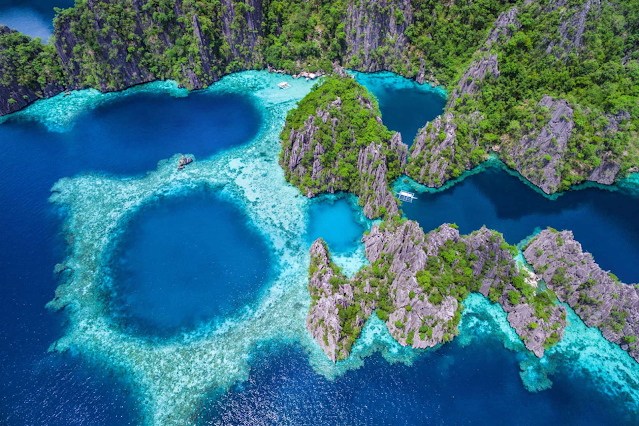
Coron Island lies within the Calamian Islands group in northern Palawan. Its clear azure waters provide underwater visibility extending up to 24 m (80 ft), which attracts divers from all over the world keen to explore the Second World War wrecks the destination is famous for. Ecotourism thrives on Coron, its lakes and lagoons among some of the cleanest in Southeast Asia.

8. Vigan (Ilocos Sur)


The delightful city of Vigan, the capital of the province of Ilocos Sur, should be explored at leisure. Fusing colonial Spanish architecture with that of native Philippine and Oriental building designs and construction, the destination's streets, plazas, and heritage buildings are a pleasure to discover.

9. Asik-Asik Falls (Cotabato)


Incredibly, this wondrous waterfall was only discovered in 2010. Asik-Asik means "sprinkle sprinkle" in the local Hiligaynon language, though after heavy rain the waters can turn into a cascade. The previously hidden waterfall is located near the village of Sitio Dulao, in the mountainous Alamada region of Cotabato province.

10. Oslob (Cebu)


Oslob on Cebu Island is renowned for its whale sharks. A good spot for sightings is Sogod Bay, and the best time of the year is from November through May, when these gentle giants migrate through the area. While observing whale sharks from boats on the water's surface is perfectly acceptable (pictured), resist the temptation to swim with them. The whale shark is a protected species and it is illegal to harass them.

11. MassKara Festival (Negros Occidental)


One of the most eagerly anticipated of all Philippine festivals is the colorful and exotic MassKara Festival. Held annually in Bacolod on the fourth Sunday of October, the event is influenced by the Carnival of Venice and the Rio Carnival.

12. Mayon Volcano (Albay)


The near-perfect cone of the Mayon Volcano, the most active volcano in the Philippines, is a cherished landmark. It looms large, 2,463 m (8,081 ft), over the island of Luzon.

13. Manila


Chances are you'll enter the Philippines via Manila, the country's busy and densely populated capital city. Founded by Spanish conquistadors in 1571, Manila today packs a historic and cultural punch. Spend a few days exploring its many neighborhoods including Binondo and Makati (pictured), Manila's modern shopping hub.

14. Taal Lake (Batangas)


Taal Lake surrounds the exposed cone of Taal Volcano, itself filled to the brim with what looks like green tea. The freshwater crater lake is found in the province of Batangas, on the island of Luzon. Regular tours of the lake are available to tourists. After crossing the lake, visitors travel to the top of the volcano island on horseback for incredible views like this one.

15. El Nido (Palawan)


El Nido region, in the northernmost tip of mainland Palawan, boasts one of the most diverse ecosystems in the Philippines, and is protected for its unique flora and fauna, and pristine geologic formations. This includes over 50 spotless white sand beaches and a network of shallow lagoons (pictured).

16. Hundred Islands National Park (Pangasinan)


In fact totaling 124 islands, this outstanding national park is located in Pangasinan province, in the northern Philippines. This is the place for island-hopping, so why not jump in a bangka (native watercraft) and explore the reefs and golden beaches at leisure? Remember to pack snorkeling gear!

17. Corregidor Island (Bataan)


Corregidor is one of the most important historic sites in the Philippines. During the Second World War, it was the location of two costly sieges and pitched battles—the first during the first months of 1942, and the second in January 1945—between the Imperial Japanese Army and the US Army. The ruined army barracks and military installations defended by the Americans serve as part of the Pacific War Memorial complex.

18. Tubbataha Natural Park (Palawan)


The uninhabited Tubbataha islands and reefs in the middle of the Sula Sea rank among some of the best diving sites in the world. The park is a unique example of an atoll reef with a very high density of marine species. As a center of marine biodiversity, Tubbataha contains 75% of the described coral species and 40% of the world's reef fish.

19. Magellan's Cross (Cebu)


A cross of tindalo wood said to encase the original cross planted by Portuguese explorer Ferdinand Magellan on April 21, 1521 is housed in a chapel next to the Basilica Menor del Santo Niño in Cebu City. On April 27, six days after planting the cross, Magellan was killed at the Battle of Mactan.

20. Batanes


This archipelagic province in the country's northernmost Cagayan Valley region is appreciated for its verdant pastoral landscape, a hilly and mountainous environment that some travelers say remind them of New Zealand. The province's three largest islands, Batan, Itbayat, and Sabtang, are the only inhabited islands. Incidentally, the Japanese incursion of the Philippines during the Second World War began with the invasion of Batan Island, on December 8, 1941. Pictured is the Basco lighthouse. Its viewing deck is the perfect place to take in the whole of Batan Island.

21. Fort San Pedro (Cebu)


Built by the Spanish and dating back to 1738, this is the oldest triangular bastion fort in the Philippines. It's located in Cebu City, on Cebu Island, where the first Spanish settlement was established. Its sturdy weathered walls house an engaging museum that preserves all sorts of documents and artifacts relating to Spanish colonial rule.

22. Philippine eagle


Endemic to the country's forests, the Philippine eagle is the country's national bird. This majestic raptor, one of the rarest and most powerful birds in the world, is critically endangered, so spying one circling above the canopy will be a real privilege.

23. Puerto Princesa Subterranean River National Park (Palawan)


The Puerto Princesa Subterranean River National Park was voted as a New7Wonders of Nature in 2012 for its unbeatable biodiversity and the fact that the river flows directly into the sea, with its brackish lower half subjected to tidal influence, distinguishing it as a significant natural global phenomenon. The park is found on the western coast of the island of Palawan and can be visited by sightseeing watercraft.

24. Bohol Island (Bohol)


Mention Bohol and chocolate springs to mind—the Chocolate Hills, numerous mounds of brown-colored limestone formations that have put this part of the Philippines on the tourism map. In fact, the entire landscape is a national Geological Monument.

25. Manila Ocean Park


Manila's amazing oceanarium teems with over 14,000 marine creatures representing 277 species, all indigenous to the Philippines and Southeast Asia. The main attraction is the subterranean walkway tunnel (pictured), which provides a spectacular underwater view of sharks, stingrays, and other denizens of the deep.

26. Filipino cuisine


One of the great delights of visiting the Philippines is indulging in its delicious and varied cuisine. Dishes range from the very simple to the more complex. Pictured is pork adobo (or adobong baboy)—braised pork belly, with bay leaves, soy sauce, vinegar, and spices—known for its simplicity and ease of preparation.

27. Street food


If eating on the go, Filipino street food will surprise and sustain you. Try shakoy, also known as pilipit—deep fried twisted donuts, a favorite dessert snack.

28. La Trinidad (Benguet)


Make a diversion to La Trinidad, the capital of Benguet province and celebrated for the first and largest community artwork project in the Philippines, "Colors of StoBoSa." Dozens of hillside residences have been decorated in rainbow hues to produce a stunning multicolored canvas, which was retouched in 2018. The painting has a projected life expectancy of five years, so visit sooner rather than later.

29. Sagada (Mountain Province)


One of the country's more bizarre tourist attractions can be found in Sagada, a destination tucked away in the aptly named Mountain Province. The people of Sagada follow a unique burial ritual whereby coffins containing the town's dearly departed are hung either inside the caves or on the face of the cliffs rather than placed into the ground. If you visit, whatever you do don't touch the coffins. Instead, observe the scene from a distance using binoculars.

30. Quiapo (Manila)


Pause at the Minor Basilica of the Black Nazarene in the Quiapo district of Manila and admire the revered Black Nazarene, a life-sized image of a dark-skinned, kneeling Jesus Christ carrying the cross carved from a dark wood in the 16th century in Mexico.

📷 : All Photos from Shutterstock except Black Nazarene (Getty Images)