Showing posts with label University of the Philippines. Show all posts

Monday, 5 October 2026

UP Manila enters Global Top 500 ranking

UP Manila enters Global Top 500 – U.S. News & World Report

Andrea Gregorio
Inquirer.net
05 October 2026

MANILA, Philippines —The University of the Philippines (UP) Manila emerged as the Philippines’ lone representative in the global Top 500 of the U.S. News & World Report’s 2026-2027 Best Global Universities rankings.


The country’s premier health sciences university rose 32 places from its previous ranking of No. 479 to No. 447 among 2,250 universities evaluated by U.S. News & World Report.

UP Manila said Monday that it “joined other universities that entered the roster of the best universities in the world, including Stanford University, Massachusetts Institute of Technology, Princeton University, and Harvard University, among others.”

UP Manila ranked first in normalized citation impact and in the percentage of highly cited papers among the top 1 percent most-cited publications.

It also placed No. 112 among the best universities in Asia and No. 972 in global research reputation.

Despite posting a lower global score of 50.8 in the latest rankings compared with its 52.5 score in the 2024-2025 rankings, UP Manila improved its overall position.

The rankings assess universities based on 13 indicators covering academic research performance, as well as global and regional reputation.

These include publication output, citations, books, international collaborations, conferences, and research reputation.

U.S. News & World Report said the indicators were selected to allow comparisons of higher education institutions across countries.

The media company noted that while the rankings primarily measure academic research and reputation, universities included in the list are likely to have highly respected faculty members.

The methodology for the five regional rankings—covering Africa, Asia, Australia and New Zealand, Europe, and Latin America—was also based on each institution’s standing in the overall Best Global Universities rankings, according to U.S. News & World Report. /mcm

Wednesday, 30 September 2026

Six Philippine universities were included in the Times Higher Education (THE) World University Rankings 2027

Ateneo leads 6 Philippine universities in Times Higher Education 2027 global rankings

Ellalyn De Vera-Ruiz
Manila Bulletin
Sep 30, 2026

Six Philippine universities were included in the Times Higher Education (THE) World University Rankings 2027, led by the Ateneo de Manila University, which retained the country’s top spot for the fifth consecutive year.


The London-based THE released the 2027 rankings on Wednesday, Sept. 30, placing Ateneo in the 1,001-1,200 band globally, followed by the University of the Philippines in the 1,201-1,400 band and the University of Santo Tomas in the 1,601-1,800 band.

De La Salle University and Mapua University were both placed in the 1,801-2,000 band, while Mindanao State University-Iligan Institute of Technology landed in the 2,001+ category.

The six Philippine institutions were among 2,297 universities from 118 countries and territories included in this year’s rankings.

“The THE World University Rankings measure what matters most to sector leaders, strategists and policymakers: research excellence and impact; the teaching environment; global academic standing; links with industry beyond the ivory towers; and international talent attraction, reach and influence,” THE Chief Global Affairs Officer Phil Baty said.

The five criteria used by THE are Teaching, Research Environment, Research Quality, International Outlook, and Industry, which are further divided into 18 performance indicators.

Globally, the University of Oxford retained the top position in the 2027 rankings.

The THE World University Rankings have been published since 2004 and assess research-intensive universities using institutional data, research publications and academic reputation survey responses.

Wednesday, 8 April 2026

Two Philippine schools have placed for the first time in the global top 100 of QS' world university rankings by subject

PH breaks into QS global top 100 by subject, but still far behind SEA neighbors

Cristina Chi
Philstar Global
08 April 2026

MANILA, Philippines — Two Philippine schools have placed for the first time in the global top 100 of QS' world university rankings by subject, according to its latest edition, but the country still trails its Southeast Asian neighbors with higher-ranked academic programs.


Ateneo de Manila University entered the 51–100 band in Theology, Divinity & Religious Studies, climbing from 101–150 last year. The University of the Philippines debuted in the same band for Library & Information Management, a subject in which it had not previously been ranked. Neither university had placed in the top 100 in any discipline before.

The Commission on Higher Education called the two schools' placements a "historic breakthrough for the country."

Hospitality & Leisure Management also emerged as the Philippines' strongest subject, based on QS' rankings, with three schools — Adamson University, Lyceum of the Philippines University and UP — all placing in the global top 200.

The rankings, released late March by London-based higher education analysts Quacquarelli Symonds (QS), evaluate how specific academic programs — not universities — stack up globally. Unlike QS' overall university rankings, which rate institutions as a whole, the subject edition zeroes in on specific disciplines, from archaeology to veterinary science, across 55 fields.

Programs are scored on five indicators, weighted differently by discipline: how academics and employers worldwide rate the institution in that field, and how its research performs in terms of citation impact, productivity, and international collaboration. 

Research data is drawn from Elsevier's Scopus database; reputation scores come from global surveys of over 150,000 academics and 100,000 employers.

Rankings like QS have faced growing scrutiny, particularly from academics in developing countries who say the metrics favor well-funded Western institutions. Fidel Nemenzo, former UP Diliman chancellor, wrote in a BusinessWorld piece this month that the system rewards what is easily counted — citations, publication volume — while ignoring teaching quality and public service. 

QS' latest rankings by subject show a considerable gap between the Philippines and its regional peers. Malaysia fielded 356 ranked entries from 28 institutions, with 44 programs in the global top 100, 14 in the top 50, and one in the top 10. 

Indonesia had 189 entries from 26 universities and 15 were in the top 100. Thailand had 170 entries from 16 institutions and 18 top-100 programs. The Philippines had 47 programs from six schools — and two in the top 100.

Of the Philippines' 47 ranked programs, 14 climbed in rank, five dropped, 19 stayed stable and nine were new. Seven entries hit record-high ranks: UP in Library & Information Management, History (201–250), Arts & Humanities (257), and Life Sciences & Medicine (316); Ateneo in Theology; Adamson in Hospitality & Leisure Management (101–150); and De La Salle University in Philosophy (151–200).

Hospitality as the Philippines' best program

The Philippines' highest showing in any single discipline came in Hospitality & Leisure Management, where three schools placed in the global top 200, more than in any other subject.

Adamson University debuted at 101–150, the highest Philippine rank in the field. Lyceum of the Philippines University ranked 151–175, and UP debuted in the same band. Both Adamson and Lyceum were entirely new to the QS subject rankings this year.

No other program offering performed at this level. The next most represented programs — Business & Management Studies, Economics & Econometrics, English Language & Literature, and Politics & International Studies — each had three schools ranked, but none placed higher than the 151–200 band.

The University of the Philippines accounted for 22 of the country's 39 narrow subject entries — more than half — and all four broad faculty area entries. 

Thursday, 26 March 2026

Philippine universities held steady positions in the 2026 QS World University Rankings

UP, Ateneo, La Salle hold ground in 2026 QS rankings

SHERYLIN UNTALAN,
GMA Integrated News 
26 March 2026

Philippine universities held steady positions in the 2026 QS World University Rankings by Subject, with leading institutions maintaining their global brackets in English and improving placements in broader fields such as Arts and Humanities. 


The latest rankings, released by Quacquarelli Symonds (QS), assessed more than 21,000 academic programs from around 1,900 institutions across 100 countries, covering 55 disciplines grouped into five major subject areas.

English Language and Literature

In English Language and Literature, three Philippine universities retained their 2025 global brackets:

University of the Philippines (UP) remained in the 151–200 bracket, with an academic reputation score of 63 and a global rank of 153.

Ateneo de Manila University stayed within the 201–250 bracket, posting an academic score of 58.3 and rank 226.

De La Salle University (DLSU) also held its position in the 201–250 bracket, with an academic score of 59 and rank 211.

These results supposedly indicate relative stability among the country’s top universities in humanities-driven disciplines, even as global competition intensifies.

Arts and Humanities

In the broader Arts and Humanities category, Philippine universities showed notable improvements:

UP climbed to rank 257, up from 331 in 2025, with an academic reputation score of 70.2.

Ateneo improved to rank 333, from 345 previously.

DLSU advanced to rank 365, rising from the 401–450 bracket last year.

The upward movement reflects strengthening recognition of Philippine institutions in interdisciplinary humanities research and teaching.

Global trends: Asia-Pacific on the rise

QS noted that the 2026 subject rankings reflect shifting dynamics in global higher education.

Northern America remains the most represented region overall, but Asia-Pacific systems are gaining ground.

Southern Asia (40%) and Southeast Asia (38%) recorded some of the highest proportions of institutions moving up in the rankings.

Emerging fields are also reshaping the landscape. Computer Science and Information Systems and Medicine remain the most widely ranked subjects, while Data Science and Artificial Intelligence saw the highest number of new entries.

Meanwhile, more established regions, including Eastern Europe and Eastern Asia, posted higher shares of institutions moving down the rankings, signaling increased global competition.

Despite limited movement in English studies, the improved standings of Philippine universities in Arts and Humanities highlight gradual progress in global academic reputation.

The 2026 results underscore a broader trend: while traditional education hubs remain dominant, universities in developing regions—including Southeast Asia—are steadily gaining visibility in international rankings.—MCG, GMA Integrated News

Thursday, 17 July 2025

Mindoro as biodiversity hotspot

Scientists discover more of Mindoro’s ancient technology, biodiversity

Raymond Gregory Tribdino
Manila Times
17 July 2025

Scientists from the Ateneo de Manila University (ADMU), collaborating with international experts and institutions, have uncovered compelling evidence of Mindoro’s significant role in ancient maritime activities in Southeast Asia. At almost the same time, biologists from the University of the Philippines-Diliman (UPD) revealed a new species of mice endemic to the biodiverse island.

A map of Island Southeast Asia (ISEA) and the Sunda region as it appeared roughly 25,000 years ago at the height of the last Ice Age, with locations of archaeological sites surveyed by the Mindoro Archaeology Project. (Base Map: www.gebco.net, 2014)

The ADMU findings detail effective human migration, advanced technological innovation, and long-distance intercultural relations dating back more than 35,000 years. The compilation of a 15-year study detailed in the Ateneo researchers' latest publication from the Mindoro Archaeology Project offers some of the oldest evidence of Homo sapiens (anatomically modern humans) in the country. These discoveries were made in Ilin Island, San Jose, and Sta. Teresa, Magsaysay all in Occidental Mindoro.

Mindoro, unlike most other main Philippine islands except Palawan, was never connected to mainland Southeast Asia by land bridges or ice sheets. Sea crossings were always necessary to reach it, which likely spurred the development of sophisticated technologies for traversing and surviving this environment.

Mindoro’s unique geological history and isolation are also reflected in its extraordinary biodiversity. The island is home to a bounty of endemic mammalian wildlife found nowhere else on Earth, including the famous tamaraw, the Mindoro warty pig and the humble Mindoro shrew.

Recently, three more species were added to this list with the discovery of Philippine forest mice, all belonging to the Apomys genus. From 2013 to 2017, teams of field biologists led by Filipino scientist Dr. Danilo Balete surveyed relatively understudied forests of Mindoro. During their expeditions, they noticed three distinctive forest mice that appeared noticeably different from the island's known endemic species, Apomys gracilirostris.

Evidence of Sophisticated Ancient Technology

The ADMU study called Chronology and Ecology of Early Islanders in the Philippines: The Mindoro Archaeology Project, published on June 1 this year, outlined a variety of finds—including human remains, animal bones, shells, and tools made from stone, bone, and shell — show that Mindoro's early inhabitants had successfully harnessed land and marine resources.

Over 30,000 years ago, the island’s inhabitants already possessed seafaring capabilities and specific fishing skills, enabling them to catch predatory open-sea fish species like bonito and shark, and establish connections with distant islands and populations in the vast maritime region of Wallacea.

“Particularly noteworthy is the innovative use of shells as raw material for tools, culminating in the manufacture of adzes from giant clam shells (Tridacna species) 7,000 to 9,000 years ago. These tools bear a striking similarity to shell adzes found across Island Southeast Asia, as far as Manus Island in Papua New Guinea, more than 3,000 kilometers away,” the ADMU study indicated.

The researchers also found a human grave on Ilin Island dating to about 5,000 years ago. The body was laid to rest in a fetal position, bedded and covered with limestone slabs. The burial method was similar to other flexed burials found across Southeast Asia, suggesting shared ideological and social influences and emerging social complexity across a vast area from the mainland to distant islands.

These archaeological sites have yielded evidence of culturally sophisticated inhabitants who were behaviorally and technologically adapted to coastal and marine environments. Collectively, these discoveries suggest Mindoro and nearby Philippine islands were part of an extensive maritime network that existed during the Stone Age, facilitating cultural and technological exchange between early human populations across Island Southeast Asia for millennia.

The latest publication from the Mindoro Archeology Project was authored by Dr. Alfred F. Pawlik, Dr. Riczar B. Fuentes and Dr. Tanya Uldin of the Ateneo de Manila University Department of Sociology and Anthropology; Dr. Marie Grace Pamela G. Faylona of the University of the Philippines-Diliman Department of Anthropology, De La Salle University Department of Sociology and Behavioral Sciences and Philippine Normal University College of Advanced Studies; and Trishia Gayle R. Palconit, a PhD student at the University of Ferrara, Italy.

Mindoro's Unique Endemic Wildlife

Mindoro's unique geological history and isolation are also reflected in its extraordinary biodiversity. The island is home to a bounty of endemic mammalian wildlife found nowhere else on Earth, including the famous tamaraw, the Mindoro warty pig and the humble Mindoro shrew.

Recently, three more species were added to this list with the discovery of Philippine forest mice, all belonging to the Apomys genus.

Between 2013 and 2017, field biologists, led by renowned Filipino scientist Dr. Danilo Balete, surveyed Mindoro's relatively understudied forests. During their expeditions, they observed three distinctive forest mice that appeared noticeably different from the island's known endemic species, Apomys gracilirostris.

Dr. Balete collaborated with Dr. Mariano Roy Duya and Melizar Duya of the University of the Philippines Diliman College of Science, Institute of Biology (UPD-CSIB), along with U.S. biologists. They analyzed the genes, fur, and skull structures of the forest mice, confirming after nearly a decade of laboratory work that the three are indeed new species: the tiny Apomys minor, the hairy-eared A. crinitus and A. veluzi. The latter was named in honor of the late Maria Josefa "Sweepea" Veluz, a distinguished mammalogist of the National Museum of Natural History of the Philippines.

There are now 12 endemic mammals unique to the island of Mindoro from the previous count of nine. It also solidifies the island's status as a unique evolutionary hotspot, now recognized as the smallest known island globally where mammal speciation has occurred.

The study, titled "Three new species of Philippine forest mice (Apomys, Muridae, Mammalia), members of a clade endemic to Mindoro Island," is published in the journal Zootaxa.

Friday, 24 January 2025

Laguna harbors the first ever recorded swamp eel fossil in the world

Today I Learned: PH Geologists Found the First-Ever Global Record of a Swamp Eel Fossil

Christa I. De La Cruz 
Esquire Philippines
24 January 2024

"The fossil nobody wants," said Allan Gil Fernando of the National Institute of Geological Sciences, University of the Philippines Diliman.

The piece of rock was initially discarded and ignored by a student during fieldwork at the fish fossil locality site in Antipolo, Rizal, in 2013. The fossil specimen isn't complete, after all. However, the geologist, being the self-admitted hoarder that he is, stored it in his office without knowing its identity and significance. More than 10 years later, the specimen in question was identified to be the first-ever global record of a swamp eel fossil.


Freshwater Fossils Found in Pleistocene Laguna Formation

The research, "Fossil fish assemblage of the Laguna Formation, Philippines: unveiling the uniqueness of Pleistocene freshwater ecosystems in Southeast Asia," was published in the Swiss Journal of Paleontology in January 2025. It was a collaborative effort among Filipino scientists from the National Museum of the Philippines' Geology and Paleontology Division (Abigael Castro and Jaan Ruy Conrad Nogot), University of the Philippines Diliman's National Institute of Geological Sciences (Allan Gil Fernando) as well as the School of Archaeology (Clarence Magtoto), and Mines and Geoscience Bureau (Kevin Garas). Tomas Prikryl, the lead researcher, is from the Institute of Geology of the Czech Academy of Sciences; Dominique Mediodia and Chien-Hsiang Lin from Taiwan joined them. The group attempted to make great strides in Philippine and Southeast Asian paleoichthyology (the study of prehistoric fish).

"The fossil record in the Philippines, particularly concerning fish, is notably sparse. [... This limited evidence has provided only fragmented insights into the past biodiversity and evolutionary history of the region’s freshwater ecosystems. The absence of freshwater fossil records leaves a significant gap in our understanding of how this ecosystem has changed over time, especially in response to climatic and geological events," Prikryl et al. wrote.

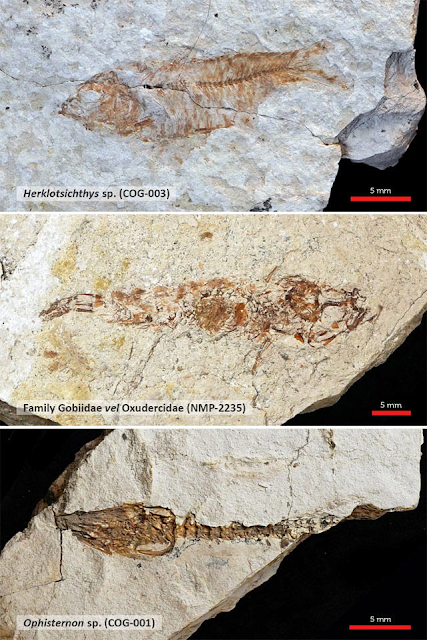
Their objective was to document a collection of freshwater fish fossils from the Pleistocene Laguna Formation in Antipolo, Rizal Province. This included a total of 14 articulated and semi-articulated specimens, which were deposited at the National Institute of Geological Sciences - University of the Philippines and at the National Museum of the Philippines.

Living specimens were compared to the fish fossil specimens, and their physical features—from length to dorsal profile—were documented. We'll not go into the specifics, but the scientists went as far as recognizing the prehistoric fish's jaws and measuring the skull. These are important not only in identifying the species, but also in studying the environment of their habitat, which in this case was the Laguna Lake.

"The fish fossil assemblage of the Pleistocene Laguna Formation is predominantly composed of the families Dorosomatidae, a Gobiidae vel Oxudercidae, and Synbranchidae. These fossils represent the first records of freshwater fish in the Philippines and the first discovery of these taxa in the tropical West Pacific region. Notably, this study also provides the first-ever record of a synbranchid fossil globally," the researchers concluded.


What This Means for Philippine Ecosystems

Aside from establishing several firsts, this discovery represented the first systematic study of freshwater fish fossils in the Philippines and provided valuable data that can be used to compare with modern ecosystems.

First, it provided solid evidence that the distribution of Herklotsichthys (a genus of herrings found mostly in Southeast Asia and Australia, with one species each in the Persian Gulf, the Red Sea, and the western Indian Ocean) was prehistorically restricted in the Indo-Pacific region.

Second, the presence of dorosomatid fish fossils in the lake suggests a habitat transition from marine to freshwater in the Pleistocene period. This is similar to Taal Lake, where fish species adapted from brackish to freshwater. The presence of demersal swamp eels and gobioid fishes also suggests that the Pleistocene Laguna Lake once had a silty and muddy bottom.

Third, the gobioid fossil from the Pleistocene showed their adaptability through all those periods in history. Up to 89 species of Gobiidae have been recorded in the Philippines, with 20 of them endemic (or found only in the country).

Fourth, the identification of the Pleistocene synbranchid fossil suggested that the swamp eel has an Indo-Pacific origin.

"These newly discovered freshwater fish fossils from the Pleistocene Laguna Formation in the Philippines not only provided evidence of their presence in the West Pacific region but also offered new insights into the origin and historical geographic distribution of these taxa," they said.

6 Philippine universities in world rankings

6 Philippine universities in world rankings

Neil Jayson Servallos 
The Philippine Star 
January 24, 2025

MANILA, Philippines — Six Philippine universities earned spots in Times Higher Education (THE)’s World University Rankings by Subject, missing only one out of 11 disciplines rated this year.


The University of the Philippines, Ateneo de Manila University, De La Salle University (DLSU), University of Santo Tomas, Mapua University and Mindanao State University – Iligan Institute of Technology (MSU-IIT) earned spots in all subjects except Law.

Under Arts and Humanities, Business and Economics, only UP and DLSU earned rankings and shared spots for each subject at the 601+ and 801+ brackets, respectively.

Both universities were also the only institutions that earned rankings in the Medicine and Health subject, with UP emerging at the top locally at the 501-600 spot.

UP was the lone school to be ranked within the Life Sciences at the 801-1000 bracket.

Mapua emerged as the top Philippine school in Computer Science and Engineering, ranking within the 801-1000 and 1001-1250 brackets, respectively. Under the same subjects, UP and DLSU shared the No. 2 spot.

DLSU was the top Philippine university in Education studies at the 401-500 spot, followed by UP and UST at the 501-600 bracket. DLSU also topped the ranking among local universities in Psychology at the 401-500 spot, followed by Ateneo at 501-600.

Under Physical Sciences, only UST did not receive a ranking. Mapua and MSU-IIT earned rankings within the 801-1000 bracket, followed by UP, Ateneo and DLSU at the 1001+ bracket.

UP, Ateneo and DLSU landed on the same spots globally in Social Sciences at the 801-1000 bracket.

The rankings were based on key indicators submitted by each university during the academic year 2022, THE said.

Key indicators included research quality, industry, international outlook, research environment and teaching.

‘UP Best performing’

Most Filipinos perceive the University of the Philippines as the “best university” in the country, a survey conducted by the OCTA Research group showed.

The survey, conducted from Nov. 10 to 16, found that 71 percent of the respondents perceiving UP as the best university in the Philippines.

Some 15 percent selected DLSU, while 14 percent chose Ateneo de Manila.

The respondents were asked to select among the three universities or provide a different answer.

Less than one percent chose “others,” the survey results showed.

Based on the poll, UP was perceived as the “best performing” university in the country across all geographic areas and socio-economic indicators.

OCTA, whose founders include several UP professors, said it released the survey results to UP as a public service.

The survey was non-commissioned and had 1,200 respondents and a margin of error of plus/minus three percent. – Janvic Mateo