Showing posts with label cities. Show all posts

Sunday, 13 September 2026

Baguio City wins WHO Healthy Cities Recognition Awards

Baguio wins 2026 WHO award for use of data in health initiatives

GMA News
13 September 2026

Baguio City was recognized by the World Health Organization (WHO) for its initiative in using data in providing targeted health and social access to residents.


"The City of Pines" received the “Data for Equity: Informing Action, Improving Health” award at the 2026 WHO Healthy Cities Recognition Awards during the 11th Global Conference of the Alliance for Healthy Cities in Sydney, Australia on September 1.


The Baguio local government unit said the city was recognized for “its contribution to the health and well-being of its citizens and to the advancement of Healthy Cities goals in the Western Pacific.”

Under Baguio’s City Planning, Development and Sustainability Office, the barangay-level Livability Index maps disparities in health, social conditions, and access to basic services across the city’s barangays.

The Index shows the residents’ experience in their communities, generating data that can help city officials identify areas facing greater challenges and determine where interventions and investments are most urgently needed.

By identifying differences in living conditions across communities, LGUs can plan targeted responses and allocate resources to those most in need.

The findings in the index are also integrated into city planning, budgeting, and investment decisions, strengthening the role of evidence in determining development priorities.

Baguio received the same award in 2021 for its Smoke-Free Baguio campaign.

— Mariel Celine Serquiña/RF, GMA News

Tuesday, 31 March 2026

Two PH cities in UN's 20 Cities Towards Zero Waste

Iloilo City, San Fernando (Pampanga) among UN’s 20 cities towards zero waste

MARIEL CELINE SERQUIÑA
GMA Integrated News 
31 March 2026

Iloilo City and San Fernando, Pampanga have been named among the United Nations’ 20 Cities Towards Zero Waste, recognizing local governments that have demonstrated ambitious and innovative approaches to reducing waste.


The recognition highlights cities advancing circular economy solutions and building more sustainable, resilient, and inclusive urban systems.

The initiative is led by the UN Secretary-General’s Advisory Board on Zero Waste, with support from UN-Habitat and the UN Environment Programme.

The UN also recognized the following cities for their zero-waste efforts:

    Accra (Ghana)

    Bologna (Italy)

    Chefchaouen (Morocco)

    Dar es Salaam (Tanzania)

    Dehiwala (Sri Lanka)

    Florianópolis (Brazil)

    Gaziantep (Türkiye)

    George Town (Malaysia)

    Hangzhou (China)

    Kisumu (Kenya)

    Kuala Lumpur (Malaysia)

    Lilongwe (Malawi)

    San Francisco (United States)

    Sanya (China)

    Suzhou (China)

    Varkala (India)

    Yokohama (Japan)

    Zapopan (Mexico)

According to the UN Environment Programme, the world generates more than 2.1 billion tons of municipal solid waste each year.

This underscores the critical role of cities in addressing the global waste crisis and its impacts on climate change, biodiversity, public health, and livelihoods.

The 20 Cities Towards Zero Waste initiative aims to recognize city leadership and innovation while promoting the exchange of best practices and lessons learned.

It also seeks to inspire other cities to pursue zero-waste strategies and adopt local-level circular economy approaches.

“Cities are at the frontline of the zero-waste transition. Local and regional governments are managing waste systems; they are reshaping local economies, influencing consumption patterns, and advancing inclusive solutions that integrate informal workers and communities,” said Anacláudia Rosbach, Executive Director of UN-Habitat.

The UN official emphasized the importance of local governments in driving environmental and systemic change, noting that cities play a central role in advancing sustainable development.

“This initiative underscores the critical role of cities as implementers of change. It demonstrates how local action, when supported by strong governance and partnerships, can accelerate the transition toward more resilient, circular, and inclusive urban systems,” she added.—MCG, GMA Integrated News

Tuesday, 15 July 2025

Manila among most affordable cities for the rich in 2025

Manila among most affordable cities for the rich in 2025

Ayie Licsi 
Philstar.com
15 July 2025

Manila is among the most affordable cities for the wealthy, ranking 23rd out of 25 major cities around the world in the Julius Baer Lifestyle Index for 2025.


The index analyzes the cost of 11 goods and nine services representing the discretionary purchases of high-net worth individuals (HNWI). This includes items like watches, jewelry, handbags, luxury clothing, shoes, cars, as well as services such as healthcare, education, etc.

Singapore remains the costliest city for the affluent in 2025, followed by London in second, and Hong Kong in third. 

Meanwhile, the five most affordable cities for the rich are Mumbai, Mexico City, Santiago De Chile, Manila, Vancouver, and Johannesburg. The South African city is the least costly city for the rich in 2025.

The Philippines' capital city dropped two places from its 21st spot in 2024. The index noted the "peculiarity" with the results concerning Manila, as there had been a 7.5% increase in average local currency prices.

What do the rich spend on?

Across regions, the index found a rise in business class air fares by 18.2%. This is attributed to a change in how people travel, "revenge spending," and an increased focus on experiential luxury.

"Upscale leisure travelers like to enjoy their entire journey. They do not want to get to the airport as late as possible and simply work or sleep through the flight as many business travelers do. As a result of this, many airlines are investing heavily in lounges, food and wine, and onboard amenities," the index reads.

HNWIs are also investing in their health and well-being. 100% of those surveyed in APAC said that they are taking some measures to increase their longevity through lifestyle changes such as regular exercise, good diet, gene therapy, and cryogenic chambers.

In the past 12 months, the affluent in APAC have spent the most on fine dining (65%), smartphones (65%), hotels (64%), healthcare (63%), and high-end clothes for women (55%).

As for specific commodities, champagne and ladies' handbags were the second and third costliest in Manila out of the 25 cities.

For the Lifestyle Index, prices were gathered from brand-owned boutiques, websites, and authorized vendors in 25 major cities in November 2024 and March 2025. Researchers also interviewed 360 HNWI with bankable household assets of $1 million or more across regions.

Tuesday, 10 June 2025

Fil-Am elected mayor of San Antonio, Texas

Fil-Am daughter of Ilocana public school teacher wins US mayoral race

Story by Cristina Chi 
Philstar Global
10 June 2025

MANILA, Philippines — The daughter of an Ilocana immigrant made history over the weekend by becoming the first Filipino-American and woman of color elected mayor of San Antonio, Texas — the seventh-biggest city in the United States. 


Gina Ortiz Jones, 44, defeated her conservative rival, former Texas Secretary of State Rolando Pablos, with 54.3% of the vote in Saturday's runoff election, according to US media reports. This also makes Jones the first openly gay mayor and only the third woman to lead the Texas metropolis of 1.5 million residents.

Jones will take office on June 18 for a four-year term. 

Her mother, Victorina Ortiz, left behind an established career as a public school science teacher in Pangasinan to immigrate to the United States in the 70s, according to an interview with Jones by People Asia.   

A University of the Philippines Diliman graduate, Victorina initially worked household jobs after arriving in the US before eventually returning to education — spending over 40 years teaching special needs students at a public school district in San Antonio.

"My journey has been a uniquely American story. My mom came to this country from the Philippines and raised me and my sister by herself," Ortiz said in her campaign website.  

The decision to leave the Philippines required courage that Jones says she inherited. "That same courage is in my heart, that's in my blood, that's in my sister's heart," she told People Asia magazine in 2023.  

Jones said she was raised by her mother to be conscious of finding ways to give back to her community. "It’s why my sister and I both joined the military, and it’s why I’ve worked as a public servant," the San Antonio mayor-elect said.

Historic win amid partisan battle

Jones' victory is seen a breakthrough for Filipino-American political representation in the United States, where Asian-Americans remain underrepresented in major offices despite being the fastest-growing ethnoracial group in the US electorate.

Before running for mayor, she unsuccessfully sought a congressional seat twice under the Democratic party, losing close races in 2018 and 2020 in South Texas.

According to a report by the Texas Tribune, the mayoral race turned bitterly partisan, with Jones having to parry attacks from Pablos, whose campaign ran television advertisements questioning her military record and painting her as an outsider.

Jones responded by assembling a coalition of progressive organizations, veterans groups and labor unions. Her platform focused on expanding pre-kindergarten programs, increasing affordable housing, and improving internet access in poor neighborhoods. 

Pablos trailed by more than 12,000 votes, according to a report by the San Antonio Express.

From Air Force to City Hall

Jones served as an intelligence officer in Iraq under the US military's "Don't Ask, Don't Tell" policy, which prohibited openly gay service members. She left the Air Force early to care for her mother, who had been diagnosed with cancer while Jones was deployed.

She later worked for federal agencies, including the Defense Intelligence Agency, before serving as undersecretary of the Air Force under US President Joe Biden — the first openly gay woman of color in that position.

Friday, 14 February 2025

Manila one of Asia's most romantic destinations

Manila among 5 best Asian Valentines' destinations

Aric John Sy Cua
Manila Times
14 February 2025

DIGITAL travel platform Agoda listed Manila as one of its top five most romantic destinations in Asia for couples celebrating Valentine's Day.

The list, published on Thursday, described Manila as having a "warm and welcoming" atmosphere, and pointed to sunsets in Manila Bay.


"Manila, with its warm and welcoming atmosphere, provides couples with a cozy escape. The city's rich history and cultural sites, combined with its picturesque sunsets, create an ideal setting for love to blossom," Agoda said.

Malaysia's capital, Kuala Lumpur, leads the list, with its skyline offering "a stunning backdrop for romantic evenings."

Tokyo in Japan is in second place, with its "fusion of old and new."

"Couples can stroll through serene gardens, explore historic temples, and then dive into the vibrant nightlife, making it a city that offers endless romantic possibilities," Agoda said.

Behind Manila are two cities in Thailand, its capital Bangkok and the city of Pattaya. Bangkok was mentioned for its "lively energy and serene temples," as well as its bustling markets and the romantic dinner cruise along the Chao Phraya River.

Pattaya, on the other hand, offers "stunning beaches and vibrant nightlife" for couples seeking relaxation and adventure.

Agoda's data also pointed out a 35-percent increase in accommodation searches for domestic destinations for Valentine's Day, which falls on Friday.

"At Agoda, we are dedicated to helping couples find the perfect spot to celebrate their love. Whether it's a city staycation or a beach getaway, Agoda has the best deals to set the stage for a magical weekend of romance," Agoda senior vice president for supply Andrew Smith said.

Wednesday, 29 January 2025

Cebu among top pet-friendly cities in Asia

Cebu among top pet-friendly cities in Asia

Morexette Marie B. Erram
Cebu Daily News
29 January 2025

CEBU CITY, Philippines — Fantastic news for fur parents who want to visit the Queen City of the South with their four-legged loved ones.


Cebu City was named among the top pet-friendly cities in Asia for 2024.

Online travel platform Agoda recently revealed their list of top 10 pet-friendly cities in the region, with Cebu ranked second, next to Vietnam’s coastal city Da Nang.

Rounding up the top five are Vietnam’s Hanoi, Nha Trang, and Tainan in Taiwan respectively.

Manila, the country’s capital, landed on the 10th spot. Aside from Manila, completing the top ten were Pattaya (Thailand), Taichung (Taiwan), Ho Chi Minh City (Vietnam), and New Delhi (India).

According to Agoda, their list of pet-friendly cities is based on the average number of accommodations that allow guests to bring in their pets.

In addition, the Singapore-based firm observed an increase in pet travel in Asia, particularly among Millennials and Gen Z.

They recorded a 64 percent growth pet-friendly properties in 2024.

“Millennials and Gen Z leading the charge as they embrace pet parenthood and splurge on their furry friends, according to a recent study by Allied Market Research,” they added.


Thursday, 21 November 2024

Baguio wins SDG award in Asia-Pacific

Baguio wins SDG award in Asia-Pacific

The Manila Times
21 November 2024

BAGUIO CITY — This city has just created a big name in the Asia-Pacific, thanks to its continuing pursuit of the Sustainable Development Goals (SDGs).

The Summer Capital placed second in the 3rd CityNet Unescap SDG City Awards program behind its innovative urban program entitled "Mapping Urban Resilience: a Digital Twin to Baguio's Livability Index."

The city was cited for pioneering the use of digital technology to enhance urban planning and resilience.

City Mayor Benjamin Magalong. Photo from Baguio City Public Information Office

Mayor Benjamin Magalong welcomed the recognition, saying it is a testament to the city's commitment to creating a sustainable, inclusive and resilient city. It also affirmed the city's status as a model for other cities striving to achieve the SDGs.

The city was second to Busan, South Korea, which took the top position with its Children's Cultural Complex project. Bandung, Malaysia, placed third with its entry "Transforming the Springs Conservation Area into a Public Space."

Aside from the major award, the city also copped the top prize in the thematic category Smart City Award again for the "Mapping Urban Resilience" case study. It shared the distinction with Subang Jaya, Malaysia, for its "WhatsApp Business for City Services."

There were 350 submissions from different countries in the Asia-Pacific region and 70 were prequalified. The entries were trimmed to 10 finalists and from the pool, the top three were selected.

City planning and development coordinator Donna Tabangin received the award on behalf of the city government during the awarding ceremony held on Tuesday in Iloilo City.

The CityNet Escap SDG City Awards gives recognition to innovative urban practices of local governments to address urban challenges and advance the SDGs across Asia-Pacific.

These projects must align with the thematic categories of Inclusive City, Smart City, Circular City and Resilient City, and were evaluated based on their innovation, leadership, implementation clarity, positive outcomes, long-term sustainability and replicability.

The panel of judges came from leading international organizations, including the CityNet Secretariat, the United Nations-Habitat, the United Nation Development Program (UNDP) and the Habitat for Humanity.

Established in 1987, CityNet is an association of urban stakeholders committed to sustainable development in the Asia-Pacific region. It is supported by the United Nations Economic and Social Commission for Asia and the Pacific (Escap), UNDP and UN-Habitat. The network now has 150 municipalities, nongovernment organizations, private companies and research centers as members. GABY KEITH

Wednesday, 21 August 2024

Manila is officially the nightlife capital of Asia

Manila’s Nightlife Shines: Second Best in the World for 2024

Tripzilla
21 August 2024

Manila is officially the nightlife capital of Asia and a global hotspot, claiming the second spot in Time Out Travel’s 2024 list of the world’s best cities for nightlife. The bustling Philippine capital has earned this prestigious title with its vibrant and eclectic nighttime offerings, making it a top destination for party enthusiasts and night owls alike.

Manila ranks second in world’s best cities for nightlife in 2024


Manila’s nightlife has always been renowned for its energy and diversity, and this recent accolade further cements its reputation. The city’s nightlife scene is a lively mix of high-energy nightclubs, chic bars, and unique underground venues, catering to a wide range of tastes and preferences. From world-class DJs spinning at renowned clubs to intimate live music performances in cozy venues, Manila offers something for everyone seeking an unforgettable night out.

What sets Manila apart

Diverse Entertainment Options: Manila is home to some of the most iconic nightlife spots in the region. Clubs like The Palace and Valkyrie are known for their electrifying atmospheres and top-notch international acts. But the city's nightlife goes beyond the mainstream, featuring underground parties, themed nights, and pop-up events in unconventional locations like art galleries and industrial spaces.

Cultural Fusion: The city’s nightlife is infused with its rich cultural heritage, offering a blend of traditional and modern experiences. Live music venues showcase local talent and international artists, while a variety of dining options ensure that every night out is complemented by exceptional food and drinks.

Ever-Changing Scene: Manila’s nightlife scene is dynamic and ever evolving, with new spots and trends constantly emerging. This ensures that there’s always something new and exciting to explore, keeping the city’s nightlife fresh and engaging.

Safety and Accessibility: Manila prioritises the safety of its nightlife-goers, with well-policed areas and reliable transportation options available late into the night. The city's vibrant nightlife is not only exciting but also secure and accessible.

For those planning a visit to Manila, the city’s nightlife is a must-explore. Whether you’re looking to dance the night away at a high-energy club, enjoy a sophisticated evening at a rooftop bar, or discover hidden gems in the underground scene, Manila promises an unparalleled nightlife experience. Dive into the city’s nocturnal offerings and see for yourself why Manila has earned its place as a global nightlife powerhouse.

World’s best cities for nightlife in 2024

  1. Rio de Janeiro, Brazil
  2. Manila, Philippines
  3. Berlin, Germany
  4. Guadalajara, Mexico
  5. Austin, USA
  6. Lagos, Nigeria
  7. Rotterdam, Netherlands
  8. Manchester, UK
  9. Budapest, Hungary
  10. Accra, Ghana
  11. Buenos Aires, Argentina
  12. Taipei, Taiwan
  13. Singapore

Asia’s best cities for nightlife in 2024:

  • Manila, Philippines
  • Taipei, Taiwan
  • Singapore

Manila’s recognition as a top nightlife destination reflects its status as a vibrant, ever-evolving city that never sleeps. Pack your party shoes and get ready to experience the best of Manila’s nightlife firsthand!

Wednesday, 19 June 2024

Daly City - Quezon City foster stronger sisterhood

Daly City reaffirms sister city ties with Quezon City

Story by Nimfa U. Rueda 
Inquirer.net
19 June 2024

DALY CITY, Calif. – As Daly City raised the Philippine flag in honor of Philippine Independence Day on Friday, the “Pinoy Capital” of the US, also reaffirmed its sister city ties with Quezon City.


During the flag-raising ceremony at City Hall, Daly City Mayor Juslyn Manalo presented to Consul General Neil Ferrer a proclamation declaring June 14 as Philippine Independence Day in the city.

The proclamation, signed by all the councilmembers, also highlighted the sister city ties between Daly City and Quezon City, which aim “to foster an awareness of Filipino culture, encourage the integration of Filipino residents of Daly City into the civic life of the city and to encourage trade and commerce.”

The 10th Philippine flag-raising ceremony at City Hall was hosted by Daly City and the Pilipino Bayanihan Resource Center (PBRC), which was recently named the 2024 Nonprofit of the Year for California Assembly District 19.

Leading the ceremony were Ferrer and PBRC founder Perla Ibarrientos, who initiated the very first Philippine Independence Day flag-raising at City Hall in 2014.

In his remarks, Consul General Ferrer thanked the City for hosting important Fil-Am events, including the Philippine Independence Day celebration and the “Kasayahan sa Daly City” for Filipino American History Month, which provide a venue for the community “to take pride in their unique culture, history and identity.”

“I recognize the diversity and dynamism of the Filipino-owned businesses in your city and I offer a special mention to Fil-Am Cuisine, which was recently inducted into the inaugural class of Daly City’s Legacy Business Recognition Program,” Ferrer said.

Ferrer said he looks forward to working with the city government in forging closer relations between the Philippines and the United States through programs such as the sister city cooperation between Quezon City and Daly City.

More than 30 percent of Daly City’s total population are of Filipino descent, the highest concentration of Filipinos and Fil-Ams in the United States.

University lecturer Benito Vergara Jr. chronicled the history of the vibrant Fil-Am community in the city in his 2009 book, “Pinoy Capital: The Filipino Nation in Daly City.”

Other dignitaries in attendance included California State Senator Scott Wiener, San Francisco Board of Supervisors Member Catherine Stefani, Japanese Deputy Consul General Hajime Kishimori, Fil-Am Daly City Vice Mayor Rod Daus-Magbual and Councilmembers Glenn Sylvester and Teresa Proaño.

Monday, 17 June 2024

Manila is One of the World's 'Hottest' Casino Destinations in 2024

Manila is One of the World's 'Hottest' Casino Destinations in 2024, Study Says

Story by Estrellita Faustino 
Esquire Philippines
17 June 2024

Manila is one of the world’s hottest casino destinations this year, according to a United Kingdom-based sports-betting and tipster community. 


According to research done by OLBG.com (Online Betting Guide), the online betting platform of British company Invendium Ltd., Manila ranked sixth in the Global Casino Index of 2024, with a score of 6.68 index points out of 10. With around 48.21 average table games per casino, Manila garnered 94,200 annual casino searches during the research period of May 2023 to April 2024. 

OLBG’s research included the number of casinos per 1,000 people, the average number of restaurants per casino, and the average daily rate of local Airbnb rentals in order to come up with the rankings on the index.

Manila had .09 casinos per 100,000 people, 2.79 average restaurants per casino and charged an average of about 37.21 British pounds (about P2,770) per night in an AirBnB, which was the most affordable in all the cities in the index’s top 10. Only Bogota, Colombia was cheaper with an average of 35.19 pounds per night. 

"Manila, the capital of the Philippines, has the second most affordable Airbnbs in our study," the write-up about the Philippine capital in OLBG’s website said. "With 14 casinos in the city, it is a fantastic destination for visitors to enjoy a night at the casino after soaking up the city’s unique Spanish-influenced culture." 

Ranked first in the Global Casino Index for 2024 is Macau, with a score of 9.32 points. The Chinese territory was followed by Philadelphia with a score of 7.24; and Las Vegas with 7.2. The rest of the Top 10 includes Singapore (6.84), and Calgary in Canada (6.72), New Orleans (6.6), Vienna (6.28), Brisbane (6.16), and Melbourne (6.08).

The research also found that Google searches for "casinos near me" increased 50 percent last year globally.

OLBG’s parent Invendium Ltd. operates some of Europe’s leading sports-betting sites and claims to have a membership of 50,000 and "millions of visits daily." OLBG, meanwhile, provides a platform for betting tips and strategies, and is among the most popular sports-betting sites in Europe. Aside from sports-betting tips, it also publishes betting odds for politician-candidates, Grammy nominees and possible winners, contestants for shows like The Great British Bake-Off, among others. 

Meanwhile, the Philippine Amusement and Gaming Corp. (Pagcor) has projected gross gaming revenues (GGR) in the country to reach P336 billion in 2024, a 17.8-percent increase from the P285.27 billion recorded last year. The surge will likely come from the increasing share of electronic e-games to the gaming industry. 

In a recent news statement, PAGCOR reported total GGR in the country reached P81.7 billion in the first three months of the year, 18.54-percent higher from the P68.92 billion in the same period in 2023, with licensed casinos accounting for some 61 percent or P49.7 billion of the total. However, licensed casinos (-8.2 percent), PAGCOR’s own casinos (-8.3 percent to P4.7 billion), and bingo operations (-21.5 percent to P4.81 billion) all recorded lower gaming revenues in the period, year-on-year.

The e-games sector, meawhile, saw a surge in revenue in the first quarter this year to P22.5 billion, more than six times its P3.5-billion revenue in the same period last year. 

"The e-games revenue performance continues to exceed our projections, and this reflects how gaming technology and the proliferation of mobile devices is influencing not only our daily lives but our entertainment choices as well," PAGCOR chairman and CEO Alejandro H. Tengco said. "With the way technology is constantly shaping our lives and the way we do business, and even the way we choose to be entertained, the future of gaming clearly lies in this sector." 

Tengco said state-run gaming agency has improved its regulatory policies and reduced fees, which also contributed to the strong performance of the e-games sector.

Monday, 10 June 2024

Manila Moves Up in 2024 Global Top 100 List of Emerging Startup Ecosystems

Manila Moves Up in 2024 Global Top 100 List of Emerging Startup Ecosystems

Story by Paul John Caña 
Esquire Philippines 
10 June 2024

Despite funding challenges and a general air of uncertainty, Manila’s startup ecosystem is bouncing back and is showing signs of recovery. The biggest proof is that the country’s capital has moved up in the annual ranking of the world’s Emerging Startup Ecosystems. From last year’s 91-100 spot, Manila is now at 81-90, driven mainly by growth in the fintech, e-commerce and gaming sectors. 


Manila shares the 81-90 spot with global startup ecosystem heavy hitters like Las Vegas (Nevada, USA), Columbus (Ohio, USA), Kansai Region (Japan), Bucharest (Romania), San Bernardino and Santa Barbara (California, USA), Turin (Italy), Madison (Wisconsin, USA), and Ho Chi Minh City (Vietnam). 

Manila placed higher in the list than cities like Rio De Janeiro (Brazil), Leipzig (Germany), Cape Town (South Africa), Valencia (Spain), and Adelaide (Australia).

According to the ecosystem focus page, the GSER estimates Manila’s total startup ecosystem value at $6.4 billion (about P375 billion) as of the second half of 2021 to 2023. This is up significantly from last year’s estimate of $3.5 billion but still far from the global average of $29.4 billion. 

"In 2023, startups in the Philippines raised $960 million across 96 deals," the report said. "In mid-2023, Manila-based VC Kaya Founders closed $12 million in new funds, aiming to broaden their investment focus across pre-Seed to Series A stages."

Kaya Founders is one of the country’s most prominent investment firms focusing on early-stage startup companies. It has invested in many of the country’s top startups, including Etaily, GoRocky, Kindred, Kraver’s Canteen, Locad, Netbank, Plastic Credit Exchange, Paymongo, Peddlr, Toki, and many more. 

By the numbers

Manila’s startup ecosystem value grew a hefty 72 percent between the periods of the second half of 2021 to 2023 versus the second half of 2019 to 2021. For comparison, the global average in ecosystem value growth was only 46 percent last year. 

Total early-stage funding in the country (also from the second half of 2021 to 2023) was at $371 million (vs global average of $655 million), while total venture capital funding was at $1.1 billion between 2019 to 2023 (vs global average of $4.6 billion).

Manila also ranked in the GSER’s Top 15 of the Asia Ecosystem in Bang for Buck, Top 20 in Asia Ecosystem in Funding, and Top 30 in Asia Ecosystem in Performance.

"The Philippines is rising steadily in the Global Innovation Index, from #100 in 2014 to #56 in 2023, with plans to break into the top 50 by 2028 as outlined in the 2023-2028 Philippine Development Plan," the report said. "The Department of Trade and Industry (DTI), Department of Science and Technology, and Department of Information and Communications Technology lead efforts to support the country’s tech startup ecosystem. The National Innovation Council leads in developing the country’s innovation goals, priorities, and long-term national strategy."

Looking at the sub-sector strengths, the GSER highlighted the 38 percent growth, from 216 companies to 299, between 2021 to 2023 in fintech. Thanks to the Bangko Sentral ng Pilipinas Digital Payments Transformation Roadmap, digital retail payments soared from just one percent in 2013 to 50 percent of all transactions in 2023.

In e-commerce, the Philippines ranked fifth in the region for e-commerce traffic thanks largely to the extreme popularity of online marketplaces Shopee and Lazada, whose combined user bases is expected to balloon to 60.41 million by 2027.

And in gaming, the country is still the world’s undisputed leader in Web3 gaming interest for the third year in a row. The report made special mention of the Web3 Gaming Summit hosted by YGG last year and the launch of the country’s first esports course at Lyceum Philippines University.

In some ways, the GSER made many of the same points highlighted in the 2024 venture capital report released by Foxmont Capital Ventures and Boston Consulting Group. That report acknowledged the slowdown in funding for startups over the past year but still chose to shine a light on other bright spots in the startup ecosystem, including the country achieving a record number of deals, and how much the country is growing its share of regional capital.

Finally, the GSER put the spotlight on some major players in the country’s startup ecosystem, including the Gobi-Core Philippines Fund, Plug and Play Tech Center, Ideaspace, Launchgarage Innovation Hub, Brainsparks, and Startup QC.

"The Philippines invests in its startup ecosystem to create opportunities for a more prosperous and sustainable future, enhance quality of life, bolster global competitiveness, and foster innovation by addressing the critical challenges of our society and changing market needs," the report quoted DTI Usec. Rafaelita M. Aldaba of the agency’s Competitiveness and Innovation Group as saying.

Regional rankings

This year’s GSER report also includes a ranking of startup ecosystems by region. In Asia, Manila made it to the 21-25 ranking, tied with Bangkok (Thailand), Wuhan (China), Kansai Region (Japan), and Ho Chi Minh City (Vietnam). 

Asia’s top startup ecosystem this year is Singapore followed by Beijing, Seoul, Tokyo, and Shanghai.

For other Southeast Asian cities, Jakarta was at 12th place, second only to Singapore. The Indonesian capital was followed by Kuala Lumpur at 16th, Manila, Bangkok and Ho Chi Minh, and Hanoi at 26-30.

State of global startups

The GSER recognized the global downturn in startup metrics, including VC funding, and exit deal value, saying that both fell below the 2019 levels but, as in the Foxmont-BGC VC report, chose to look at the bright spots.

"While global Series A funding fell 46 percent in 2023 compared to 2022, average Series A deal size increased in H2 2023 compared to H2 2022," the report said. "Q1 2024 shows signs of further improvement. The Cleantech and Generative AI (GenAI) sub-sectors offer another positive note, demonstrating that frontier innovation can still attract investor enthusiasm regardless of global funding conditions."

The top 3 in the global top 40 ecosystems retained their positions from last year, with Silicon Valley still at number one and New York and London tied at second place. Tel Aviv has moved up one rank and is now tied with Los Angeles at number 4, while Tokyo has entered the Top 10 for the first time, moving up to number 10 from number 15 last year. 

The GSER 2024 is the 12th edition of the report that "provides insights into the world’s leading startup ecosystems, emerging trends, and key challenges facing entrepreneurs." Startup Genome says the report is based on an extensive study of more than 4 million companies across over 350 startup ecosystems.

Sunday, 2 June 2024

Philippines: $397-billion reclamation projects underway, more planned

Philippines: $397-billion reclamation projects underway, more planned

Mega projects expanding urban landscape, adding spaces, with more on the drawing board

Jay Hilotin, Senior Assistant Editor
Arab News
May 31, 2024 

Manila: The skyline of the Philippine capital is changing. So is the view from above. Multi-billion-dollar mega projects are expanding the urban landscape, with massive sea-ward transformation projects in progress – or on the drawing board.

The aim: push back the sea, create new spaces and opportunities. Manila Bay is the centre of this action. Outside the capital, more land reclamation jobs are planned or are in progress.

The total area of land reclamation projects in the Philippines, both completed and planned, is significant. As of 2023, there are around 187 ongoing and approved reclamation across the country.

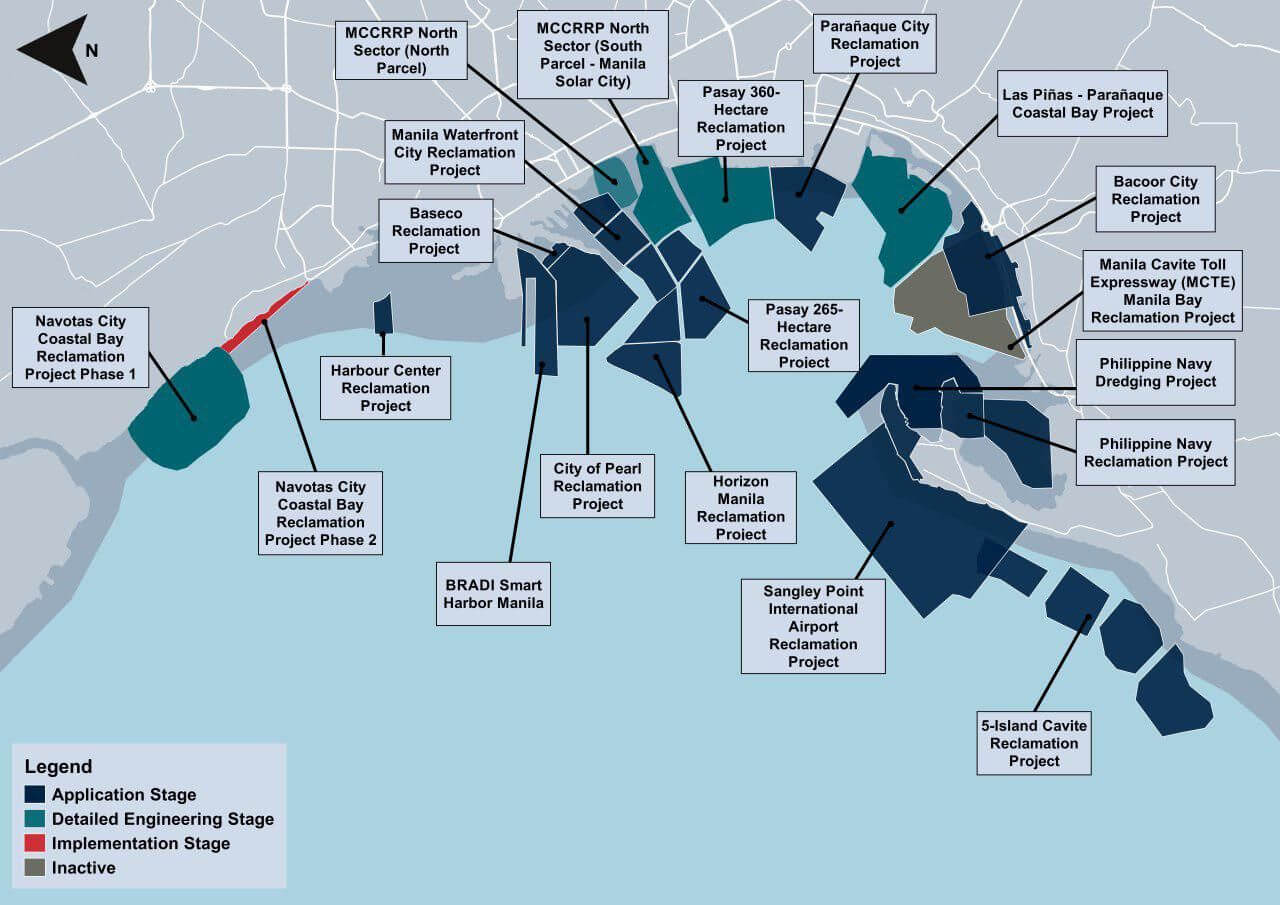
Grabbed from: 6-soon-to-rise-manila-bay-reclamation-sites-in-2019.jpg (1280×905) (kmcmaggroup.com)

Specifically, Manila Bay has a considerable concentration of these projects, valued at more than 23 trillion pesos ($397 billion), according to one estimate.

Reclamation, a trend that started here in the early 1960s, has been revived in recent years. It’s helping decongest cities, creating new land for development, mass housing and easing the pressure cramped metropolises.

Here’s the lowdown:

Manila Bay Reclamation
Area: 5,503 hectares (13,598 acres)

The Roxas Boulevard reclamation projects collectively represent a significant expansion of the Manila Bay coastline. This involves 14 approved projects covering 5,503 hectares (55 km2).

Also known as the Manila Bay Reclamation Project, this involves several planned and ongoing reclamation initiatives along the Manila Bay coastline, particularly in the areas adjacent to Roxas Boulevard. Components include the 148-hectare Manila Solar City Project (a mixed-use development), the 419-hectare Horizon Manila, and the 318-hectare Manila Waterfront City.

The total investment for property development is estimated at nearly 23 trillion​ pesos ($397 billion). The original plan was to reclaim 3,000 hectares (30 km2) of land in Manila Bay.

Besides the SM Mall of Asia Complex, it is known for the 77-hectare (0.77 km2) Cultural Center of the Philippines Complex, the Aseana City Business Park, integrated resorts and complexes such as the City of Dreams Manila, Okada Manila and Solaire Resort, and the Asiaworld compound where the Parañaque Integrated Terminal Exchange (PITX) is situated.

Bulacan Aerotropolis
Area: 1,168 hectares (2,886 acres)

Developed by San Miguel Corp. (SMC), this project includes the construction of the New Manila International Airport, also known as Bulacan International Airport, and surrounding urban infrastructure. The project area spans 2,500 hectares (25 km2) with the airport covering 1,168 hectares and an adjoining airport city, part of the under-construction $15-billion behemoth. It’s a major part of the overall effort to boost the region’s economic growth​​.


Part of the material used for this reclamation project is the use of up to 6 million tonnes of silt, solid waste and trash dredged from rivers in Manila and nearby provinces.

These include 3 million tonnes extracted from more than 50 kilometers of rivers in the flood-prone Bulacan province spanning the cities and towns of Meycauayan, Obando, Bulakan, Bocaue, Marilao, Balagtas, and Guiguinto. Moreover, 1.2 million tonnes of waste were dredged from 26 kilometers of the Pasig River, 1.1 million tons from 11 kilometers of the Tullahan River, and almost 320,000 tonnes from the San Juan River.


Cebu South Coastal Urban Development Project (CSCUD):
Area: 300 hectares (740 acres)

This includes various projects like the Cebu South Coastal Urban Development Project, which focuses on commercial, residential, and industrial areas to stimulate economic activity in Cebu.


It has an ambitious socialised housing component. The South Road Properties (SRP), also known as the South Reclamation Project, is a 300-hectare (740 acres) reclamation area in Cebu, a trading and cultural hub in central Philippines.

The area, which is reclaimed from Mactan Channel, is located off the coast of the southern district of Cebu City, near Barangays Mambaling, Inayawan, and Pasil.​

This is a large-scale initiative aimed at transforming the southern coastal areas of Cebu City into a modern urban hub. Its primary objective: alleviate congestion in the city centre, promote sustainable urban growth, and enhance the overall quality of life for residents.


The project will be developed in three phases and aims to provide 40 buildings for socialised housing across a 60-hectare site and other areas along the SRP. Phase 1 alone covers 30 hectares and is expected to benefit approximately 10,000 informal settler families.

The development is part of the larger "National Pabahay Para sa Pilipino Housing" drive to address the housing deficit by constructing 6 million units by the end of President Ferdinand Marcos Jr.'s term in 2028.

The project will also have essential facilities such as schools, markets, and health centers to create a sustainable and integrated community and aligns with the overall national budget allocated for this extensive housing initiative.

Cebu City North Reclamation Area (NRA)
Area: 169 hectares (417 acres)

The Cebu City North Reclamation Area (NRA), started in 1962 with about 169 hectares, has been further expanded to cover about 330 hectares today. Situated along the northern coastline of the city, it provides easy access to key transportation hubs like the Cebu International Port and the Mactan-Cebu International Airport. Its central location makes it a crucial area for business, commerce, and tourism.


The NRA is a significant economic driver for Cebu City, housing several commercial establishments, shopping malls, and office buildings. Major developments in the area include SM City Cebu, at least 20 hotels, and the Cebu Business Park, which hosts numerous multinational corporations and local businesses.

These establishments contribute significantly to the local economy by providing jobs and attracting investments. Its central location makes it a crucial area for business, commerce, and tourism.

Navotas Coastal Development
Area: 650 hectares (1,606 acres)

This development north of Manila, aims to develop urban, commercial, industrial, housing and green spaces to support the local economy and improve living standards in Navotas​. This significant undertaking covers an extensive area along the coastal region of Navotas City. The entire project is designed to cover approximately 650 hectares. A substantial portion of the project involves land reclamation from Manila Bay.


This reclaimed land will be used for new developments and infrastructure. A significant portion of the reclaimed land will be dedicated to housing, aimed at providing affordable and sustainable living spaces for thousands of families.

Large tracts of land will also be used for commercial and industrial activities. The development also includes parks, recreational areas, and waterfront promenades, enhancing the livability and aesthetic appeal of the area.

Pasay Reclamation Project
Area: 265 hectares (654 acres)

This project, covering approximately 265 hectares, is a large-scale development initiative aimed at transforming the coastal area of Pasay City (south of Manila) into a thriving urban hub.

This development aims to enhance economic growth, provide housing and job opportunities, and improve the overall quality of life through the creation of new residential, commercial, and industrial zones, as well as public amenities and green spaces, to be implemented in several phases.

Following the initial land reclamation and establishment of basic infrastructure, including roads, utilities, and seawalls, the residential and commercial zones will be developed, along with public amenities. Further expansion of industrial areas and completion of remaining infrastructure and public spaces.

Las Piñas-Parañaque Coastal Bay Project
Area: 635 hectares (1,569 acres)

The Las Piñas-Parañaque Coastal Bay Project is planned to cover a total area of approximately 635 hectares, reclaiming the shallow coastal area from Asia World Properties to the municipality of Bacoor in Cavite. This reclaimed land will support various types of development – residential, commercial, and industrial zones, along with infrastructure for flood control and coastal defense.

In October 2021, the Philippine Supreme Court en banc voted 11-2 to approve the reclamation project covering approximately 530 hectares of the Manila Bay coastline in Las Piñas and Parañaque, ruling that the alleged environmental threat was not sufficiently established.

In 2009, Alltech Contractors proposed developing 321.26 hectares in Las Piñas and 174.88 hectares in Parañaque along the Manila Bay coastline.

Senator Cynthia Villar (Las Piñas ex-representative), along with local residents, petitioned the Supreme Court to scrub this reclamation, arguing it would increase “flood risk” in their communities. The Philippine Reclamation Authority (PRA) approved the project in 2010, after subjecting to environmental compliance.

The proponents submitted an amended Environmental Performance Report and Management Plan (EPRMP) in December 2010, expanding the project to 203.43 hectares in Parañaque and 431.71 hectares in Las Piñas.

In March 2011, the Department of Environment and Natural Resources–Environmental Management Bureau (DENR-EMB) issued an Environmental Compliance Certificate (ECC) for the project. Villar contended that the project would impede the flow of the Las Piñas-Zapote and Parañaque rivers. In 2013, the Court of Appeals (CA) denied the petition, stating that the project had undergone the proper process, and noted that the submission of an EPRMP is a valid form of Environmental Impact Assessment (EIA).

Panglao Island Reclamation
Area: 450 hectares (1,112 acres)

The Panglao Island Reclamation project, located in Panglao Island, which is part of Bohol province in the Central Visayas region of the Philippines, is situated southwest of Bohol's main island and is known for its beautiful beaches, dive sites, and tourism attractions.

It is planned to cover a total area of approximately 450 hectares. This reclaimed land will be utilised for various purposes, including residential, commercial, tourism, and industrial development. Panglao Island is connected to Tagbilaran City, the capital of Bohol, by two bridges.

The island is famous for its popular tourist destinations. The island is home to Bohol-Panglao International Airport, which boosts connectivity and accessibility, making it an ideal location for further development.

The Davao Reclamation Project
Area: 214 hectares (504 acres)

The Davao Reclamation Project, also known as the Davao Waterfront Development Project, is a major land reclamation initiative in Davao City, located in the southern part of the Philippines.

In January 2023, Davao City officials and representatives from the Philippine Reclamation Authority signed a Memorandum of Understanding – in line with the application of the city to reclaim and develop 57 hectares along the reclaimable areas enclosed by the Davao City Coastal Road Project.


This extensive reclamation will be developed to support a variety of uses, including residential, commercial, industrial, and public amenities. An area has been earmarked for affordable housing units and high-end residential complexes, as well as commercial spaces, offices, retail establishments, hotels, entertainment facilities, industrial activities, public amenities and green spaces.

Cebu Reclamation Projects
Area: 765 hectares (1,890 acres)

The Cebu Reclamation Projects are collectively substantial – adding over 765 hectares of new land to support various types of development. These projects aim to enhance Cebu’s economic capacity, provide new residential and commercial spaces, and improve public amenities while addressing environmental sustainability and regulatory compliance.

Includes multiple smaller-scale projects in areas such as Balamban, Carmen, Compostela, Minglanilla and Oslob, focusing on port facilities, commercial spaces, and public amenities​​. Toledo City (Area: 18 hectares, 44.5 acres) reclamation project will form part of the waterfront area's urban development effort as a new place for a sports stadium, yacht club, commercial and business process outsourcing centers, hospitality, and education facilities.

Balamban reclamation project (Area: 8.4 hectares, 20.75 acres) is the west Cebu province's shipbuilding capital. It plans to construct a dome, a wharf, and an evacuation center in its 84,000-square-meter proposed reclamation area.

Oslob reclamation project (Area: 10 hectares, 27.7 acres) is planned in the whale-watching town of Oslob. It poised to build a commercial hub in its planned 10-hectare reclamation lot. Dumanjug, another town in Cebu, wants to establish income-generating food and commercial facilities in its undetermined size of reclamation area.

Each of the five-hectare reclamation projects in the towns of Carmen and Compostela will be home to their respective public market, transport facilities and structures to protect residents from storm surges.

Dumaguete Smart City
Area: 174 hectares (430 acres)

The Dumaguete Smart City, a 174-hectare, 23-billion-peso township project aims to transform Dumaguete, a city in central Philippines, into a technologically advanced urban center. The project is expected to drive significant economic growth and social benefits for Dumaguete.

By improving infrastructure and public services, the Smart City initiative aims to attract new investments, create job opportunities, and boost the local economy. The integration of smart technologies is also anticipated to enhance the quality of life for residents, providing better healthcare services, improving education systems, and ensuring more efficient public transportation.

Efforts are being made to minimize the environmental footprint through the use of green technologies and sustainable practices.


Looking ahead

Reclamation, like bridge-building, does offer significant economic and social benefits.

It's not all bed of roses. Besides the engineering challenges, there are environmental concerns raised. Fisherfolk and local communities have expressed their opposition to some of these projects, citing their potential negative environmental impacts. These concerns, and others, must be carefully considered to ensure sustainable practices and comprehensive environmental assessments, in order to mitigate the downsides.

Adherence to national and local regulations, i.e. conducting comprehensive Environmental Impact Assessments (EIA), securing necessary permits and approvals from relevant authorities, including the Philippine Reclamation Authority (PRA) and the Department of Environment and Natural Resources (DENR), and thorough environmental scrutiny underscores the need to balance development with ecological preservation.

Tuesday, 21 May 2024

Nine PH cities made it to Top 1000 Cities by Oxford Economics

Nine Philippine cities among top 1,000 global urban economies 2024 Oxford Economics Global Cities Index

By Chino S. Layco
Manila Bulletin
May 21, 2024 

AT A GLANCE

  • Manila ranks 256th globally with strengths in economics and human capital but weaknesses in quality of life.
  • Cebu City is at 436th place, excelling in the environment but lacking in quality of life.
  • Other Philippine cities like Cagayan de Oro, Davao City, and Angeles City are also identified.
  • Bacolod shines in the environment but struggles with human capital.
  • Dagupan highlights strong environmental aspects.
  • Zamboanga excels in the environment but faces economic challenges.
  • General Santos thrives in the environment but faces challenges with human capital.
  • The 2024 Global Cities Index by Oxford Economics provides insights into urban environments worldwide, with New York, London, San Jose, Tokyo, and Paris leading the rankings.

UK-based think tank Oxford Economics has identified nine cities in the Philippines among the largest urban economies in the world.

In the Oxford Economics Global Cities Index, which ranks the 1,000 largest cities worldwide, Manila is the biggest city in the Philippines but is not considered a major player on the global scale.

Taken from Rising Philippines Facebook Page

The Oxford Economics report did not specify if "Manila" refers to just the capital city or includes the entire metropolitan area in the National Capital Region (NCR). The report did not list any other NCR cities besides Manila. 

Oxford Economics ranks based on five categories: economics, human capital, quality of life, environment, and governance.

“By analyzing these five dimensions in depth, the Global Cities Index provides a nuanced understanding of each city's strengths and areas for improvement, empowering policymakers, investors, employers, and residents to make informed decisions,” Oxford Economics said in a statement.

Among the 1,000 urban economies worldwide, Manila is ranked 256, placing it above the global average scores, although not among the top-performing cities.

Based on the report, Manila’s strength is human capital, ranking 101, followed by economics (150) and environment (238). However, its weakest points are quality of life (461) and governance (614).

Another city that has made it to the global rankings is Cebu City, which secured the 436th spot worldwide. The Queen City of the South excels in the environment (24) but lags behind in quality of life (684).

Cagayan de Oro ranked third in the Philippines, holding the 487th position globally. Similar to Cebu City, CDO’s strong suit lies in the environment (338), while its weakness is quality of life (626).

Davao City occupied the 500th position, with its main weakness being in human capital (645) and strength in the environment (229).

Angeles City has also been listed in the global rankings, securing the 502nd place. Its strength lies in the environment (191), while its weakest aspect is human capital (634).

Bacolod attained the 538th position among the 1,000 global urban economies. Its strength is in the environment (12) but shows weakness in terms of human capital (739).

Meanwhile, Dagupan ranked 604 globally, with its environment as a key advantage (220) and human capital is its weakness (701).

Zamboanga, positioned eighth in the Philippines, held the 695th global rankings. It excels in the environment (48) but faces challenges in economics (961).

General Santos, placed at 723 globally, known as the country's tuna capital, showed strength in the environment while encountering difficulties in human capital (915).

In the 2024 Global Cities Index, the first publication by Oxford Economics, New York leads the list, which also claimed the top position in the Economics category. 

London secures the second spot, followed by San Jose, Tokyo, and Paris.

Monday, 13 May 2024

Philippine partners with UK’s creative cities

Philippine partners with UK’s creative cities

Story by Louella Desiderio 
Philstar Global
13 May 2024

MANILA, Philippines — The Philippine Creative Industries Development Council (PCIDC), led by the Department of Trade and Industry (DTI), has forged partnerships with three of Scotland’s United Nations Educational, Scientific and Cultural Organization (UNESCO) – designated creative cities as part of efforts to support Philippine cities’ aspiring for creative city designation.

Under the Philippine Creative Industries Development Act, the PCIDC, which is chaired by the DTI, is mandated to establish the Philippine Creative Cities Network to help accelerate efforts for cities’ UNESCO creative city accreditation.

During the PCIDC delegation’s visit to the United Kingdom last May 8 to 10, meetings were held to discuss how to leverage the cities’ strengths, creative talents and assets to drive economic growth, while enhancing cultural enrichment and promoting social cohesion.

To help Philippine cities become UNESCO-designated creative cities, Trade Secretary Alfredo Pascual vowed to expand the opportunities for synergies between the Philippines and the UK’s creative cities.

In photo: DTI Secretary Fred Pascual and V&A Dundee Director of Operations Christian Moire


In photo: DTI Secretary Fred Pascual, Perth City of Craft and Folk Arts Anna Day, Dundee City of Design Annie Marr

“By taking inspiration from the best practices and innovative approaches of our British counterparts, we can adapt and tailor our strategies to address the unique challenges and opportunities present in our own creative cities,” he said.

There are currently three UNESCO-designated creative cities in the Philippines such as Baguio for crafts and folk arts (2017), Cebu for design (2019) and Iloilo for gastronomy (2023).

To enable other Philippine cities to become UNESCO-designated creative cities, the DTI is implementing the Lunsod Lunsad Program, which involves providing support and financial resources to cities that aim to position themselves as vibrant creative hubs.

To help cities harness the creative potential of their communities, the program provides capacity-building and facilitates access to funding.

Key officials of Abertay University in Dundee shared their strategies to promote industry-academe innovation partnerships for cultivating talent and driving growth in the game development and digital animation industries.

> photos from DTI website


Sunday, 5 May 2024

Makati, finalist in WWF's One Planet City Challenge

Makati a finalist in WWF competition

Story by Nillicent Bautista 
Philstar Global 
May 5, 2024

MANILA, Philippines — Makati City has earned a spot as a national finalist in the World Wide Fund for Nature (WWF)’s One Planet City Challenge (OPCC) 2024.


The OPCC, which was launched in 2011, was previously known as the Earth Hour City Challenge, a friendly competition that recognizes cities with proactive climate initiatives and commitment to sustainable urban development.

“This distinction not only celebrates Makati’s environmental achievements but also sets us as a leader in ecological responsibility among over 350 cities from 50 countries,” the Makati City government said in a Facebook post.

The cities of Baguio and Tagum were also selected as finalists out of the 15 cities in the Philippines that pitched their entries.

‘Compliance badge’

Makati Mayor Abby Binay on Friday also announced that the city has also earned a “compliance badge” from the Global Covenant of Mayors for its action on climate mitigation and adaptation.

According to the city government, the badge is awarded to cities that have “accomplished and achieved progress in their local climate action in all three pillars: mitigation, adaptation and access to energy.”

Only three other cities in the Philippines received the same distinction: Quezon City, Ormoc City and Dipolog City.