Thursday, 17 July 2025

Mindoro as biodiversity hotspot

Scientists discover more of Mindoro’s ancient technology, biodiversity

Raymond Gregory Tribdino
Manila Times
17 July 2025

Scientists from the Ateneo de Manila University (ADMU), collaborating with international experts and institutions, have uncovered compelling evidence of Mindoro’s significant role in ancient maritime activities in Southeast Asia. At almost the same time, biologists from the University of the Philippines-Diliman (UPD) revealed a new species of mice endemic to the biodiverse island.

A map of Island Southeast Asia (ISEA) and the Sunda region as it appeared roughly 25,000 years ago at the height of the last Ice Age, with locations of archaeological sites surveyed by the Mindoro Archaeology Project. (Base Map: www.gebco.net, 2014)

The ADMU findings detail effective human migration, advanced technological innovation, and long-distance intercultural relations dating back more than 35,000 years. The compilation of a 15-year study detailed in the Ateneo researchers' latest publication from the Mindoro Archaeology Project offers some of the oldest evidence of Homo sapiens (anatomically modern humans) in the country. These discoveries were made in Ilin Island, San Jose, and Sta. Teresa, Magsaysay all in Occidental Mindoro.

Mindoro, unlike most other main Philippine islands except Palawan, was never connected to mainland Southeast Asia by land bridges or ice sheets. Sea crossings were always necessary to reach it, which likely spurred the development of sophisticated technologies for traversing and surviving this environment.

Mindoro’s unique geological history and isolation are also reflected in its extraordinary biodiversity. The island is home to a bounty of endemic mammalian wildlife found nowhere else on Earth, including the famous tamaraw, the Mindoro warty pig and the humble Mindoro shrew.

Recently, three more species were added to this list with the discovery of Philippine forest mice, all belonging to the Apomys genus. From 2013 to 2017, teams of field biologists led by Filipino scientist Dr. Danilo Balete surveyed relatively understudied forests of Mindoro. During their expeditions, they noticed three distinctive forest mice that appeared noticeably different from the island's known endemic species, Apomys gracilirostris.

Evidence of Sophisticated Ancient Technology

The ADMU study called Chronology and Ecology of Early Islanders in the Philippines: The Mindoro Archaeology Project, published on June 1 this year, outlined a variety of finds—including human remains, animal bones, shells, and tools made from stone, bone, and shell — show that Mindoro's early inhabitants had successfully harnessed land and marine resources.

Over 30,000 years ago, the island’s inhabitants already possessed seafaring capabilities and specific fishing skills, enabling them to catch predatory open-sea fish species like bonito and shark, and establish connections with distant islands and populations in the vast maritime region of Wallacea.

“Particularly noteworthy is the innovative use of shells as raw material for tools, culminating in the manufacture of adzes from giant clam shells (Tridacna species) 7,000 to 9,000 years ago. These tools bear a striking similarity to shell adzes found across Island Southeast Asia, as far as Manus Island in Papua New Guinea, more than 3,000 kilometers away,” the ADMU study indicated.

The researchers also found a human grave on Ilin Island dating to about 5,000 years ago. The body was laid to rest in a fetal position, bedded and covered with limestone slabs. The burial method was similar to other flexed burials found across Southeast Asia, suggesting shared ideological and social influences and emerging social complexity across a vast area from the mainland to distant islands.

These archaeological sites have yielded evidence of culturally sophisticated inhabitants who were behaviorally and technologically adapted to coastal and marine environments. Collectively, these discoveries suggest Mindoro and nearby Philippine islands were part of an extensive maritime network that existed during the Stone Age, facilitating cultural and technological exchange between early human populations across Island Southeast Asia for millennia.

The latest publication from the Mindoro Archeology Project was authored by Dr. Alfred F. Pawlik, Dr. Riczar B. Fuentes and Dr. Tanya Uldin of the Ateneo de Manila University Department of Sociology and Anthropology; Dr. Marie Grace Pamela G. Faylona of the University of the Philippines-Diliman Department of Anthropology, De La Salle University Department of Sociology and Behavioral Sciences and Philippine Normal University College of Advanced Studies; and Trishia Gayle R. Palconit, a PhD student at the University of Ferrara, Italy.

Mindoro's Unique Endemic Wildlife

Mindoro's unique geological history and isolation are also reflected in its extraordinary biodiversity. The island is home to a bounty of endemic mammalian wildlife found nowhere else on Earth, including the famous tamaraw, the Mindoro warty pig and the humble Mindoro shrew.

Recently, three more species were added to this list with the discovery of Philippine forest mice, all belonging to the Apomys genus.

Between 2013 and 2017, field biologists, led by renowned Filipino scientist Dr. Danilo Balete, surveyed Mindoro's relatively understudied forests. During their expeditions, they observed three distinctive forest mice that appeared noticeably different from the island's known endemic species, Apomys gracilirostris.

Dr. Balete collaborated with Dr. Mariano Roy Duya and Melizar Duya of the University of the Philippines Diliman College of Science, Institute of Biology (UPD-CSIB), along with U.S. biologists. They analyzed the genes, fur, and skull structures of the forest mice, confirming after nearly a decade of laboratory work that the three are indeed new species: the tiny Apomys minor, the hairy-eared A. crinitus and A. veluzi. The latter was named in honor of the late Maria Josefa "Sweepea" Veluz, a distinguished mammalogist of the National Museum of Natural History of the Philippines.

There are now 12 endemic mammals unique to the island of Mindoro from the previous count of nine. It also solidifies the island's status as a unique evolutionary hotspot, now recognized as the smallest known island globally where mammal speciation has occurred.

The study, titled "Three new species of Philippine forest mice (Apomys, Muridae, Mammalia), members of a clade endemic to Mindoro Island," is published in the journal Zootaxa.

Tuesday, 15 July 2025

PH economy doubled since 2010 - World bank

Philippine economy doubled since 2010, created over 11 million jobs

Thony Rose Lesaca
Manila Standard
15 July 2025

Rapid gross domestic product (GDP) growth has doubled the Philippine economy since 2010 and created over 11 million jobs, according to a World Bank report released Tuesday.


“Since 2010, the Philippines has forged ahead, achieving record low unemployment and doubling its GDP. Rapid growth put the country in the top quartile of fastest growing middle-income countries [MICs], while the 11.7 million jobs created led to a record low 3.8 percent unemployment rate in 2024,” the World Bank said in its Growth and Jobs report.

Data showed that employment grew 0.4 percentage points annually faster than the working-age population, with a shift towards wage-earning jobs in more productive sectors. Economic growth was propelled by a “spatial catch-up,” leading to relatively rapid income growth for the poor.

“At the historical growth rate from 1990 to 2010, the economy would have taken 19 years to double. Instead, GDP growth since 2010 has been consistent with the economy doubling every 13.5 years,” the report noted.

“Faster GDP growth came with employment outpacing working-age population [WAP] growth by 0.4 percentage points per year,” it said.

The report also said that the newly created jobs were of higher quality, with an increase in waged positions rather than self-employment, and a move towards more productive sectors.

Growth was fueled by pro-investment reforms, macroeconomic stability, and a surge in public and private investment.

Foundational infrastructure spending, structural reforms, and private capital mobilization were key drivers.

Capital accumulation accounted for over 90 percent of growth, reflecting high investment returns. Lagging regions contributed significantly, with most new jobs in non-tradable sectors, though IT and IT-enabled services also boomed.

Post-pandemic, economic growth has been among the highest in Asia and globally among emerging economies.

Poverty incidence declined to 15.5 percent in 2023 from 18.1 percent in 2021 and below the pre-pandemic level of 16.7 percent in 2018.

The labor market also improved, with the unemployment rate falling to 4.3 percent in 2024, surpassing the government’s target of 4.4 percent to 4.7 percent.

“Nevertheless, significant structural challenges persist,” the report cautioned. “Capital deepening and labor force expansion have primarily driven economic growth, while gains in total factor productivity remain limited.”

Regions outside the National Capital Region (NCR) experienced faster labor productivity growth over the past 15 years. Low-income regions (LIRs) and medium-income regions (MIRs) saw 3.2 percent and 2.5 percent annual productivity growth, respectively during the post-global financial crisis (GFC) period, a significant improvement from 2.3 percent and 2.1 percent between 2001 and 2009.

The National Capital Region experienced a decline in annual growth in value added per worker, from 3.1% to 1.5%.

The accelerated labor productivity growth in LIRs and MIRs was attributed to an increased number of formal firms, with LIRs achieving 3.8 percent growth and MIRs 2.7 percent growth post-GFC.

Many of these firms capitalized on non-tradable activities like construction, real estate, commerce, and hospitality services, driven by local demand. The rise in formal firms also led to improved wage employment, increasing from 60 percent to 67 percent in LIRs and 77 percent to 84 percent in MIRs.

“Growth was also more spatially balanced than it had been [with low- and medium-income regions contributing significantly to overall GDP growth], and the real incomes of the bottom 40 percent grew at a faster rate than the incomes of the wealthiest 20 percent,” the World Bank said.

“Underpinning this progress were improved labor outcomes, including a shift from self-employment (primarily in agriculture) to wage employment (mainly in services), driven by higher public investment (mainly in connectivity infrastructure) and reforms that helped increase private investment,” it said.

Manila among most affordable cities for the rich in 2025

Manila among most affordable cities for the rich in 2025

Ayie Licsi 
Philstar.com
15 July 2025

Manila is among the most affordable cities for the wealthy, ranking 23rd out of 25 major cities around the world in the Julius Baer Lifestyle Index for 2025.


The index analyzes the cost of 11 goods and nine services representing the discretionary purchases of high-net worth individuals (HNWI). This includes items like watches, jewelry, handbags, luxury clothing, shoes, cars, as well as services such as healthcare, education, etc.

Singapore remains the costliest city for the affluent in 2025, followed by London in second, and Hong Kong in third. 

Meanwhile, the five most affordable cities for the rich are Mumbai, Mexico City, Santiago De Chile, Manila, Vancouver, and Johannesburg. The South African city is the least costly city for the rich in 2025.

The Philippines' capital city dropped two places from its 21st spot in 2024. The index noted the "peculiarity" with the results concerning Manila, as there had been a 7.5% increase in average local currency prices.

What do the rich spend on?

Across regions, the index found a rise in business class air fares by 18.2%. This is attributed to a change in how people travel, "revenge spending," and an increased focus on experiential luxury.

"Upscale leisure travelers like to enjoy their entire journey. They do not want to get to the airport as late as possible and simply work or sleep through the flight as many business travelers do. As a result of this, many airlines are investing heavily in lounges, food and wine, and onboard amenities," the index reads.

HNWIs are also investing in their health and well-being. 100% of those surveyed in APAC said that they are taking some measures to increase their longevity through lifestyle changes such as regular exercise, good diet, gene therapy, and cryogenic chambers.

In the past 12 months, the affluent in APAC have spent the most on fine dining (65%), smartphones (65%), hotels (64%), healthcare (63%), and high-end clothes for women (55%).

As for specific commodities, champagne and ladies' handbags were the second and third costliest in Manila out of the 25 cities.

For the Lifestyle Index, prices were gathered from brand-owned boutiques, websites, and authorized vendors in 25 major cities in November 2024 and March 2025. Researchers also interviewed 360 HNWI with bankable household assets of $1 million or more across regions.

Saturday, 12 July 2025

New Manila airport to propel economic growth

New Manila International Airport positions Philippines for long-term growth

Sharon Joy Roset-Saclolo
Inquirer.net
12 July 2025

A brighter chapter is set to open for Philippine aviation.

With the New Manila International Airport (NMIA) now under development in Bulakan, Bulacan, the country is building on the momentum of aviation reforms and infrastructure upgrades—setting the stage for stronger economic growth, improved connectivity, and a better travel experience for millions.


Designed to be one of the most modern airports in the world, NMIA is expected to offer more efficient movement of passengers and cargo, complement the ongoing rehabilitation of Ninoy Aquino International Airport (NAIA), and support a new wave of regional development.

A next generation gateway

The development of NMIA is led by San Miguel Aerocity Inc. through a 50-year concession agreement with the national government.

The first phase is scheduled to begin construction in January 2026. This will include two runways, a modern terminal, and key facilities designed to serve up to 35 million passengers annually, and is expected to be completed by the end of 2028.

Once fully completed, the airport aims to handle up to 100 million passengers each year.

Complementing, easing pressure on NAIA

NMIA is being built to work alongside NAIA, which is now undergoing a P170.6-billion upgrade to improve its capacity and passenger experience.

Once the rehabilitation is done, NAIA will be able to handle up to 62 million passengers a year and manage 48 flights per hour. With both airports operating, the country will have a stronger, more reliable aviation system that can keep up with growing travel demand.

Infrastructure and connectivity

With the new airport located only 18 km from SM North Edsa and 15 km from Balintawak, it’s almost part of Metro Manila.

Good transportation access is a big part of NMIA’s design. New roads and terminals will connect the airport to Metro Manila and nearby provinces. A six-lane highway will link it to the North Luzon Expressway (NLEx), and a transport terminal will be built to serve provincial buses and other types of public transportation.

There are also proposals to extend the MRT-7 line—currently under construction between Quezon City and San Jose del Monte in Bulacan—so that it could eventually connect to the NMIA site.

If approved, this extension would make it easier for travelers from northern Metro Manila and nearby areas to reach the airport. For now, the plan remains under review and has not yet been finalized.

How air travel powers broader progress

NMIA is expected to do more than enhance air travel—it will also contribute to economic growth and the development of surrounding areas.

The project is projected to generate over one million jobs and pave the way for an airport city with dedicated spaces for businesses, residential communities, and industrial facilities.

This bigger plan highlights how the airport can help guide how land is used, bring in new investments, and make the country more competitive in tourism and trade. As more roads and facilities are built, and travel becomes easier, businesses in different industries—such as logistics, hotels, real estate, and manufacturing—are likely to look at Bulacan and nearby areas for new opportunities.

Rebuilding global confidence, reigniting tourism

For years, the country’s aviation system has carried growing demand with very limited capacity.

NAIA, which for decades is the lone international gateway for Metro Manila, is now being upgraded to meet higher standards and improve service.

The addition of NMIA—designed with modern facilities, future-ready technologies, and world-class design—marks a turning point in how the Philippines is seen by the world. It’s a major step toward restoring confidence, improving the traveler experience, and presenting the Philippines as a premier destination in the region.

Positioning for the future

Recognizing how these major infrastructure changes influence property values, development prospects, and long term investment strategies will be essential for those looking to take part in this rapidly evolving growth corridor.

As the country builds toward a more connected future, the New Manila International Airport will play a central role in driving local progress and shaping the next wave of regional development.

NMIA is not just a new dot on the map—it’s the Philippines’ runway for growth to take off. It will propel Bulacan into a prime growth area of Metro Manila, while ushering in business to nearby provinces.

Large scale investors will be drawn in with its world-class connectivity, fueling growth in years to come.

The author is the associate director and head of Research at Leechiu Property Consultants Inc.

Thursday, 10 July 2025

PH 3rd safest destination for Travelers in 2025 - Travelbag

Philippines Ranks Third Safest Destination for Travelers in 2025, According to Travelbag

Christa I. De La Cruz 
Esquire Philippines
10 July 2025

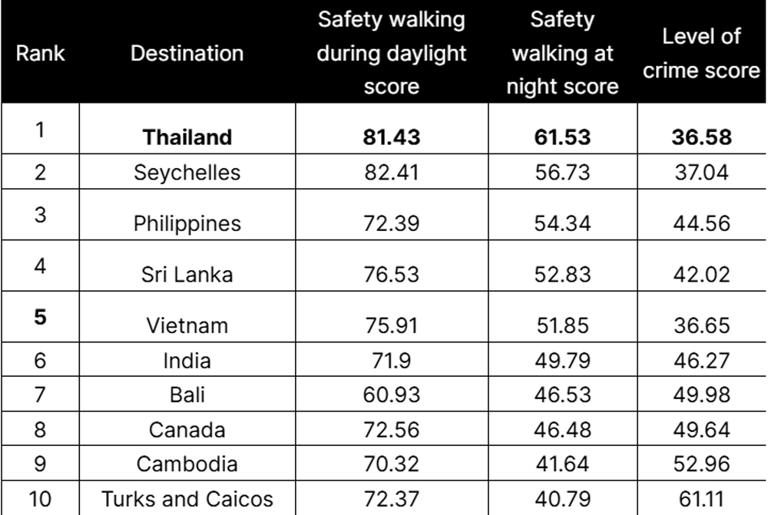
Research by travel booking platform Travelbag revealed that the world's safest destination for travelers in 2025 is Thailand, with the Philippines ranking third in the list.

Philippines Ranks Third Safest Destination for Travelers in 2025, According to Travelbag

For many travelers, feeling safe is just as important as the destination. Whether it's a quiet solo trip, a family adventure, or a romantic getaway, knowing that you won't be robbed at gunpoint anytime soon makes a big difference. The long-haul travel platform examined safety ratings, crime levels, and how safe people feel walking around both day and night based on data from Numbeo.

Travelbag

The Philippines, with its thousands of islands, rich culture, and famously friendly people, is increasingly viewed as a safe choice for tourists. The Travelbag report gives the Philippines solid scores: 72.39 for "Safety walking during daylight" and 54.34 for "Safety walking at night." Its "Level of crime" is noted at 44.56. These numbers suggest a country where you can enjoy adventure with growing peace of mind.

This positive ranking comes as the Philippines actively works to improve tourism and safety. The Department of Tourism (DOT) and local governments focus on traveler safety. For instance, cities like Dumaguete and Davao have been named among the safest in the country for 2025 by the World Travel Index. They scored well for day and night safety, low crime rates, and strong public trust in authorities. Dumaguete earned a Safety Index score of 81.36, making it the highest among Philippine cities and ranking 1097th globally. Davao City in Davao Del Sur, which used to be the first on the list, came in second with a Safety Index score of 80.73. Bulacan, Balanga (Bataan), Lucena (Quezon), Naga City (Camarines Sur), Baguio City, Puerto Princesa, Legazpi City, and Makati City round up the top 10 in the Philippines.

The DOT is also planning to establish Tourist First Aid Facilities in popular tourist destinations like La Union, Boracay Island, Siargao Island, Panglao Island, Palawan, and Puerto Galera. These locations will have medical staff ready to help.

Saturday, 5 July 2025

Makati bar earned its 10th awards in Asia's Best Bars 2025

Makati's The Curator included in Asia's Best Bars 2025 list

Camille Santiago
Philstar.com
05 July 2025

Makati's very own The Curator Coffee and Cocktails is once again making waves after securing a spot on Asia's Best Bars 2025 list.


For the tenth consecutive year, The Curator has earned its spot among Asia's elite bars, securing the 78th position on this year's prestigious list.

The Curator was hailed as a "stalwart" in Asia's 50 Best Bars rankings, particularly noted for its "specialty in all things caffeinated."

While its ranking fell from last year's 33rd spot, the third-wave coffee shop proudly remains the only Philippine bar featured on the extended 51-100 list.

The Curator, founded by David Ong and Bernice Tiu, is a cafe by day and a bar at night. Make your way to the back of the store and enter the hidden door that leads you into a cozy lounge.

Their unique menu is a storytelling experience in itself, with each notable story and name thoughtfully paired with a distinct cocktail and flavor profile, inviting patrons to explore.

The complete list has yet to be revealed.

According to its website, the Asia's 50 Best Bars list is compiled from the votes of its Academy, which comprises 265 "most knowledgeable and travelled members of the bar industry, drinks media, and mixology experts from across Asia."

Filipino American elected vice president of US Conference of Mayors

Filipino American elected vice president of US Conference of Mayors

Story by Nimfa U. Rueda 
Inquirer.net
05 July 2025

SAN DIEGO – San Diego Mayor Todd Gloria has been elected vice president of the United States Conference of Mayors, it was announced this week.


The USCM is the official, non-partisan organization of cities with populations of 30,000 or more. There are more than 1,400 cities in the country.

“I am honored by this opportunity to serve as vice president of the United States Conference of Mayors,” Gloria said. “This is an extremely challenging time for America’s cities, as we work through a deeply divided environment in Washington, D.C., to deliver more housing that working families can afford, lower the cost of living, and keep our communities safe.

Gloria will serve as vice president through June 2026 and “will help shape the conference’s advocacy agenda, guide the organization’s policy priorities, and serve as a leading voice for America’s cities on the national stage,” a statement from Gloria’s office read.

USCM held its annual meeting June 19-22. The organization elected Oklahoma City Mayor David Holt as president. During the conference, Gloria sponsored and helped pass six policy resolutions:

— opposing the renaming of Department of Defense assets honoring civil-rights leaders, such as the U.S.N.S. Harvey Milk;

— supporting federal investments in ocean pier infrastructure;

— supporting the classification of safe parking programs as interim shelters;

— supporting the extension of funding for the federal Emergency Housing Vouchers Program;

— supporting the passage of the Naomi Schwartz and Susan Rose Safe Parking Act; and

— supporting the passage of the Revitalizing Downtowns Act.

“This is about bringing San Diego’s experience and leadership to the national conversation and strengthening our alliances to ensure cities have a seat at the table,” Gloria said. “We’ve proven that when local governments are empowered and resourced, we can deliver real progress.

Gloria was elected to the USCM Advisory Board in 2021, and then as a trustee in 2022.

Since June 2024, he served as the second vice president of the organization. He serves on the conference’s Executive Committee, is the co- chair of its LGBTQ Alliance and serves on the Criminal and Social Justice Committee. (CNS)